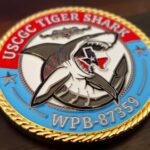
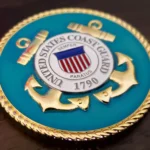
A Coast Guard challenge coin usually has to be two things at once: official enough to represent the service, and genuinely the crew’s. This one from USCGC Tiger Shark does it by splitting the faces. The front is a cartoon tiger shark with the map of Texas gripped in its teeth. The reverse is the Coast Guard emblem with embossed anchors. A gold rope runs around the edge of both.
Why Cartoon Mascots Work Better on Coins Than Realistic Art
A cartoon is the most coin-friendly illustration style there is, and it is worth understanding why, because people often assume a realistic rendering would be the more impressive choice.
Cartooning already does everything a coin needs. Heavy outlines, so every shape has a defined edge. Flat areas of color rather than gradients. Exaggerated features, so the character is recognizable from its silhouette alone. Deliberate omission of detail that does not contribute. Those are not stylistic quirks, they are the exact adaptations an image needs in order to survive being shrunk and struck in metal.
Realistic art relies on the opposite. Subtle shading, fine texture, accurate proportion and small details carrying the expression. Reduce it to coin size and the shading flattens, the texture turns to noise and the proportions that made it accurate stop reading at all.
So a cartoon mascot on a coin is not the casual option. It is the technically correct one, and it is why unit mascots across every service tend toward caricature.
A Visual Joke Needs No Caption
The Texas map in the shark’s teeth is a joke, and unit coins are one of the few semi-official objects where that is entirely normal. It is also usually the reason people keep them.
There is one rule, and it is absolute: the joke has to work without a caption. A coin has no room to explain itself, and the person receiving it is holding it for about four seconds before putting it in a pocket. If the gag needs a sentence, it needs a different medium.
What works is a single visual relationship the viewer can see in one look. One thing doing something to another thing. A mascot holding, eating, carrying or standing on something recognizable. What does not work is wordplay that needs reading, an in-joke that needs context, or a reference that needs a date.
The other reason this particular design works is the division of labor between the faces. With the humor on the front, the reverse can be entirely straight, which means the coin is never only a joke. Put a gag on both sides and the piece stops being able to represent the unit officially. Put it on one, and it does both jobs.
A Rope Edge Carries Meaning, Not Just Craft
The coin has a gold rope pattern running around its edge, and this is the part most people overlook when specifying a coin.
An edge treatment is usually chosen for texture and feel. A rope edge on a maritime coin is doing more than that, because rope is a maritime object. The edge is carrying content, not just craft, and it does it in the one part of the coin that costs nothing to use, because neither face loses any space to it.
That opens up a decision worth making deliberately rather than leaving to default. The edges in common use include:
- Rope, which reads as maritime and suits any sea service, port, marine unit or vessel.
- Reeded or milled, the fine vertical grooves found on currency, which reads as official and monetary.
- Diamond cut, which catches light and reads as modern and precise.
- Plain, which is correct when the faces are busy and anything else would be noise.
Pick the one that says something about the unit if there is one that does, and plain if there is not. Options vary by project and tooling, so ask when you request a quote. See also challenge coin plating options.
The Emblem on the Other Face
The reverse carries the Coast Guard emblem with the anchors embossed, and it is deliberately plain next to the front.
That restraint is the thing making the whole coin work. An official emblem does not need help, and adding color, texture or extra devices around it only dilutes it. Embossing the anchors and leaving the rest alone gives the face enough physical interest to not look empty while keeping it unmistakably formal.
Service emblems and seals are controlled by the service, so use the approved artwork and route approval through your command. We produce from the artwork a customer supplies and rely on the customer to hold the right to supply it.
Who Orders Coast Guard Coins
Coins come from every level of the service, and knowing which level you are is most of the design brief.
Cutters and patrol boats, which usually build the coin around the vessel, its name and its mascot. Stations and sectors, which build it around their area and their mission. Air stations, which build it around the airframe. Chief’s Messes, which order separately from the command and have their own traditions, covered on the Coast Guard cutter coin page. And the Coast Guard Auxiliary, whose flotillas order their own.
A cutter, for reference, is any commissioned Coast Guard vessel 65 feet or longer with a permanently assigned crew and accommodation aboard, carrying the prefix USCGC.
About the Coast Guard
The Coast Guard traces to 4 August 1790, when Congress authorized a fleet of cutters to enforce tariff law, creating the service known variously as the Revenue-Marine and the Revenue Cutter Service. In 1915 it merged with the United States Life-Saving Service to become the Coast Guard. It is one of the United States armed services and sits under the Department of Homeland Security.
See more Coast Guard challenge coins and a rescue swimmer coin.
Order a Coin for Your Unit
Send your unit’s emblem and your mascot artwork if you have it, and say which face each should take. If you want a particular edge, name it at the quote stage, because the edge is tooled rather than added afterwards.
Professional artwork is free with unlimited revisions, the minimum order is 50 coins, and nothing goes into production until you approve a digital proof. Standard production runs about 45 to 50 days after final artwork approval, rush production is available on many projects, and shipping within the continental United States is included. Embleholics is veteran-owned, SDVOSB and registered in SAM.gov.
Finished Coin (Front)
Finished Coin (Back)
Frequently Asked Questions
What is a Coast Guard challenge coin?
A Coast Guard challenge coin is a coin made for a Coast Guard unit, which may be a cutter or patrol boat, a station, a sector, an air station, a Chief’s Mess or an Auxiliary flotilla. Most carry the unit’s own mascot or identity on one face and the Coast Guard emblem on the other.
Do cartoon mascots work on challenge coins?
Yes, better than realistic artwork does. Cartooning uses heavy outlines, flat color and exaggerated features that make a character recognizable from its silhouette, which is exactly what survives being reduced and struck in metal. Realistic art depends on subtle shading, fine texture and accurate proportion, all of which break down at coin size.
Can a challenge coin carry a joke?
Yes, and unit coins are one of the few semi-official objects where humor is expected. The rule is that the joke must work without a caption, because a coin has no room to explain itself. A single visual relationship the viewer gets in one look works; wordplay, in-jokes needing context and references needing a date do not.
Should humor go on both sides of a coin?
No. Keep it to one face and leave the other straight, so the coin can represent the unit officially as well as personally. A coin with a gag on both sides can only ever be a joke.
What is a rope edge on a challenge coin?
A rope edge is a twisted cable pattern tooled around the coin’s rim. On a maritime coin it carries meaning as well as texture, since rope is a sea service object, and it costs nothing in design space because neither face gives anything up to it.
Which edge treatment should I choose for a coin?
Pick one that says something about the unit if there is one. A rope edge reads maritime, a reeded or milled edge reads official and monetary because it is the edge used on currency, and a diamond cut edge reads modern and precise. A plain edge is the right answer when the faces are busy. Options vary by project and tooling, so ask when you request a quote.
What is a Coast Guard cutter?
A cutter is any commissioned Coast Guard vessel 65 feet or longer with a permanently assigned crew and accommodation aboard. Cutters carry the prefix USCGC, and the term comes from the Revenue-Marine and Revenue Cutter Service, which used it for their vessels in the late eighteenth and nineteenth centuries.
When was the Coast Guard founded?
The service traces to 4 August 1790, when Congress authorized a fleet of cutters to enforce tariff law, creating what became the Revenue Cutter Service. It merged with the United States Life-Saving Service in 1915 to form the Coast Guard, which today sits under the Department of Homeland Security.
More Coast Guard Projects