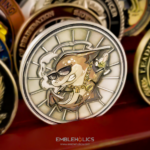
The team asked for a simple coin in a conventional circle, and then put a cartoon mascot on it. Those two instructions are not in conflict, and the combination is the most interesting thing about this piece.
Humor on a Serious Coin
Rescue swimmers do one of the more dangerous jobs in the fire service. The coin has a mascot in sunglasses holding a cocktail on it. That is not a mismatch, it is how these teams actually talk about themselves.
Specialist teams tend toward dark or dry humor, and their coins reflect it. Units that do difficult work rarely want a solemn coin. A solemn coin is what an outside organization makes about them; a wry one is what they make about themselves. If your team’s group chat has a running joke, that joke belongs on the coin more than a motto does.
It also makes the coin specific. Every water rescue team in the country could use a wave and a life ring. Only one has this particular mascot doing this particular thing, which means the coin cannot be mistaken for any other team’s.
And it survives reduction well. A cartoon is already a simplification, with bold shapes and clear outlines, which is exactly what reproduces cleanly at coin size. A realistic illustration of the same subject would lose its detail.
The one caution is audience. A coin that will be handed to officials, civilians or families is a different object from one that circulates inside the team. Plenty of units order both, a straight version for formal presentation and an internal one, from the same artwork session.
A Brushed Surface With Etched Lines
The coin is built on a brushed metal surface with etched line work, and only the mascot and the waves carry paint.
A brushed finish is a directional texture applied instead of a mirror polish. It catches light softly rather than reflecting it, which does two useful things on a coin like this. It stops the bare metal looking like an area where the color was left off, and it keeps glare off the surface so the etched lines stay readable at any angle.
Restricting the paint to a few elements is what gives them impact. On a coin where most of the surface is brushed metal, the painted mascot is the only color on that face, so the eye goes straight to it. Painting the whole face and hoping the mascot stands out would produce a weaker result.
The reverse uses bold red and blue waves framing the emblem, which is the right treatment for a device that needs a setting. A frame of movement around a static emblem gives the face energy without adding anything that competes for attention.
Designing a Water Themed Coin
Water is a common subject on first responder and naval coins and one of the harder ones to execute, so a few points are worth setting out.
Waves work as shapes, not as texture. A stylized wave with a clear outline reads at coin size. An attempt at realistic water becomes a gray mottle, because the detail that makes water look like water is exactly the detail that disappears when reduced.
Bold color beats accurate color. Water is not actually blue, but a strong blue reads as water instantly where a realistic gray green reads as nothing. This is one place where the obvious choice is the correct one.
Waves are good at framing. Because a wave is a curved form, it follows the rim of a round coin naturally and makes a ring around a central device. That is a more useful role for water than trying to depict a whole seascape.
And motion needs contrast. A wave only reads as moving if there is something still next to it. The emblem at the center is what makes the waves look like waves.
About the Program
The Seattle Fire Department’s rescue swimmer program provides water rescue around the clock. Training is demanding and includes cold water work, breath-hold diving and entanglement escape, and the department’s foundation has donated equipment to expand the water response capability, including rescue watercraft.
A small, highly trained team inside a large department is the classic coin buyer: specific enough that a coin means something, and distinct enough that the department’s general coin does not cover it. See more firefighter challenge coins and a fire district challenge coin.
Order a Coin for Your Team
Professional artwork is free with unlimited revisions, and nothing goes into production until you approve a digital proof. The challenge coin minimum is 50 pieces, standard production runs about 45 to 50 days after final artwork approval, rush production is available on many projects, and shipping within the continental United States is included. Embleholics is veteran-owned, SDVOSB and registered in SAM.gov.
Two suggestions. If your team has a mascot, a nickname or a running joke, send it along with the official logo; the unofficial material is usually what makes a coin worth keeping. And if you want both a formal version and an internal one, say so at the start, because two designs worked up in the same artwork session cost far less than two separate projects. Request a free quote to begin.
Frequently Asked Questions
What is a water rescue challenge coin?
It is a coin made for a team that performs water rescue, such as a fire department’s rescue swimmers or a dive team. The designs usually combine the team’s official emblem with water imagery, and often a mascot the team has adopted for itself.
Can a serious unit have a humorous coin?
Yes, and specialist teams often prefer it. A solemn coin is what an outside organization makes about a unit; a wry one is what the unit makes about itself. A running joke makes the coin specific in a way a generic motto cannot.
Should we make a formal and an informal version?
If the coin will be handed to officials, civilians and families as well as circulating inside the team, two versions is a reasonable answer. Working both up in the same artwork session costs far less than commissioning two separate projects.
Does a cartoon reproduce well on a coin?
Yes, better than realism. A cartoon is already built from bold shapes and clear outlines, which is exactly what survives reduction to coin size. A realistic illustration of the same subject loses the detail that made it realistic.
What is a brushed finish and why use it?
It is a directional texture applied to bare metal instead of a mirror polish. It catches light softly rather than reflecting it, which keeps glare off etched line work and stops the unpainted areas looking like places where the color was left off.
Why paint only part of a coin?
Because the painted areas then have the whole face to themselves. On a coin that is mostly brushed metal, the eye goes straight to the few colored elements. Painting everything and hoping the important part stands out gives a weaker result.
How do you draw water on a challenge coin?
As stylized shapes with clear outlines, not as texture. Realistic water becomes a gray mottle at coin size, because the fine detail that makes it look like water is the first thing to disappear. Bold blue reads as water instantly.
Where should waves go in a coin design?
Around the edge, framing a central device. A wave is a curved form, so it follows a round rim naturally, and a ring of movement around a still emblem is what makes both elements work. Depicting a whole seascape rarely succeeds at this size.
More Firefighters Projects