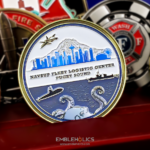
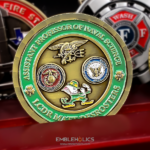
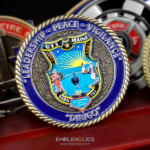
USS Louisiana is the fourth United States Navy ship to carry that name, and its crest draws on both the state’s traditions and the three earlier ships. That lineage is what this coin is actually about. The front carries the submarine sculpted in relief with a shadow effect adding depth to the main color, on a brass colored base, with Navy blue and the trident carried through.
A Name With a Lineage
Most ship coins represent one vessel. A coin for a ship whose name has been used before can represent a line, and that is a richer subject.
The crest is where the lineage lives. A ship’s crest is designed to reference the namesake and, often, the ships that held the name previously. That makes it the single most information-dense element available, which is why a ship coin usually works better built around the crest than around the hull.
But a crest is dense heraldry. Which means it needs its own face. Crowded alongside a sculpted vessel and an inscription, a crest becomes an illegible disc. Given a face to itself, every element in it reads.
The state connection is worth using. A ship named for a state can draw on that state’s symbols, colors and traditions, which gives the design something no other ship has. It also makes the coin meaningful to people from that state as well as to the crew.
And earlier ships can appear explicitly. Hull numbers, silhouettes of previous classes, or commissioning dates listed in a ring are all ways of putting the line on the coin. It is a good use of a rim, and it says something an inscription cannot. For an Ohio-class boat with an unusual naming history, see our USS Henry M. Jackson Challenge Coin.
See also a USS Maine challenge coin and a ballistic missile submarine coin.
A Submarine Sculpted in Relief
A submarine is one of the easier naval subjects to sculpt and one of the harder ones to make interesting, for the same reason: it is a smooth tube.
The silhouette is the identification. Hull proportion, the position and shape of the sail, the rudder and stern planes. There is almost no surface detail to lose, so a submarine reproduces cleanly at coin size where a surface ship’s superstructure would soften.
But smooth forms need help to read. A featureless hull sculpted in relief catches light evenly across its length, so it can look like a bar rather than a vessel. That is exactly what the shadow effect on this coin addresses: deepening the tone along one side of the hull creates the impression of a curved surface turning away from the light.
Which is a painting technique, not a sculpting one. Worth knowing as an option. Shading within a single color area, rather than using separate flat colors, gives a sculpted element depth beyond what the relief alone provides. It costs more attention at the artwork stage and it is the difference between a submarine that looks round and one that looks flat.
And a three quarter view beats a profile. A bow-quarter angle shows the hull receding and gives the sail some foreshortening, which suits relief. A pure side view is the flattest possible presentation of the flattest possible subject.
Brass With Navy Blue
A brass colored base with Navy blue carried through is about as traditional as a naval coin palette gets, and it works for a specific reason.
Brass is a warm metal, blue is a cool color, and the two sit at opposite ends of the temperature range. That contrast is stronger than any two colors of the same temperature could manage, which means the blue elements read clearly against the metal without needing a dark outline to separate them.
The trident carried into the design is the other piece of continuity. A device that appears on the ship’s crest, on the missile system and on the dolphins its crew wears is doing work across the whole coin rather than sitting as one element among many.
About the Boat
USS Louisiana (SSBN 743) is the eighteenth and last Ohio-class ballistic missile submarine, and the fourth Navy ship to bear the name. Her keel was laid on 23 October 1992 and she has been in commission since 1997, carrying Trident ballistic missiles.
Being the last of a class is itself a reason for a coin. It fixes the boat’s place in a line that is now closed, which is the kind of thing a crew wants recorded in something they can hold.
See more naval submarine force coins and Navy challenge coins.
Order a Coin for Your Ship
Professional artwork is free with unlimited revisions, and nothing goes into production until you approve a digital proof. The challenge coin minimum is 50 pieces, standard production runs about 45 to 50 days after final artwork approval, rush production is available on many projects, and shipping within the continental United States is included. Embleholics is veteran-owned, SDVOSB and registered in SAM.gov.
Two suggestions. Send the ship’s crest artwork and give it its own face, because a crest is dense heraldry that fails when crowded and works when given room. And if the design includes a sculpted hull, ask about shading within the color rather than flat fills, since a smooth form needs tonal help to read as curved rather than flat. Request a free quote to begin.
Frequently Asked Questions
What is a ship namesake challenge coin?
It is a coin built around a ship’s name and the line of vessels that carried it, rather than around one hull. Many Navy ships are the third or fourth to bear their name, and the crest usually references both the namesake and the earlier ships.
Should a ship’s crest go on its own face?
Yes. A crest is dense heraldry with multiple devices packed into a small area. Crowded alongside a sculpted vessel and an inscription it becomes an illegible disc, but given a whole face every element in it reads.
How do you show a ship’s lineage on a coin?
Hull numbers, silhouettes of the earlier classes, or commissioning dates listed in a ring around the rim. That is a good use of rim space and it conveys the line more directly than an inscription would.
Does a submarine reproduce well on a coin?
Yes, better than a surface ship. A submarine has almost no surface detail to lose, so the silhouette carries the identification, where a surface ship’s superstructure softens into texture at coin size.
Why does a sculpted submarine look flat?
Because a smooth hull catches light evenly along its length, so the relief alone does not read as curved. Deepening the tone along one side creates the impression of a surface turning away from the light.
Can a single color be shaded on a coin?
Yes, and it is worth asking for on smooth sculpted forms. Shading within one color area, rather than using separate flat fills, gives depth beyond what the relief provides. It takes more attention at the artwork stage.
What angle suits a ship on a coin?
A three quarter or bow-quarter view. It shows the hull receding and gives the sail or superstructure some foreshortening, which suits sculpted relief. A pure profile is the flattest possible presentation.
Why do brass and Navy blue work together?
Because brass is a warm metal and blue is a cool color, so they sit at opposite ends of the temperature range. That contrast is stronger than two colors of similar temperature, which means the blue reads clearly against the metal without needing a dark outline.
More Navy Projects