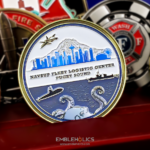
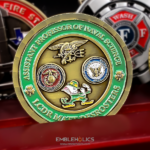
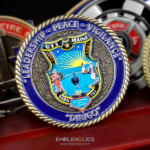
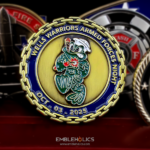
The front is built around the original insignia of the Navy’s Submarine Service: a submarine flanked by two stylized dolphins, named Castor and Pollux. The reverse carries every one of the Submarine Force’s insignias and emblems, each engraved. The brief was a coin representing the whole force rather than any one command within it.
The Dolphins as a Central Device
The submarine insignia is one of the better devices in the Navy for reproduction in metal, and the reasons are worth knowing if you are building a coin around it.
The composition is already symmetrical. A central submarine with a dolphin on each side is balanced on the vertical axis, which means it sits on a round face without any adjustment. Most insignia have to be fitted; this one arrives fitted.
It is horizontal, which suits a disc. The device is wider than it is tall, so it fills the broadest part of a circular face and leaves the space above and below for lettering. A tall device would waste that.
The dolphins are curved forms with clean outlines. No fine internal detail, no thin projections, nothing that softens when reduced. They read at any size, which is exactly what a struck device needs.
And the earned meaning does the rest. Dolphins are a qualification badge. Everyone receiving this coin wore them, which means the device carries weight no designed emblem could, and it needs no explanation on the coin itself. When to use the device on a coin is covered on our USS Henry M. Jackson Challenge Coin page.
One note on sculpting. The dolphins work best with the relief hierarchy running outward: the submarine hull as the base plane, the dolphins raised above it, their heads and tails highest. Flattening them to a single depth loses the overlapping that makes the device read as three elements rather than one shape.
Every Insignia on One Face
The reverse carries all of the Submarine Force’s insignias and emblems, which is the ambitious half of this coin and the part worth planning carefully if you want the same.
Count them before you design. This is the step people skip. Each emblem is a complete design drawn to stand alone, and the face has a fixed area. Six fit comfortably, ten are tight, and beyond that something has to give. Knowing the number first determines whether the idea is possible at all.
Arrange them in a ring, not a grid. A circle has no top and no first position, so a ring gives every command equal prominence and removes the question of order. A grid immediately implies a hierarchy, and in a force made up of commands that compare themselves to each other, that is a conversation to avoid.
Scale to equal visual weight. Emblems are not naturally the same proportions. Some are tall, some wide, some dense. Scaling them so each occupies equal visual weight rather than an equal bounding box is a deliberate adjustment, and skipping it is what makes most multi-emblem coins look lopsided.
Simplify inside each one. At this size the internal detail of any emblem will not survive. What has to survive is the silhouette, because that is what people recognize. A reduced emblem that keeps its outline reads correctly; a faithful one that turns to mush does not.
And engrave rather than sculpt. A dozen sculpted emblems produce a dozen competing high points with nothing to separate them. Recessed line work holds them all at one depth, which keeps the face organized.
See also a cartoon challenge coin, a DEVRON 5 coin and a ship namesake challenge coin.
A Coin for a Whole Force
Most coins in this gallery represent a boat, a squadron or a command. This one represents the entire Submarine Force, and that is a different brief.
It has to work for everyone in it. Which rules out anything specific to one command, one platform or one homeport. The qualification badge and the full set of emblems are both answers to that, approached from opposite directions: one thing everybody shares, or everything everybody belongs to.
It is not tied to a date or a deployment. A force-level coin should still be correct in five years, so no years, no hull numbers, nothing that ages.
And the quantity is different. A force-level coin has a much larger potential audience than a unit coin, which usually means it is ordered at a higher level and distributed downward, or reordered repeatedly from the same die. Either way, a design with nothing time-specific on it is what makes that possible.
About the Submarine Force
The Submarine Force operates in the undersea environment, and its roots go back to the founding of the country. The Turtle is cited as the first submersible with a documented record of combat use.
United States Navy submarines are crewed entirely by volunteers, selected through rigorous testing and observation.
See more Navy challenge coins.
Order a Force or Command Level Coin
Professional artwork is free with unlimited revisions, and nothing goes into production until you approve a digital proof. The challenge coin minimum is 50 pieces, standard production runs about 45 to 50 days after final artwork approval, rush production is available on many projects, and shipping within the continental United States is included. Embleholics is veteran-owned, SDVOSB and registered in SAM.gov.
Two things to settle before artwork. Count the emblems you want on the coin and send them all at the start, because the number determines whether a ring arrangement is possible and adding one later means reworking the whole face rather than slotting it in. And leave dates and hull numbers off a force-level design, so one die serves for years and can be reordered without a new artwork cycle. Request a free quote to begin.
Finished Coin (Front)

Finished Coin (Back)

Frequently Asked Questions
What is a Naval Submarine Force coin?
It is a coin representing the whole submarine force rather than one boat or command. Designs usually center on either the qualification badge everyone shares or the full set of subordinate command emblems.
Why does the submarine insignia work well on a coin?
Because it is already symmetrical and horizontal, so it fits a round face without adjustment and leaves room above and below for lettering. The dolphins are curved forms with clean outlines and no fine detail to lose.
How should the dolphins be sculpted?
With the relief running outward: the hull as the base plane, the dolphins raised above it, their heads and tails highest. Flattening them to one depth loses the overlapping that makes the device read as three elements.
How many emblems fit on one coin face?
Six fit comfortably and ten are tight. Beyond that something has to give, so count them before designing rather than after. Each emblem is a complete design drawn to stand alone, and the face has a fixed area.
Should multiple emblems be in a ring or a grid?
A ring. A circle has no top and no first position, so every command gets equal prominence and the question of order never arises. A grid immediately implies a hierarchy.
Why scale emblems to equal visual weight?
Because they are not naturally the same proportions, so matching their bounding boxes leaves some looking larger than others. Scaling to equal visual weight is a deliberate adjustment and skipping it is what makes multi-emblem coins look lopsided.
Should multiple emblems be engraved or sculpted?
Engraved. A dozen sculpted emblems produce a dozen competing high points with nothing separating them, where recessed line work holds them all at one depth and keeps the face organized.
Should a force level coin carry a date?
No. A coin representing a whole force should still be correct in five years and should be reorderable from the same die, so years, hull numbers and anything else that ages are best left off.
More Navy Projects