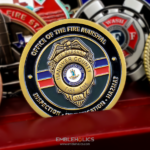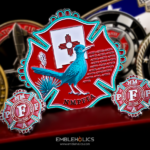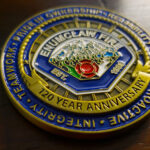
An anniversary coin is the one case where dating the die is the whole point. This one was made for the Enumclaw Fire Department in King County, Washington, to mark its 120th anniversary, and the brief was classic but colorful: the department’s emblems on both faces, heavily detailed engraving, and color used properly rather than sparingly. A department reaching 120 years has earned a piece that looks like it took some effort.
An anniversary coin is deliberately finite
Everywhere else on this site we advise keeping dates off the die so a coin can be reordered. An anniversary coin is the exception, and it should be. The year is the reason the coin exists. A 120th anniversary coin without the number is just a department coin, and nobody will remember what it was for in ten years.
That changes how you order it.
- Order the whole run at once. There is no sensible reorder, so the quantity you choose is the quantity that will ever exist. Count current personnel, retirees, the auxiliary and commissioners, families, and the mutual aid departments you will want to give one to, then add a margin. Running short on a milestone coin cannot be fixed.
- Decide early whether it is for the department or for the community. Some departments produce a milestone coin for members only; others sell or give them at an open house or parade, which is a much larger number and a different price point.
- Keep a reserve. Departments that mark an anniversary almost always wish they had held back a box for the next twenty years of retirements and presentations.
If you want both a milestone piece and a standing coin, that is two designs. The anniversary coin carries the year and is struck once. The department’s standing coin carries no date and is reordered forever. Running them together costs two dies but solves two different problems properly.
Where the year goes
Giving the anniversary number real prominence is the point, and it is usually underdone. A date set small in a rim reads as a footnote. For a milestone coin the number should be a primary element, either as the figure itself or as a span of years, and it should be large enough to read without looking for it.
Two framings, and they say different things. A span, such as the founding year and the current year, emphasises continuity and shows how long the department has been running. A single number, such as 120, emphasises the achievement. Departments with a long history usually prefer the span; departments marking a round number often prefer the figure.
Watch the founding date. Fire departments are frequently older than their official incorporation, having begun as a volunteer bucket brigade or a hose company before being formally established, and there is often more than one defensible founding year. Settle which one the department is counting from before it is struck into metal, because somebody will have an opinion afterwards.
Most calls are not fires
This is worth saying on a fire department coin page because it affects what belongs on the coin. Enumclaw’s department covers a service area of around 56 square miles and some 22,500 residents, and in 2022 it answered 2,829 calls, of which 78 percent were emergency medical. That ratio is not unusual. Most modern fire departments are majority-EMS organizations that also fight fire.
A coin showing only fire imagery represents less than a quarter of what the department actually does. Departments vary in whether they mind, and plenty are happy with the traditional imagery because the identity is a fire service identity. But it is worth asking the question before the design is fixed, particularly if the coin is going to the whole department including the medics.
The easy fix is one element. A star of life alongside the traditional fire imagery, or EMS worked into the reverse, acknowledges the majority of the workload without changing the coin’s character.
Colorful and detailed, done properly
A heavily detailed engraved field with full color is at the expensive end, and for a once-only milestone piece that is usually the right call. The reasoning is the opposite of a standing coin: there is no reorder to amortise against, and the coin is meant to be the keepsake version, so the money should go into the piece rather than into holding unit cost down.
Where to spend it. Engraved patterning across the field costs once in the die and makes the whole coin feel worked rather than stamped. Color is charged per coin per area, so it still pays to consolidate: a few strong, well-placed colors read better than a dozen small ones and cost materially less across a run.
Ordering a milestone coin
Tell us the anniversary, the founding year you are counting from, and who is getting one. That last answer usually moves the quantity by a factor of five, because a members-only coin and a community coin are different orders. Bring the department’s emblems and any historical imagery you want considered. You can see more firefighter challenge coins we have produced, including the Chicago Fire Department coin and the Clarence Fire Company coin, or send your details through the free quote form.
Frequently Asked Questions
Should an anniversary coin have the year on it?
Yes. This is the one case where dating the die is correct, because the year is the reason the coin exists. A milestone coin without the number is just a department coin and nobody will recall what it marked. It does mean the coin cannot be reordered, which is why the run should be sized generously and ordered all at once.
How many anniversary coins should we order?
More than you think, because there is no second run. Count current personnel, retirees, the auxiliary, commissioners, families and the mutual aid departments you will want to present one to, then add a margin and hold a reserve box back. Departments that mark a milestone almost always wish they had kept some for the following years of retirements and presentations.
Should we put a span of years or a single number?
A span, such as the founding year and the current year, emphasises continuity and shows the length of service. A single figure emphasises the achievement itself. Departments with long histories tend to prefer the span and those marking a round number tend to prefer the figure. Either way, make it a primary element rather than small text in the rim.
What if our founding date is disputed?
Settle it before striking, because it cannot be changed afterwards. Many fire departments predate their formal incorporation, having started as a volunteer bucket brigade or hose company, so there is frequently more than one defensible year. Agree internally which date the department counts from rather than discovering the disagreement once the coins arrive.
Should a fire department coin include EMS imagery?
It is worth considering. Most modern fire departments answer far more medical calls than fires, often around three quarters of their total volume, so a coin carrying only fire imagery represents a minority of the actual work. Adding one element, such as a star of life alongside the traditional imagery, acknowledges that without changing the coin’s character.
Should a milestone coin be more elaborate than a standard one?
Usually yes. A standing coin is reordered repeatedly, so holding the unit cost down matters. A milestone coin is struck once and kept, so the money is better spent on the piece. Engraved patterning across the field is particularly good value here, because it costs once in the die and makes the whole coin feel worked rather than stamped.
Can we have both an anniversary coin and a regular department coin?
Yes, and it is the cleanest solution if you want both. The anniversary coin carries the year and is produced once; the standing coin carries no date and can be reordered indefinitely for new members and presentations. It means two dies, but each one does its job properly instead of compromising between them.
More Firefighters Projects