A volunteer fire company challenge coin is funded by the company itself, usually through fundraising rather than a municipal budget, and it almost always carries the company’s history. The history is the thing the members share, which is why it does the work a modern logo cannot.
How Volunteer Fire Companies Order Coins
Most firefighters in the United States are volunteers, and volunteer companies buy differently from career departments in four ways that matter.
The money is their own. A city fire department has a budget line. A volunteer company has fundraising: the chicken barbecue, the boot drive, the hall rental, the annual appeal. A coin order competes with turnout gear and apparatus maintenance for the same pot, which makes the decision a real one rather than a formality.
The person ordering is a volunteer. Usually someone on the fundraising committee or a line officer, doing this around a full-time job, often for the first time. Clear answers matter more than a range of options.
The coin is frequently sold, not given. Volunteer companies sell coins at open houses, parades, banquets and community events, both to raise money and because people in the community actually want one. That changes the quantity calculation, because the coin is stock rather than an allocation.
They are old, and they know it. A volunteer company often predates the town’s police department, and sometimes the town’s incorporation. That history is not a footnote to these organizations. It is the main thing, and it is almost always what they want on the coin.
The occasions are company anniversaries and centenaries, new station and hall openings, apparatus deliveries, member service milestones, memorials, and fundraising for specific equipment.
For career and union work, see our pages on IAFF local and industrial brigade coins and firehouse and company coins.
Using a Company’s Own History as the Design
Here is the approach that suits these organizations better than anything else, and nothing on the site has covered it.
Put the company’s own past on the coin, rendered as it actually looked.
Historic apparatus. The first engine. The hand-drawn wagon. The 1940s pumper that sat in the bay for thirty years. Almost every old company has one piece of apparatus that everybody knows about, and it is usually in a photograph on the wall of the hall.
The original station. Companies that have moved feel strongly about the building they started in.
The founding year, given real prominence. Not tucked into the border in six-point type. On a company that has been running since 1916, the year is a headline, not a footnote.
Period lettering and finishes that match the era rather than the present day.
Why it works. A volunteer company coin is handed to people who have given it fifteen or thirty years, and sold to a community whose families have been in the company across generations. A current logo tells you what the organization is. The 1916 wagon tells you what it has been, and what those people are part of. The second one is what the coin is for.
The practical part: you will be working from an old photograph. That is normal and it is usually the only reference that exists. What helps is a photograph where the subject is reasonably sharp and seen from a useful angle, ideally close to a side profile, because that is the view that reads on a coin. Send the best original you have rather than a phone photograph of a framed print behind glass, and if the only image is poor, send it anyway and we will tell you what can be done with it. Historic subjects are often redrawn rather than traced, so the reference needs to be good enough to draw from rather than good enough to print.
Two Metal Tones Instead of Paint
The front of this coin carries no paint at all. The wagon is rendered in copper against a gunmetal-colored field, and the entire image is made from the difference between two metal tones.
That suits a historic subject in a way enamel does not. Colored enamel sits on top of the metal as a separate material, and it reads as modern because it is the technique modern coins use. Two metal tones read as older, partly because the color is coming from the metal itself rather than from something applied to it, and partly because copper against dark metal is what period objects actually look like.
It also gives the subject the right weight. An 1916 hand-drawn wagon picked out in bright red enamel would look like a toy. The same wagon in copper looks like an artifact.
The finish range that makes this possible is covered on our page about plating and finish options.
What Goes on a Fire Company Coin?
The Maltese cross, the oldest and most recognized symbol in the fire service, and the default frame for most fire coins.
The company name and number, which for volunteer companies is often accompanied by the district or township.
Founding and anniversary dates, usually both when the coin marks a milestone.
Apparatus, historic or current.
The station or hall.
A motto, and the colors the company already uses on its apparatus and patches, which are usually well established and should be matched rather than reinvented.
Memorial elements appear on many fire coins, for members lost in the line of duty and for those who served long careers. Those are handled with the same restraint as any memorial design, covered on our page about memorial and remembrance coins.
About This Clarence Fire Company Coin
Clarence Fire Company was founded in 1916 and is a volunteer fire company serving Clarence, New York.
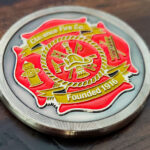
The front of the coin carries the company’s original hand-drawn chemical fire-fighting wagon, sculpted and engraved in copper against a gunmetal-colored field, with no paint anywhere on that face. The edge is thickened and carries a simple line pattern. The reverse carries the company logo, etched and painted in its own colors.
The two faces take completely opposite approaches, and that is the best decision on this coin. The front is the past: no color, two metal tones, a subject from 1916 rendered in a way that looks like 1916. The reverse is the present: the current logo, in the colors the company uses today, painted.
Most coins choose one treatment and apply it to both sides. This one uses the split to say something. Turn it over and you move a century. For a company whose whole identity rests on how long it has been doing this, that is a more articulate design than any amount of decoration would have been.
The thickened edge with its line pattern is a small choice that supports the same idea, since a heavier rim reads as older and more substantial than a thin modern one. Rim treatments are covered on our page about rim and edge designs.
Can We Use Our Company’s Emblem on a Coin?
Most companies can, since the emblem usually belongs to the company itself, but the authorization still has to come from the organization rather than from us. Company emblems, department patches, municipal seals and district devices are controlled by the bodies that own them, and a volunteer company operating under a township or fire district may need that body’s approval as well as its own.
The practical version is straightforward. Clear the artwork through your company’s officers before you order, and send us artwork your organization is authorized to supply. We produce from what the customer provides and we do not grant permission on anyone’s behalf.
Design a Coin for Your Fire Company
The minimum order is 50 coins, which is worth knowing up front when a company is fundraising for its own. Companies that plan to sell coins at events usually order well above it, because the cost per coin falls and stock moves faster than expected at an open house or a parade.
Professional artwork is free with unlimited revisions, and nothing goes into production until you approve a digital proof. You do not need artwork to start. A photograph of the patch, a scan of an old picture of the apparatus, or a description is enough. Standard production runs about 45 to 50 days after final artwork approval, rush production is available on many projects, and shipping within the continental United States is included. Embleholics is veteran-owned, SDVOSB and registered in SAM.gov. See more custom firefighter challenge coins or request a free quote.
Frequently Asked Questions
What is a volunteer fire company challenge coin?
A volunteer fire company challenge coin is a custom coin made for a volunteer fire organization, funded by the company itself rather than by a municipal budget. These coins usually carry the company’s history, founding year and apparatus, and are often sold at community events as well as given to members.
Can a volunteer company sell coins to raise funds?
Yes, and many do. Coins sell well at open houses, parades, banquets and community events, and for a self-funded company the coin is both an identity item and a fundraiser. Companies planning to sell usually order above the minimum, since the cost per coin falls with quantity.
Can an old photograph be used as the basis for a coin design?
Yes, and for historic subjects it is usually the only reference available. A reasonably sharp image from a useful angle, close to a side profile, works best. Send the best original you have rather than a phone photograph of a framed print, and we will advise if the image is too poor to draw from.
Can historic apparatus be reproduced on a coin?
Yes. Historic engines, hand-drawn wagons and early pumpers are among the strongest subjects for a volunteer company coin, because they are specific to that company and instantly recognizable to its members. The apparatus is normally redrawn from a photograph rather than traced.
Can a coin use two metal colors instead of paint?
Yes. Two metal tones, such as copper against a darker gunmetal field, can carry an entire image with no enamel at all. This suits historic subjects particularly well, because the color comes from the metal itself rather than sitting on top of it, which reads as period rather than modern.
What goes on a fire company coin?
Fire company coins usually carry the Maltese cross, the company name and number, founding and anniversary dates, apparatus either historic or current, the station, and the colors the company already uses. Memorial elements are common and are handled with restraint.
Can we use our company’s emblem on a coin?
Company emblems are usually the company’s own, but authorization still comes from the organization rather than from a manufacturer, and a company operating under a township or fire district may need that body’s approval too. Clear it through your officers and supply artwork the company is authorized to provide.
What is the minimum order for fire company coins?
The minimum order for custom challenge coins is 50 coins. For a volunteer company that typically covers the active membership with some left over, and companies intending to sell coins at events generally order well above it because the cost per coin drops with quantity.
More Firefighters Projects