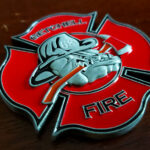
The front of this coin is a bulldog in a firefighter helmet with a hatchet in its teeth, sculpted in relief on a Maltese Cross in black and red. It was made for Getchell Fire in Snohomish, Washington.
Why the Bulldog Works So Well in Metal
The bulldog is one of the most used animals in unit and department insignia, and unlike some popular choices it genuinely earns its place on a coin.
The head is almost all silhouette. A heavy jaw, a flat muzzle, wide-set jowls and small ears. Those are large shapes, and large shapes are what survive being reduced to coin size. Compare an eagle, whose feather detail is the first thing to go, or a horse, which is recognized mostly by proportion rather than outline.
It has depth built in. A bulldog’s face is a set of folds and planes at different heights, which gives a sculptor a natural relief hierarchy: brow forward, muzzle back, jowls hanging. An animal with a smooth head has to have its depth invented.
And the expression carries. The breed reads as stubborn and immovable at any size, which is the whole reason organizations pick it. You do not need to see the eyes to get the message.
Adding a prop makes it specific. A bare bulldog belongs to anybody; a bulldog in a firefighter helmet biting a hatchet belongs to a fire department. The prop is what turns a generic mascot into this department’s mascot, and it costs nothing in legibility because a helmet and a hatchet are both strong shapes in their own right.
Sculpting an Animal in Relief
This mascot is sculpted rather than drawn flat, which is the right call for an animal head and worth understanding before you ask for one.
A flat animal reads as a logo; a sculpted one reads as a creature. Relief catches light across the brow and casts shadow under the jaw, and that shading is what makes a face look like a face rather than a shape.
The depth hierarchy is the whole job. A coin has a limited range of relief available, so the sculptor is deciding what projects furthest and what sits back. On a dog’s head that usually means the muzzle and brow forward, the ears and the back of the skull receding. Get the order wrong and the result looks swollen rather than carved.
Eyes need recessing, not detailing. The instinct is to add detail to the eyes. At coin size the better approach is a deep recess that fills with shadow, because a dark socket reads as an eye where a carefully modeled eyeball reads as a bump.
And a prop in the mouth needs clearance. A hatchet held in the teeth has to be distinctly separated from the jaw, or the two merge into one mass. A small gap of background between the object and the face is what keeps them readable as two things.
See 2D vs 3D challenge coins for the difference between flat and sculpted work.
The Maltese Cross as the Outline
The coin is cut to a Maltese Cross, which is the fire service’s own symbol and the most natural custom shape in the sector.
The cross is a firefighter’s badge of honor, signifying that he works in courage, a ladder rung away from death. Using it as the outline rather than as a device printed on a round coin means the piece is identified before any detail is read.
It also suits a sculpted mascot particularly well, because the cross has a broad central area where a head sits comfortably with the arms framing it. A star would have eaten most of that space in points.
Two production points on any eight-pointed outline. The tips bend, so slightly rounded points are both traditional and practical. And the concave notches where the arms meet concentrate stress during the strike, so they are usually softened very slightly in the artwork. See custom shaped challenge coins.
Black and Red on a Fire Coin
Two colors, and they are doing specific jobs.
Black is the most forgiving fill on a coin, so it absorbs small variations that would show against a pale background, and it gives the sculpted areas somewhere dark to cast shadow into. Red then has the face to itself as the only bright element, which is why a two color coin can look stronger than a six color one.
It is also the right register. Fire service colors are not a styling choice, they are what people expect, and a department coin that used an invented palette would look like it came from outside the service.
About the Department
Snohomish was founded in 1859 as Cadyville, named for the pioneer settler E. F. Cady, and renamed Snohomish in 1871. By July 1888 the city had a water line system and was seriously considering an organized fire company, and in August that year an official volunteer department was organized with a hose cart and 1,000 feet of hose, paid for by citizen donations.
Today new firefighter hires in Snohomish County complete a 14 week Snohomish County Fire Training Academy, training to South County Fire standards. See our Training Academy Challenge Coin, made for that academy’s Recruit Class 20-1.
See more firefighter challenge coins, a fire district challenge coin and a volunteer firefighter coin.
Order a Coin With Your Mascot
Professional artwork is free with unlimited revisions, and nothing goes into production until you approve a digital proof. The challenge coin minimum is 50 pieces, standard production runs about 45 to 50 days after final artwork approval, rush production is available on many projects, and shipping within the continental United States is included. Embleholics is veteran-owned, SDVOSB and registered in SAM.gov.
Two things to raise early. Say whether you want the mascot sculpted or flat, because a sculpted coin needs a three dimensional model and a deeper die and costs more, and it is not a change to make late. And send whatever artwork you have of the mascot, even a patch photo or a station wall painting; a mascot that already exists in the department is better than one invented for the coin. Request a free quote to begin.
Frequently Asked Questions
What is a bulldog challenge coin?
It is a coin built around a bulldog mascot, usually sculpted in relief. Fire departments, military units and schools use the breed because its heavy jaw and flat muzzle are large shapes that stay recognizable at coin size.
Why do bulldogs work well on coins?
Because the head is almost all silhouette and has natural depth. The jaw, muzzle and jowls are large forms that survive reduction, and the folds give a sculptor a ready-made relief hierarchy. An eagle loses its feather detail; a bulldog does not lose anything.
Should an animal mascot be sculpted or flat?
Sculpted, for a head. Relief catches light across the brow and casts shadow under the jaw, and that shading is what makes a face read as a creature. A flat version reads as a logo, which is fine for some designs but loses the character.
How are eyes handled on a sculpted animal?
By recessing them rather than detailing them. A deep socket fills with shadow and reads as an eye at coin size, where a carefully modeled eyeball reads as a bump. Adding detail is the usual mistake.
Can a mascot hold something in its mouth?
Yes, and a prop is what makes a generic mascot specific to your organization. The object needs a small gap of background between it and the jaw, though, or the two merge into a single mass at coin size.
Can a coin be shaped like a Maltese Cross?
Yes, and it is the most natural custom shape in the fire service. It identifies the piece before any detail is read, and it has a broad central area where a sculpted head sits comfortably with the arms framing it.
Are the points of a Maltese Cross coin fragile?
They bend rather than break, and slightly rounded tips help. The bigger concern is the concave notches where the arms meet, which concentrate stress during the strike and are usually softened very slightly in the artwork.
Is a two color coin worse than a full color one?
No, often better. A dark base color absorbs small imperfections and gives sculpted areas somewhere to cast shadow, which leaves the single bright color with the whole face to itself. A restricted palette frequently looks stronger than a crowded one.
More Firefighters Projects