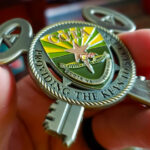
A correctional officer challenge coin usually has to represent the profession rather than one employer, and the Arizona Correctional Officer Training Academy is the clearest example of why. COTA trains officers for the Arizona Department of Corrections, Rehabilitation and Reentry and also detention officers from county, tribal and municipal facilities, so a cadet graduating from it goes to work for one of many different agencies. The coin solves that with crossed keys, which belong to the whole occupation and to no single department.
A Coin for a Profession, Not One Agency
Most unit and agency coins answer a simple question: who do you work for. A shared training academy cannot answer it, because its graduates work for dozens of different employers and will carry different badges for the rest of their careers.
COTA sits on forty acres in the western foothills of Tucson, west of Interstate 10, and runs a seven week pre-service academy with a curriculum approved by the Arizona Peace Officer Standards and Training Board. Cadets come from the state system and from county, tribal and municipal facilities, and they leave for whichever of those employed them.
That makes the design brief unusually clear once you see it. The coin has to mean something to a cadet who will spend the next twenty years in a county jail and to one headed for a state prison complex, which rules out any one agency’s badge as the subject. What they share is the work and the place they learned it, so those are the two things the coin can carry.
Why Crossed Keys
Keys are the corrections profession’s own device, used across agencies and across states, and they work for a reason that goes beyond convention.
A key is custody made into an object. It is the one piece of equipment that defines the job rather than merely accompanying it, and unlike a firearm or a vehicle it is specific to corrections rather than shared with the rest of law enforcement. Crossed, in the way branch insignia cross muskets or sabers, it reads instantly as an occupational symbol rather than as a literal object.
It also happens to be excellent coin artwork, which is luck rather than design. Keys are long, narrow, high-contrast shapes with strong silhouettes and no fine internal detail to lose at size. They reduce better than almost any badge does.
Keys Attached to a Round Coin
This coin is a round body with the crossed keys extending beyond it, which is a hybrid between a conventional coin and a fully shaped one. It is a good way to get a distinctive outline without redrawing the whole coin, and it brings one specific problem with it.
Anything that protrudes is the part that breaks. A projection catches on a pocket seam, takes the impact when the coin is dropped on an edge, and bends before any part of the round body does. Three things keep that from being a problem, and all three are decided before tooling.
- Keep the projection short. The further an element reaches from the body, the more leverage anything that catches it has.
- Keep the attachment point wide. Where the keys meet the round body is the hinge. A broad join spreads the load, a narrow neck concentrates it.
- Thicken rather than widen. Extra thickness in the projecting section adds strength without changing the silhouette the design depends on.
Done properly this is a durable coin. Done without thinking about it, it is a coin that arrives perfect and is bent within a year. If you are weighing outlines, see custom shaped challenge coins.
Brass Does the Aging, Not the Finish
The coin is brushed brass, and the antique character comes from the metal itself rather than from an antiquing process. That distinction is worth understanding, because the two routes to an old-looking coin behave differently.
Antiquing is a surface treatment. It darkens the recesses of a coin and leaves the high points bright, which produces contrast and a worn appearance on any base metal.
Brass is a warm metal to begin with. Its color is closer to aged bronze than nickel or silver will ever be, so it reads as older before anything is done to it. Brushing it removes the mirror shine, and what is left is a warm, matte, slightly used surface.
Choosing the material route rather than the finish route suits an institution, which is what COTA is. Antiquing tends to suggest history and campaigns. Brushed brass suggests something solid and long-standing, which is the right register for a training academy that has been turning out officers for decades. For the full range, see challenge coin plating options.
One practical note. Brass is a softer surface than plated nickel, so a brushed brass coin will acquire fingerprints and a patina with handling. On this design that is a feature, but it is worth knowing before you choose it for something you want to look new in five years.
Raised Badge, Engraved Lettering
The badge and insignia are embossed and the graphics and lettering are engraved, which puts two different techniques on one coin. There is a simple rule behind it that is worth borrowing.
One element comes up, everything else goes down. The badge is the subject, so it rises off the surface and catches light. The lettering is information, so it is cut into the surface where it is perfectly legible and does not compete. Raise both and the coin becomes a crowded field of high points with no clear subject. Cut both and nothing has any presence.
Lettering also behaves better engraved than raised at this scale. Cut letters have crisp edges and hold a dark line, while raised letters at small sizes lose their corners in the striking and can read as soft.
Ordering for an Academy Cycle
A seven week academy produces several classes a year, which makes the useful quantity a multiple of class size rather than a single headcount.
The design decision that follows is to leave class numbers and dates off the coin. A coin carrying the academy and the profession works for every class, so one order covers a year or more and the cost per coin drops. A coin with a class number on it has to be reordered every seven weeks, in small quantities, at the worst price. If a particular class does want its own coin, that is a separate run on top of the standing design rather than a replacement for it. For more on that distinction, see academy graduation challenge coins.
Design a Coin for Your Academy or Facility
Send your badge, patch or academy logo, and tell us whether the coin is for graduating cadets, for staff, or for both. If you want an element extending beyond a round body, say so early, because it affects the thickness and the tooling.
Professional artwork is free with unlimited revisions, and nothing goes into production until you approve a digital proof. Standard production runs about 45 to 50 days after final artwork approval, rush production is available on many projects, and shipping within the continental United States is included. Embleholics is veteran-owned, SDVOSB and registered in SAM.gov. See a training academy coin, a county sheriff coin, or more law enforcement challenge coins.
Frequently Asked Questions
What is a correctional officer challenge coin?
A correctional officer challenge coin is a coin made for corrections and detention staff, a facility, or a training academy. Because officers move between state, county, tribal and municipal employers, these coins commonly use profession-wide symbols such as crossed keys rather than a single agency’s badge, so the coin still means something after a change of employer.
What do crossed keys mean on a corrections coin?
Crossed keys represent custody, and they are the corrections profession’s own device in the way that crossed muskets represent the infantry. A key is the one piece of equipment that defines the job rather than just accompanying it, and it is specific to corrections rather than shared with the rest of law enforcement, which is why it identifies the profession at a glance.
What is the Arizona Correctional Officer Training Academy?
COTA is the Arizona Department of Corrections, Rehabilitation and Reentry’s training academy, located on forty acres in the western foothills of Tucson, west of Interstate 10. It runs a seven week pre-service academy with a curriculum approved by the Arizona Peace Officer Standards and Training Board, and it trains ADCRR officers as well as detention officers from county, tribal and municipal facilities.
Can a challenge coin have a shape extending beyond the round body?
Yes, and it is a good way to get a distinctive outline without redesigning the whole coin. The projecting part is the vulnerable part, so keep it short, keep the point where it joins the body wide, and add thickness there rather than width. Those decisions are made before tooling, not afterwards.
Is brass or antiquing better for an antique-looking coin?
They are two different routes. Antiquing is a surface treatment that darkens the recesses and leaves the high points bright, and it works on any base metal. Brass is simply a warm metal that reads as older before anything is done to it, and brushing it removes the shine. Antiquing suggests history and age, while brushed brass suggests something solid and long-standing.
Does a brushed brass coin show fingerprints?
Yes, more than plated nickel does, because brass is a softer surface and it develops a patina with handling. On a coin intended to look warm and used that is part of the appeal, but it is worth knowing in advance if you want the coin to look new years later.
Should lettering be engraved or raised on a challenge coin?
Engraved, in most cases. Cut letters keep crisp edges and hold a dark line, while raised letters at small sizes lose their corners during striking and can read as soft. A good general rule is to raise the one element that is the subject, usually a badge or emblem, and cut everything else.
Should a class number go on an academy coin?
Usually not on the standing design. A coin carrying the academy and the profession works for every class, so one larger order covers a year or more at a lower cost per coin, where a class number forces a small reorder every cycle at the worst price. A class that wants its own coin is better served by a separate short run alongside the standing design.
More Law Enforcement Challenge Coins Projects