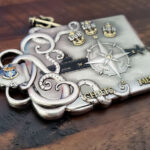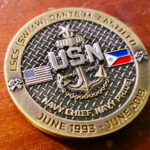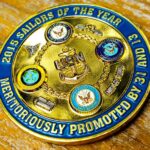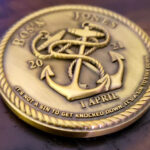
A Boatswain’s Mate Chief has anchors from two directions at once. The rating badge is crossed anchors because that is what a Boatswain’s Mate wears. The collar device is a fouled anchor because that is what a chief petty officer wears. One coin, two anchors, two completely different meanings.
The Same Device, Twice, for Different Reasons
Most coins have the opposite problem: finding enough to put on two faces. This one has an anchor on both and had to make sure they did not look like a repeat.
The rating anchor says what the job is. Crossed anchors are the badge of the Boatswain’s Mate rating, worn by anyone in it regardless of rank.
The rank anchor says what the grade is. The fouled anchor is the device of a chief petty officer, worn by chiefs across every rating in the Navy.
So the two are not redundant, they are the two halves of the person’s identity, and the coin is correct to carry both. What it has to avoid is letting them read as the same element twice.
Three things keep them apart:
One per face. Which is what this coin does. Side by side on one face they compete and the viewer reads an anchor motif. On opposite faces they read as two statements.
Different treatment. Reproduce each device as the device it actually is rather than styling them to match. A rating badge and a collar device look different in real life, and making them look alike on a coin is the error.
Different company. Give each anchor the lettering that belongs to it: the rating on one side, the rank and the name or command on the other. The surrounding text is what tells the viewer which anchor they are looking at.
For the institution a chief belongs to, see our Chiefs Mess coin page, and for the rank more generally, Navy chief coins.
A Rating Coin Is Not a Rank Coin
Worth separating, because the Navy has coins for both and they are different objects.
A rank coin belongs to a grade. Every chief in the Navy has the same device, so a chief’s coin is about reaching that grade and it works across every rating.
A rating coin belongs to a trade. It follows a sailor from command to command for an entire career, and it is shared with everyone in that rating at every rank, from a seaman striking for it to a master chief.
That has a practical consequence. A rating coin has a much larger natural audience than a unit coin and a much longer life than a rank coin, because the rating outlasts both the command and the promotion. Designs built on a rating are the ones that get reordered for years.
We cover the same distinction from the other side on our Operations Specialist page, for a rating whose work has nothing physical to show. The Boatswain’s Mate has the opposite problem: almost too much to show.
The Oldest Rating in the Navy
The Boatswain’s Mate is generally described as the oldest rating in the United States Navy, and that history is the strongest thing a BM coin can carry.
The work is deck seamanship: ground tackle, rigging, lines, boats, the upkeep of the ship’s structure, and the handling and supervision of deck crews. A Boatswain’s Mate also stands at the helm, and takes the con of small boats.
Keep it to that on the coin and on the page. A rating description turns into a list very quickly, and a list is not an identity. What distinguishes this rating is that it is the oldest one and that it is fundamentally about seamanship, and those two facts are worth more on a coin than any inventory of duties.
Two things that follow for the design. Ground tackle and rigging are rope, chain and anchors, which are the most coin-friendly subjects in the Navy because they are all strong simple forms with hard outlines. And a rating this old carries traditional devices rather than modern graphics, which is why a classic treatment suits it and a contemporary one tends to look wrong.
Brushed Gold With Almost No Paint
The client asked for a gold coin with minimal paint and color, and the result is a brushed gold base with the anchors machined into both faces and the insignia and lettering engraved.
That is the right finish for this subject, for three reasons.
A brushed field scatters light, so the relief reads from every angle and the raised anchors become the brightest things on the coin without any paint at all.
Engraving suits traditional devices. A cut line holds its edge at small sizes and keeps the character of an engraved device, where filling the same lines with color softens exactly what makes them read.
And an unpainted coin ages as metal. No paint means nothing to chip, which matters on a coin that a chief will carry rather than display.
See antique and polished finishes and plating options.
Order a Rating or Chief’s Coin
Free professional artwork, unlimited revisions and a digital proof before anything is produced. Free shipping within the continental US, a 50-coin minimum, and most orders complete 45 to 50 days after artwork approval, with rush production available. Embleholics is veteran-owned, an SDVOSB, and registered in SAM.gov.
If your coin carries both a rating badge and a rank device, tell us and we will put them on separate faces. They mean different things, and a coin that treats them as one motif loses both.
See more Navy challenge coins and anchor designs.
Frequently Asked Questions
What is a Boatswain’s Mate challenge coin?
A Boatswain’s Mate challenge coin is built on the rating rather than on a unit or a rank, which means it follows a sailor from command to command and is shared with everyone in the rating at every grade.
What is the Boatswain’s Mate rating badge?
Crossed anchors. It is worn by anyone in the rating regardless of rank, which makes it a different device from the fouled anchor worn by chief petty officers across all ratings.
Why would a coin have two anchors on it?
Because a Boatswain’s Mate Chief holds two things at once: the rating, shown by crossed anchors, and the rank, shown by a chief’s fouled anchor. They are not a repeat, they are the two halves of the person’s identity.
How do you stop two similar devices looking repetitive?
Put one per face, reproduce each as the device it actually is rather than styling them to match, and give each one the lettering that belongs to it so the surrounding text tells the viewer which they are looking at.
What is the difference between a rating coin and a rank coin?
A rank coin belongs to a grade and works across every rating, while a rating coin belongs to a trade and follows a sailor for a career. A rating coin has the larger audience and the longer life, because the rating outlasts both the command and the promotion.
What is the oldest rating in the Navy?
The Boatswain’s Mate is generally described as the Navy’s oldest rating. The work is deck seamanship: ground tackle, rigging, lines, boats and the handling of deck crews, along with standing at the helm and taking the con of small boats.
Why do anchors and rigging suit coin design?
Because they are strong simple forms with hard outlines, which is what struck metal handles best. Rope, chain and anchors read clearly at small sizes where fine mechanical detail does not.
Why use a brushed finish with no paint?
A brushed field scatters light so the raised anchors read from every angle as the brightest thing on the coin, and an unpainted coin has nothing to chip, which matters on a piece that will be carried rather than displayed.
Should traditional devices be engraved or painted?
Engraved. A cut line keeps its edge at small sizes and preserves the character of the device, while filling the same lines with color softens the detail that makes them readable.
More Navy Chief Challenge Coins Projects