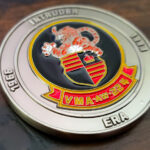
An A-6 Intruder challenge coin honors the people who served with a squadron during the years it flew that aircraft. This one marks Marine all-weather attack squadron VMA(AW)-224 from 1966 to 1993, with the squadron insignia on one face and two engraved Intruders on the other.
A Coin for One Aircraft’s Generation
For many veterans, the squadron they remember is the one they knew while working on a particular aircraft. A squadron that has flown several aircraft over its history is several communities in one. A squadron era challenge coin can mark one of those communities. An Intruder veterans coin marks the A-6 years.
Four decisions shape an A-6 Intruder challenge coin:
- The start date. The first aircraft delivered, the first operational flight and the formal transition date can sit years apart. People often disagree about which one counts.
- The end date. Any closed range leaves somebody out. A person who arrived the year after it ends wouldn’t appear on a coin about their own squadron.
- Aircraft or insignia. This coin puts the insignia (the squadron’s emblem) on one face and the aircraft on the other.
- How exact the aircraft must be. People who flew and fixed it will notice small errors, so the drawing needs to be very exact.
The end date tends to matter most to people. Choose it on purpose, and agree the date range on a coin with more than one person from the period before artwork begins. If a reunion is part of the plan, see a reunion challenge coin.
Getting the Aircraft Right
People who maintained an aircraft are an expert audience. They’ll know whether the pylons (the mounts under the wings) are right. They’ll know whether the antennas match the version they worked on, and whether the markings belong to the years being honored.
Pylons, antennas, refueling probes and paint schemes can all change over the years, so the version on the coin signals which years it honors. Four habits help keep the drawing accurate:
- Pick one year. Draw the aircraft as it was in that year. Blending several decades can produce an aircraft that never existed.
- Use period photographs. Photos taken in those years are more reliable. Later illustrations and models can show features the aircraft didn’t have yet.
- Choose silhouette or detail early. A silhouette (a solid outline with little interior detail) can sidestep most accuracy questions and often suits coin size.
- Have a crew member check the proof. The proof is the digital preview of the design. Someone who worked on the aircraft can catch what a designer can’t.
This engraved aircraft coin shows two Intruders cut into the back face. Engraving (recessed lines in the metal that form the image) keeps the drawing flat and simple, and two aircraft suggest a formation. You can see another coin with an aircraft on it in our gallery.
The Squadron
During the Intruder years, the squadron was a Marine all-weather attack squadron designated VMA(AW)-224. The 1966 to 1993 span on the coin marks the years it flew the A-6 Intruder. The front face shows the squadron insignia, with a tiger above a shield and a banner below reading VMA·AW·224. For a design built around a different Marine unit, see a Marine squadron challenge coin.
Official Marine Corps insignia usually comes with usage restrictions, and those can apply regardless of intent. If an association is ordering a Marine attack squadron coin, it’s best to confirm approval with the squadron or your chain of command before artwork begins. We work from artwork you’re authorized to supply, and we can design around your group’s identity without the insignia.
Plain by Request
The client asked for a plain challenge coin design with few decorations and limited color. The finished coin has these features:
- Front face. The squadron insignia in red, yellow and black, with white highlights on the tiger, set on an antique silver-toned base (a silver finish with darker recesses that gives an aged look).
- Raised lettering. INTRUDER across the top, 1966 on the left, 1993 on the right and ERA across the bottom, all on a stepped ring (a ring set at a different height from the center) around the insignia.
- Back face. Two A-6 Intruders engraved into the metal.
A plain design can suit veterans of one era. People usually hold and handle a coin like this, and a quiet look tends to read as serious. Engraving adds detail without adding color, so the two Intruders could appear without breaking the plain look. See our engraving and finish options for other ways to shape a plain design.
Order a Coin for Your Squadron or Association
A veteran squadron association or a serving unit can order Marine Corps challenge coins from us. Our artists create the artwork at no charge, and you can request unlimited revisions. You’ll approve a digital proof, a picture of the finished design, before anything goes into production.
Settle your date range before you contact us, since we can’t choose it for you. If an aircraft goes on the coin, tell us which year’s configuration (the exact version of the aircraft) you want and send period photographs.
Orders start at 50 coins and ship free within the continental US. Rush production is available when an event date is close. We’re veteran-owned, an SDVOSB (service-disabled veteran-owned small business), and registered in SAM.gov, the federal vendor registry. To start an A-6 Intruder challenge coin of your own, request a free quote.
Frequently Asked Questions
What is an A-6 Intruder challenge coin?
An A-6 Intruder challenge coin honors people who flew, maintained or supported that aircraft. It usually shows the aircraft, the unit insignia and a date range. This one marks VMA(AW)-224 from 1966 to 1993.
Can a coin honor one period of a unit’s history?
Yes. A coin can mark a single aircraft era, a deployment or a command tour. Set the dates first, because the range decides who the coin includes. This coin covers the years one squadron flew the A-6.
How do you choose the date range for a commemorative coin?
Agree the range with more than one person from that period before artwork starts. Any closed range leaves someone out, such as a member who arrived the year after the end date, so make that call on purpose.
Should a coin show the aircraft or the unit insignia?
Both can fit when each gets its own face. This coin puts the insignia on one face and two engraved Intruders on the other. If only one fits, an era coin often suits the aircraft and a unit coin often suits the insignia.
How accurate does an aircraft on a coin need to be?
It needs to be very accurate when the audience flew or maintained the aircraft. Pylons, antennas, refueling probes and markings can change over the years, so pick one year and draw the aircraft as it was then. Ask someone who worked on it to check the proof.
What reference images do you need for an aircraft design?
Send photographs taken in the year you want honored, ideally from several angles. Later illustrations and models can show features the aircraft didn’t have then. Tell us the configuration and any markings that must appear.
Is a silhouette better than a detailed aircraft at coin size?
Often, yes. A silhouette (a solid outline with little interior detail) sidesteps most accuracy questions at coin size. A detailed rendering can work when the engraved area is large and you have strong reference photos. Decide early, since the choice changes the artwork.
Who usually orders a coin for a past era or an association?
Squadron associations and groups of veterans from the period often place these orders. Tell us who approves the design. If the squadron insignia will appear, confirm approval with the squadron first.
More Navy Projects