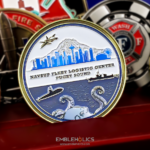
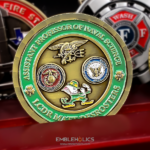
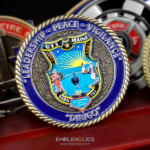
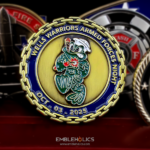
Most coins leave a good deal of bare metal showing. This one does not: nearly the whole surface is painted, including the areas inside the embossed lines. The insignias carry fine detail, a great many small lines and curves, and the brief was that no element should overpower another. It was made for the USN Fleet Introduction Team Norfolk.
What Full Color Coverage Means
There is a real distinction between a coin with color on it and a coin that is fully colored, and it is worth understanding before you specify either.
Most coins use bare metal as a design element. The unpainted areas are the plating, and they provide the contrast that makes the colored areas read. Gold or silver metal against enamel is one of the strongest pairings available.
Full coverage gives that up and buys something else. With no bare metal, the coin reads as an illustration rather than as a medal. Every area is doing work, and nothing is held back as background. For a design with a lot going on, that is often the right choice, because bare metal between busy elements can look like gaps rather than breathing room. For the opposite, a coin with no enamel at all, see our NAVIFOR Challenge Coin.
The embossed lines change role. On a normal coin the raised metal line between two colors is visible as metal and reads as an outline. Paint those lines as well and they become a colored border instead, which is softer. It is the difference between a stained glass look and a printed look.
And the color count rises. Every distinct color is a separate fill, and a fully covered coin has more areas to fill than a partially covered one. That is the main cost driver on a coin like this, more than the detail is.
See enamel and plating options and soft enamel vs hard enamel.
Painting Inside the Embossed Lines
This is the technically demanding part and worth being clear about.
An embossed line is raised metal. It exists to contain the enamel on either side of it, which is why the standard approach leaves it bare: it is a wall, not a surface. Painting the top of that wall means applying color to a narrow raised ridge rather than into a recess, which is a harder operation.
Two consequences follow. The lines have to be wide enough to take paint, so a design intended for full coverage usually needs its outlines slightly thickened at the artwork stage compared to the same design with bare metal lines. And colors on a raised surface are more exposed to wear than colors sitting in a recess, which is why an epoxy coat is worth specifying on a fully painted coin.
The payoff is a coin with no visible metal structure, which looks less like a struck object and more like an image. Whether that is what you want depends entirely on the design.
Fine Detail Without Competition
The brief here was that no element should overpower another, which on a coin this busy is the hardest instruction to execute.
Insignias built from many small lines and curves are exactly the kind of artwork that fights itself when reproduced. Four things keep it under control.
A size hierarchy. If every device is the same size, nothing leads. One element has to be clearly largest, and the rest clearly secondary, even when they are of equal importance to the organization. This is usually the conversation that takes the longest.
Separation, not reduction. The instinct when elements compete is to shrink them. The better fix is to move them apart, because a small detailed device is worse than a larger one with space around it.
Tonal grouping. Elements that sit on similar colored grounds read as belonging together, which lets the eye take in a group rather than a dozen separate things.
And simplification of the worst offenders. Some internal detail in a complex insignia will not survive the strike whatever you do. Deciding which lines to drop is better than keeping them all and letting the die decide for you.
The proof stage matters more than usual on a coin like this, and it should be looked at actual size rather than enlarged on a screen, because a design this dense can read beautifully at full screen and turn to noise at an inch and a half.
About the Team
The USN Fleet Introduction Team at Norfolk works on bringing new capability into fleet service, which is a function with the usual characteristic of support organizations: it is noticed when it fails and invisible when it succeeds.
That is a common thread among the Navy coin clients in this gallery, and it is a decent part of why coins matter in those commands. A coin is one of the few forms of recognition available to people whose output is other people’s readiness.
See also a Seventh Fleet challenge coin, a fleet logistics center coin and a fleet replacement squadron coin.
Order a Full Color Coin
Professional artwork is free with unlimited revisions, and nothing goes into production until you approve a digital proof. The challenge coin minimum is 50 pieces, standard production runs about 45 to 50 days after final artwork approval, rush production is available on many projects, and shipping within the continental United States is included. Embleholics is veteran-owned, SDVOSB and registered in SAM.gov.
Two things to raise at the quote stage. Say whether you want full color coverage or bare metal as part of the design, because it affects the line weights in the artwork and the color count in the quote, and it is not a decision to change late. And on a fully painted coin, specify a protective coat, since paint on raised surfaces wears before paint sitting in a recess does. Request a free quote to begin.
Frequently Asked Questions
What is a full color challenge coin?
It is a coin where nearly the whole surface is painted, with little or no bare metal showing. It reads as an illustration rather than as a medal, which suits a busy design where bare metal between elements would look like gaps.
Can the entire surface of a coin be painted?
Close to it, including the raised embossed lines. Leaving some metal exposed is the more common approach because the plating provides contrast, but full coverage is a valid choice and changes the character of the piece.
Can the embossed lines be painted too?
Yes, though it is harder. An embossed line is a raised wall meant to contain enamel on either side, so painting its top means applying color to a narrow ridge rather than into a recess. The lines usually need slight thickening in artwork to take it.
Does a fully painted coin wear faster?
The raised painted areas do, because color sitting on top of a ridge is more exposed than color sitting in a recess. An epoxy protective coat is worth specifying on any fully covered coin.
Is a full color coin more expensive?
Generally yes, and the color count is the reason rather than the detail. Every distinct color is a separate fill, and a fully covered coin has more areas to fill than a partially covered one.
How do you stop detailed elements competing on a coin?
Give them a size hierarchy. One element has to be clearly largest and the rest clearly secondary, even when they matter equally to the organization. Without a hierarchy the eye has nowhere to start.
Should crowded elements be made smaller?
No, moved apart. Shrinking competing devices makes each one worse; separating them keeps them readable. A larger device with space around it beats a small one in a crowd every time.
How should a dense design be proofed?
At actual coin size, not enlarged on a screen. A busy design can read beautifully at full screen and turn to noise at an inch and a half, and that is exactly the problem the proof stage exists to catch.
More Navy Projects