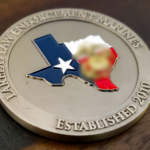
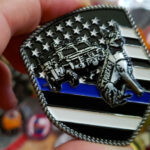
Presidential challenge coins represent recognition from the highest level of command: the President. They sit at the intersection of military tradition and executive leadership and foster a culture where service, proximity, and contribution are acknowledged tangibly.
What are presidential challenge coins? How did they become part of the office? And what does it actually mean to receive one?
What Are Presidential Challenge Coins?
Presidential challenge coins are custom coins associated with a sitting U.S. President and their time in office. They often feature the president’s name, likeness, seal, or defining design elements tied to their administration.
But the design is only part of the story.
More importantly, these coins function as a Commander-in-Chief’s form of recognition: a continuation of the long-standing military tradition of challenge coins. In that context, they are typically given in specific moments, often tied to service, praise, or shared experience.
While commemorative versions may be available to the public through official channels, a coin personally given by the President carries a different weight. It represents something earned, witnessed, or acknowledged.

BAE Systems Inc. Challenge Coin
The History of Presidential Challenge Coins
To understand presidential challenge coins, you have to start with the military.
Challenge coins have been part of military culture for generations. They represent unit identity, shared hardship, and earned belonging. Receiving one often marks inclusion, trust, or recognition within a specific group.
As Commander-in-Chief, the President occupies a unique position within that culture. While not a service member, the role carries direct authority over the military. Over time, it naturally adopted some of its traditions.
Modern presidential challenge coins trace back to President Bill Clinton, who helped formalize and popularize their use within the White House. Since then, each administration has continued the tradition, shaping it slightly in how the coins are designed and given, but maintaining the same underlying purpose: recognition.
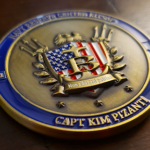
Navy Reserve Center Coin
How Presidential Challenge Coins Are Used
Presidential challenge coins may be presented during military visits, meetings with service members, or interactions with staff supporting presidential operations. In some cases, they are exchanged during diplomatic engagements or given quietly during a handshake.
Receiving a coin from the President is about acknowledgment. It signals that, in that moment, your role, presence, or contribution was recognized directly by the Commander-in-Chief.
Just as important: these coins are not requested. They are given, not sought out.
That is an important part of what gives them their meaning.
Specific Presidential Coins
Each president leaves a distinct mark on the tradition.
President Clinton (1993–2001)
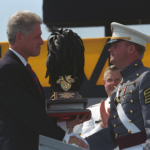
West Point, New York, May 31, 1997. Photographer: Ralph Alswang.
President Clinton is widely seen as the figure who brought presidential challenge coins into modern prominence.
Clinton was known to collect coins from service members and became deeply engaged in the tradition. His personal interest shaped how he used coins as a tool of recognition. He embraced the coins as a tool of recognition. This helped establish the expectation that presidential coins could extend beyond military-only contexts while still retaining their meaning.
President George W. Bush (2001–2009)
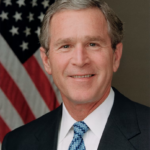
President George W. Bush (2001–2009)
President George W. Bush continued the practice with a more informal, personal approach.
He became known for presenting coins in brief, direct interactions, sometimes even subtly slipping them into a handshake. These moments reinforced the idea that recognition sometimes comes when you least expect it.
President Obama (2009–2017)

President Obama (2009–2017)
President Obama used challenge coins in a visibly symbolic way.
He regularly presented them to the personnel responsible for guarding Marine One and Air Force One, acknowledging roles that often operate behind the scenes. He was also known to leave coins at the graves of fallen service members, turning the coin into a quiet act of respect.
In these cases, the coin became more about the sentiment it represented.
President Trump (2017–2021, 2025– )
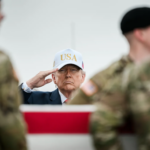
President Trump (2017–2021, 2025– )
President Trump’s approach to challenge coins introduced a stronger emphasis on personal identity in design.
His coins often incorporated distinctive visual elements tied closely to his administration and messaging. While the core tradition remained intact, this period highlighted how coin design itself can reflect the priorities and personality of a presidency.
President Biden (2021–2025)
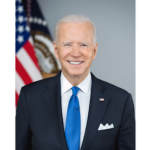
President Biden (2021–2025)
President Biden’s coins were a return to more traditional presidential styling.
The emphasis remained on continuity, maintaining the coin’s role as a symbol of office rather than individual branding. As with previous administrations, coins have been used in military and official settings to recognize service and contribution in direct, personal ways.
Can You Get a Presidential Challenge Coin?
Traditionally, presidential challenge coins are received, not acquired.
The most meaningful coins are those presented directly by the President or, in some cases, by senior members of the administration. There are, however, other ways coins enter circulation.
Commemorative versions are sometimes available through official outlets like the White House gift shop, and a secondary collector’s market exists. These coins reflect the design and history of a presidency, even if they are not tied to a specific presentation moment.
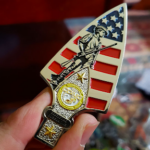
Colorado National Guard Coin
Create Your Custom Challenge Coin
Presidential challenge coins represent recognition at the highest level, but the principle behind them is the same everywhere.
The most meaningful coins are tied to a moment. A deployment. A milestone. A team that earned something together.
The best challenge coins are the ones designed with a purpose.
Every detail matters: the materials, the finish, the weight in hand, the symbolism behind the design. Done right, a coin becomes more than an object. It becomes a marker of a moment people carry with them.
If you’re creating a coin to recognize service, mark a milestone, or represent your organization, it’s worth getting it right.
Start your project with Embleholics, and build something that holds its meaning long after it’s given.
Recent Posts