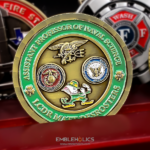
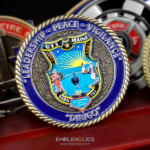
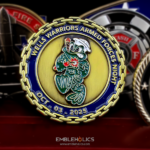
Two techniques carry this coin, and neither is common. A printed image of the center’s own building sits under a curved layer of clear acrylic, and a ring of numeric inscriptions is embossed at micro size around it. The piece is finished in glossy enamel.
A Domed Clear Layer Over a Printed Image
This is the technique that makes a photographic image work on a coin, and it is worth understanding as an option.
Printing handles what enamel cannot. Enamel fills discrete cells with flat color, so it cannot reproduce the continuous tones of a photograph or a detailed architectural rendering. Printing can, which is why any coin carrying a real image uses it.
But a printed surface needs protecting. Ink sitting on metal has nothing shielding it, and on a coin that gets handled it would wear quickly. A clear layer over the top solves that, and it is the reason printed coins are nearly always domed.
The dome also magnifies. A curved clear layer acts as a lens, so the image underneath appears slightly larger and deeper than it is. On a small printed detail that is a real gain, and it is why a domed coin looks richer than a flat printed one.
And it changes how the coin catches light. A domed surface has a single bright highlight that moves as the coin turns, which reads as depth. A flat coin has none.
Two things to know. A dome sits above the coin’s surface, so it adds thickness and the piece will not fit a capsule sized for a flat coin. And the domed area cannot carry struck detail, since it is a smooth clear layer, so any relief or lettering has to sit outside it. That is exactly why the inscriptions on this coin ring the image rather than crossing it.
See finish and coating options and making a coin from a photo.
A Building as the Subject
Putting the center’s own building on the coin is a sound choice for this kind of organization, and it works for a reason that is specific to reserve centers.
A reservist’s connection is to a place rather than to a deployment. Drill weekends happen at one building, year after year, and that building is the shared reference point for everybody who trains there. A unit insignia says which organization; the building says which center.
Architectural subjects are demanding, though, and this coin sidesteps the usual problem by printing rather than engraving. An engraved building has to be simplified heavily, because windows, cornices and brickwork are the first details to disappear at coin size. A printed image under a dome keeps them.
The trade-off is register. A printed photographic building reads as a picture; an engraved one reads as a drawing. For a commemorative piece either works, and the choice is about whether you want the real thing or an interpretation of it.
Micro-Sized Embossed Inscriptions
The ring of numeric inscriptions around the image is embossed at very small size, which is the harder of the two techniques on this coin.
Raised type at micro size is at the edge of what striking can hold. Each character is a raised ridge, and below a certain size the metal will not fill cleanly and the characters soften. Modern computerized tooling has pushed that limit down considerably, but it is still a limit rather than a preference.
Which means the content has to be short. Numbers are the ideal candidate precisely because they are few characters and bold shapes. A ring of numerals at micro size will read where a ring of words at the same size would not.
And it rewards close inspection. Micro text is not legible at a glance. You have to bring the coin close, which makes it a discovery rather than a statement, and that is the right use for it. Anything the recipient needs to read immediately should be set at a normal size elsewhere on the coin.
If you want micro detail, the practical advice is to treat it as an extra layer rather than as the main message, and to judge the proof in the hand rather than enlarged on a screen, because that is the only way to know whether it actually reads.
About Navy Reserve Centers
The Navy Reserve provides naval warfighting capabilities and expertise, with a mission of providing strategic depth and delivering operational capabilities to the Navy and Marine Corps team in peace or war.
Navy Reserve Centers are used mainly for administrative work and classroom-style training. There are hundreds across the United States, where reservists train on drill weekends and complete their service requirements.
That structure is why a center-level coin makes sense. A reservist’s unit may change, but the center is the constant, and it is the place where the people who train together actually see each other. See also a USN Recruiting Command coin and more Navy challenge coins.
Order a Coin With a Printed Image
Professional artwork is free with unlimited revisions, and nothing goes into production until you approve a digital proof. The challenge coin minimum is 50 pieces, standard production runs about 45 to 50 days after final artwork approval, rush production is available on many projects, and shipping within the continental United States is included. Embleholics is veteran-owned, SDVOSB and registered in SAM.gov.
Two things to plan for. If you want a printed image, send the highest resolution file you have, because unlike artwork a photograph cannot be redrawn larger and a low resolution source will print soft. And remember that a domed area cannot carry struck detail, so plan any lettering or relief to sit outside the dome rather than across it. Request a free quote to begin.
Finished Coin (Front)

Finished Coin (Back)

Frequently Asked Questions
What is a Navy Reserve Center challenge coin?
It is a coin made for one reserve center rather than for a deployable unit. A reservist’s shared reference point is the building where drill weekends happen, which is why center-level coins often carry the center itself.
Can a photograph or building image go on a coin?
Yes, by printing rather than enameling. Enamel fills discrete cells with flat color and cannot reproduce continuous tones, so any coin carrying a real image uses a printed layer.
Why are printed coins domed?
To protect the ink. A printed surface has nothing shielding it and would wear quickly on a handled coin. The clear layer also acts as a lens, making the image appear slightly larger and deeper than it is.
Does a dome change the coin’s size?
Yes, it adds thickness above the surface, so the coin will not fit a capsule sized for a flat piece. Packaging should be specified with the dome in mind rather than afterward.
Can the domed area carry lettering?
No. The dome is a smooth clear layer, so it cannot hold struck relief or engraved detail. Any lettering has to sit outside it, which is why inscriptions usually ring a domed image rather than crossing it.
How small can embossed text on a coin be?
Smaller than most people expect, though there is a hard limit where the metal will not fill cleanly and characters soften. Modern computerized tooling has pushed that limit down considerably, but it remains a limit.
What content suits micro-sized text?
Numbers and very short strings. Numerals are few characters and bold shapes, so a ring of them reads where a ring of words at the same size would not. Anything that must be read immediately belongs at a normal size elsewhere.
Is micro text worth including?
As an extra layer, yes. It is not legible at a glance, so it works as a detail people discover when they bring the coin close, which makes the object more interesting to hold. It should not carry the main message.
More Navy Projects