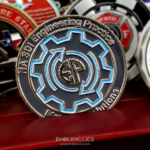
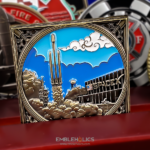
Simple on both faces and heavily colored, with a cut metal base and painted detail. One side carries the world Scouting emblem and the other the event logo, which shows North America reaching out to welcome the global Scouting community and stands for friendship and unity across the movement. This jamboree challenge coin was made for the 24th World Scout Jamboree, held at the Summit Bechtel Family National Scout Reserve in West Virginia from 22 July to 2 August 2019.
Coins at a Large International Event
A world jamboree is one of the strongest settings for a coin that exists, and the reasons are structural rather than sentimental.
Trading is already the culture. Scouts swap badges, patches, neckerchiefs and pins at jamborees as a matter of course. A coin arrives into an established exchange economy rather than having to create one.
The participants are from everywhere. Tens of thousands of young people from well over a hundred countries, most of whom will never meet again. An object exchanged in that setting is the only lasting record of a specific encounter.
Language is not shared. Which makes a visual object more useful than anything written. Two Scouts without a common language can still trade, and the coin carries the meaning.
And the event is singular. A world jamboree happens every four years in a different country. A dated piece from one is a historical object immediately, which is exactly what collectors and participants want.
See also custom organization challenge coins.
Designing for a Trading Audience
A coin meant to be traded has different requirements from one meant to be presented, and they are worth separating.
Quantity matters more than unit cost. Someone attending a jamboree to trade needs enough pieces to trade with. A beautiful coin in a run of 50 is useless at an event with 40,000 participants.
It has to read instantly. A trade is a five second transaction. The coin has to be identifiable and appealing at a glance, which argues for strong color and a clear central emblem over fine engraved subtlety.
Color beats relief here. This is the inversion of most of the advice on these pages. Sculpted detail rewards close inspection, and a trading coin rarely gets any. Bright, well separated color is what carries across a table.
And durability is secondary. A traded coin goes into a collection rather than a pocket, so the wear considerations that drive most design decisions apply much less.
The design here follows that logic precisely: simple content, full color, two clear emblems, nothing that needs study.
The 24th World Scout Jamboree
The 24th World Scout Jamboree was held in 2019 at the Summit Bechtel Family National Scout Reserve in West Virginia, organized under the World Organization of the Scout Movement. It was hosted jointly by the Scouting organizations of the United States, Canada and Mexico, which is what the event emblem refers to when it shows the continent extending a welcome.
That emblem is a good example of event design doing real work. A jamboree logo has to say where, say welcome and say the movement, to an audience that reads dozens of different languages. Representing the host continent as a gesture of welcome handles all three without a word, which is why it translates onto a coin so cleanly.
Scouting also has a long association with commemorative objects. Jamboree patches and badges go back to the earliest world events, and participants keep them for life. A coin sits naturally in that tradition.
See also Boy Scout challenge coins and a Wood Badge challenge coin.
Permission to Use Scouting Marks
This needs stating plainly, because it is the part that catches people out.
The world Scouting emblem, national Scouting marks and official jamboree logos are protected trademarks belonging to the organizations that own them. The World Organization of the Scout Movement holds the world emblem, and national associations hold their own marks. Event logos are usually controlled by the host organization.
What that means in practice is that a unit, a troop, a contingent or a council producing a coin with official marks on it needs authorization from the body that owns them, and the licensing route varies by organization. Some have a straightforward approval process for member groups; others restrict official marks to pieces produced through licensed suppliers.
The safe path for a group that wants a coin without navigating that is to design around its own identity instead. A troop number, a local landmark, a contingent’s own device and the year will produce a distinctive coin with nothing that needs clearing. Many of the best jamboree trading pieces are exactly that.
Embleholics produces from artwork a customer supplies and does not grant permission on any organization’s behalf.
Order a Jamboree or Scouting Coin
Professional artwork is free with unlimited revisions, and nothing goes into production until you approve a digital proof. The challenge coin minimum is 50 pieces, standard production runs about 45 to 50 days after final artwork approval, rush production is available on many projects, and shipping within the continental United States is included. Embleholics is veteran-owned, SDVOSB and registered in SAM.gov.
Two suggestions. Settle the permissions question before artwork if official marks are involved, because approval from the owning organization takes longer than the coin does and it cannot be sorted out after a batch exists. And if the coin is for trading rather than presenting, order generously and favor bold color over fine detail, since a trade is a five second transaction and nobody studies the piece. Request a free quote to begin.
Frequently Asked Questions
Why do Scouts trade coins at jamborees?
Because trading is already the culture. Scouts swap badges, patches and pins as a matter of course, so a coin enters an established exchange rather than having to create one.
What makes a good trading coin?
Bold color, a clear central emblem and enough quantity to actually trade with. A trade takes about five seconds, so the piece has to read instantly rather than reward study.
Should a trading coin use relief or color?
Color. This inverts the usual advice, because sculpted detail rewards close inspection and a traded coin rarely gets any. Strong, well separated color carries across a table.
How many coins does a jamboree attendee need?
More than most people plan for. A run sized for a small group is quickly exhausted at an event with tens of thousands of participants who all want to trade.
Can anyone put Scouting emblems on a coin?
No. The world emblem, national Scouting marks and official event logos are protected trademarks, and using them requires authorization from the organization that owns them.
How do you get permission for official marks?
Through the owning organization, and the route varies. Some have an approval process open to member groups, while others restrict official marks to pieces made through licensed suppliers.
What if permission is not available?
Design around your own identity instead. A troop number, a local landmark, a contingent device and the year make a distinctive coin with nothing that needs clearing, and those often trade better anyway.
What was the 24th World Scout Jamboree?
A 2019 event at the Summit Bechtel Family National Scout Reserve in West Virginia, held under the World Organization of the Scout Movement and hosted jointly by the United States, Canada and Mexico.
More Corporate Projects