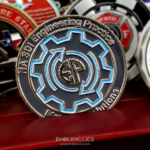
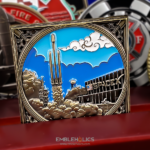
Wood Badge is the advanced leadership training course for adult Scouting volunteers and professionals, and a Wood Badge coin is a graduation piece for people who have given up several days and a great deal of effort to earn it. This one was made for Wood Badge course 135. It is a pentagonal coin on a brushed dark base, with the Wood Badge carved in relief on one face and the Scouting emblem on the other, the course’s values etched around it and paint used in only a few places.
The beads are the badge
Wood Badge takes its name from a physical object, and that object is the single most useful design element available. Baden-Powell started the training at Gilwell Park in 1919 and wanted a distinctive recognition for those who completed it. What he created was two small wooden beads on a leather thong, worn around the neck. More than a century later, course participants still finish by being presented with their beads, and Scouters still recognize them instantly.
For a coin, that is a gift. Two beads on a thong are simple enough to carve at small scale, they hold up in plain relief without needing color, and they mean nothing to anyone outside Scouting while meaning a great deal to everyone inside it. That is the ideal profile for a course coin. Pair them with the course number and you have said everything necessary.
The other recognizable Wood Badge element is the patrol. Participants are grouped into patrols named for animals — beaver, bobwhite, eagle, fox, owl, bear, buffalo and antelope — and people identify strongly with theirs for years afterwards. A coin that includes the patrol animals, or a set of coins issued one per patrol, lands particularly well with a cohort.
Get the Scouting marks cleared before anything is struck
This is the most important practical point on the page. Scouting emblems, the Wood Badge insignia, program logos and the organization’s name are protected trademarks, and they are actively enforced. Reproducing them on a coin is not automatically permitted just because the coin is for a Scouting course run by Scouting volunteers.
What that means in practice:
- Clear it through your council. Council staff deal with this regularly and know what the current position is on course items, which is more reliable than anyone’s recollection of what was allowed last time.
- Get it in writing and keep it. The same advice applies here as to a police badge on a coin: written approval costs nothing and resolves any later question instantly.
- If approval is not available, the course’s own identity still works. The beads, the patrol animals, the course number and the Gilwell association carry the meaning without reproducing a protected emblem. Several of the best Wood Badge coins we have made do not use the Scouting logo at all.
One point of naming. The organization is now Scouting America, while Scouts BSA remains the name of the program for older youth, alongside Cub Scouts, Venturing, Sea Scouts and Exploring. Course coins outlive naming changes, so it is worth checking the current usage with your council before committing wording to a die.
Course numbers, councils and reorders
A Wood Badge course carries a number identifying the council and the course, and that number is what the participants will remember. It is the thing that distinguishes their cohort from every other, and it belongs prominently on the coin rather than tucked into a rim.
It also makes the coin single-use, and that is the right call. A course coin with the course number on it cannot be reordered for the next course, which is exactly what the participants want: the coin belongs to their cohort. If a council wants a reusable coin as well, that is a separate design with the council’s identity and no course number, ordered in larger quantity and drawn down over several years.
Quantity is easy here, which is rare. The participant list is known and finite. Count the course members, add the staff, and add a modest number for the council and for people who ask later. Wood Badge cohorts are usually a few dozen, which means the die cost is a meaningful share of a small order, so it is worth confirming at the quote stage.
Why a pentagon, and why mostly unpainted
Stepping away from a circle marks the coin as a course item rather than general merchandise. A pentagon is a straightforward profile with no fragile extremities, which puts it at the inexpensive end of custom shapes, and its flat base gives the course number somewhere natural to sit.
The restrained finish is doing deliberate work. A brushed dark base with carving and only occasional paint reads as a presentation item rather than a souvenir, which suits an award earned through a demanding course. The dark tone also throws the carving forward: a bright field would flatten the relief that the design depends on, since most of the detail here is cut rather than colored.
Ordering a Scouting coin
Bring the course number, the patrol names if you want them, and confirmation that your council is comfortable with the artwork. That last point is the one that holds orders up, so start it early. Tell us the cohort size at the same time and we will come back with a realistic cost per coin for a small run. You can see other Scouting work we have produced, including the World Scout challenge coin, and the full range of specialty coins, or send your details through the free quote form.
Frequently Asked Questions
What is Wood Badge?
Wood Badge is the advanced leadership training course for adult Scouting volunteers and professionals, open to Scouters across the programs including Cub Scouts, Scouts BSA, Venturing, Sea Scouts and Exploring, as well as district and council roles. It began at Gilwell Park in 1919 under Baden-Powell and has been run worldwide since.
Why are there beads on Wood Badge coins?
Because the beads are the award. Baden-Powell created the original recognition as two small wooden beads worn on a leather thong, and course participants are still presented with beads on completion. They are instantly recognizable within Scouting, simple enough to carve at coin scale, and they read well in plain relief without needing color, which makes them the single most useful element on a Wood Badge coin.
Do we need permission to put the Scouting logo on a coin?
Yes. Scouting emblems, Wood Badge insignia, program logos and the organization’s name are protected trademarks and are actively enforced, and being a Scouting course run by volunteers does not create automatic permission. Clear the artwork through your council, get the approval in writing, and keep it on file.
What if we cannot use the Scouting emblem?
The course’s own identity carries the coin perfectly well without it. The beads, the patrol animals, the course number and the Gilwell association all communicate to Scouters without reproducing a protected mark, and several of the best Wood Badge coins we have produced use none of the official emblems.
What are the Wood Badge patrol animals?
Participants are organized into patrols named beaver, bobwhite, eagle, fox, owl, bear, buffalo and antelope, and people identify with their patrol for years afterwards. Including the patrol animals on a coin, or issuing a short set with one design per patrol, lands particularly well with a course cohort.
Should the course number go on the coin?
Yes, and prominently. The course number identifies the cohort and is the detail participants remember, so it belongs in a clear position rather than squeezed into a rim. It does mean the coin cannot be reordered for a later course, which is usually the point. A council wanting a reusable coin should run that as a separate design with no course number.
How many coins does a Wood Badge course need?
The participant list plus staff, plus a modest allowance for the council and for people who ask afterwards. Cohorts are usually a few dozen, which is a small run, so the tooling cost is a noticeable share of the total and worth establishing in the quote before the design is finalized.
More Corporate Projects