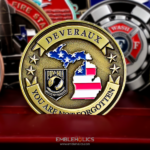
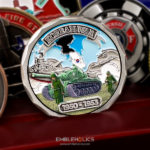
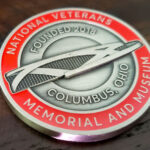
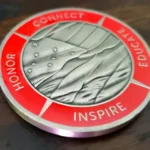
A museum coin is a retail product, and that makes it a different brief from almost every other coin we produce. This one was made for the National Veterans Memorial and Museum in Columbus, Ohio, which grew out of a vision of the late Senator John Glenn, the Marine Corps aviator and astronaut, and which tells the stories of veterans across all branches and eras rather than the history of wars. The coin is deliberately restrained: a brushed silver base, the museum building etched on the front, an engraved flag on the back, and red as the only color anywhere on it.
A museum coin is sold, not given
Every other coin on this site is given away. A museum coin has a price on it, and that one difference changes the whole specification.
- It has to survive a shelf. A unit coin is handed over in a moment. A retail coin sits in a case under lights being picked up and put down by people who are not going to buy it, so fingerprint resistance matters. This is a strong argument for a brushed or antique finish over a bright polish.
- It needs to look worth the price without being expensive to make. The margin lives in the gap between the two. Sculpted relief and a textured field cost once in the die and make a coin feel substantial; extra enamel colors cost on every single unit and often add less.
- Packaging is part of the product, not an add-on. A coin going into a display case usually needs a capsule or card at minimum. Unlike a unit coin, where packaging is the first thing we suggest cutting, here it is doing real work.
- It has to be reorderable indefinitely. No dates, no event references, nothing that expires. A museum coin should be strikeable from the same die in five years.
- Volume works differently. A unit orders once for a known group. A museum reorders against sales, so the first order is an estimate and the second is informed. Start conservatively and expect to come back.
Restraint sells better than decoration
This coin uses one color, and that is a commercial decision as much as an aesthetic one. Museum shops sell to people who have just spent two hours in a serious building thinking about serious things, and a brightly enameled souvenir reads as tat in that context. A brushed silver coin with a single red accent reads as a keepsake.
The restraint also solves the margin problem. One color area is dramatically cheaper than eight, and on a piece where visitors are comparing a coin against a mug and a book, the cost difference is what lets a museum price it sensibly.
Where a single color is used, it has to be the focal point. Scattering one color across several small details wastes it. Giving it to one element makes the eye go there, which is exactly what this design does.
Putting a building on a coin
Architecture is harder than a crest and easier than a figure. A building is mostly straight lines and repeating elements, both of which survive striking well, but two things go wrong regularly.
The first is perspective. A straight-on elevation reads clearly but looks flat. A three-quarter view has depth but needs more relief planes to keep the receding face from merging with the front. For most buildings the three-quarter view is worth the extra work, particularly for a distinctive piece of architecture where the silhouette is the point.
The second is windows. Rows of small repeated openings are exactly the detail that fills with polishing compound and disappears. The fix is to cut fewer, deeper apertures and let them read as a pattern rather than reproducing every window. A viewer’s eye completes the rest.
On permission: a museum commissioning a coin of its own building has nothing to clear. If you are making a coin of a building you do not own or operate, ask the owner first, the same as you would with any other institution’s marks.
Beyond the gift shop
Museums use coins for more than retail, and the other uses often justify the die on their own.
- Donor and member recognition. Giving levels map naturally onto coins, especially where the same design is struck in different finishes for different tiers. One die, several plating runs.
- Volunteer and docent recognition. Museums run on volunteers, and a coin is a far better thank-you than a certificate for people who are often veterans themselves.
- Exhibition and anniversary pieces. Short runs tied to a specific show or milestone, where a date on the die is appropriate because the piece is meant to be finite.
If a museum is doing more than one of these, plan them together. A single well-drawn institutional design struck in several finishes costs far less than three unrelated coins and makes the set legible as a family.
Ordering a coin for a museum or historical society
Tell us whether it is going on sale, and at what price point. That answers more questions than the artwork does, because it sets the budget per unit and therefore the finish, the enamel count and the packaging. If you want a retail coin and a donor coin, say so at the start and we will design one and finish it two ways. We are veteran-owned ourselves. You can see related work including the Combat Vets Association coin and the American Legion coin, or send your brief through the free quote form.
Finished Coin (Front)
Finished Coin (Back)
Frequently Asked Questions
What is a museum challenge coin?
A museum challenge coin is a coin produced for a museum, usually sold in its shop and often also used for donor, member and volunteer recognition. Unlike a unit coin, which is given away, it is a retail product, which changes the specification: it needs to resist handling on a shelf, carry packaging, look worth its price, and be reorderable indefinitely.
How is a retail coin different from a unit coin?
Mainly in durability of appearance, packaging and reorderability. A retail coin is handled repeatedly by browsers, so a brushed or antique finish beats a bright polish that shows every fingerprint. It usually needs a capsule or card, which on a unit coin would be optional. And it must carry no dates or event references, because it has to be strikeable from the same die for years.
Should a museum coin use a lot of color?
Usually not. Heavy enamel reads as a souvenir rather than a keepsake, which is the wrong note for most museum shops, and each additional color area adds cost to every single unit, squeezing the margin. A restrained coin with sculpted relief and a single accent color generally sells better and costs less to make.
How do you put a building on a challenge coin?
Choose the view first. A straight-on elevation is clear but flat; a three-quarter view has depth but needs more relief planes so the receding face does not merge with the front. For windows, cut fewer and deeper openings so they read as a pattern, because rows of small repeated apertures fill with polishing compound and disappear at coin scale.
Can museums use coins for donors and volunteers?
Yes, and it is often the strongest case for commissioning one. Giving levels map naturally onto coins, especially when a single design is struck in different finishes for different tiers, which costs far less than separate designs. Volunteer and docent recognition works well too, particularly at a veterans museum where many volunteers are veterans.
How many coins should a museum order first time?
Conservatively, and expect to reorder. A unit knows exactly how many people it is coining; a museum is estimating against future sales. Because the design carries no dates, reordering from the same die is straightforward, so there is no advantage in over-committing on the first run.
Do we need permission to put our building on a coin?
Not if it is your own building and your own institution. If you are producing a coin showing a building you do not own or operate, ask the owner first, the same as you would before using any other organization’s name or marks.
More Veterans Projects