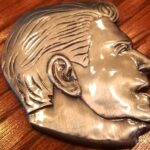
A reenlistment challenge coin is a coin a command gives a sailor, soldier, airman, or Marine at the moment they sign on for another term. This one was made for reenlisting sailors aboard the aircraft carrier USS Ronald Reagan. The coin is cut to the profile of President Reagan’s head and finished in a restrained antique silver, and the reverse carries the reenlistment oath at its center, with the ship’s motto above a torii gate and the carrier itself, hull number 76, along the bottom.
The oath is the design problem
Putting the oath on a coin means fitting about seventy words into a space the size of a bottle cap. Everything else on a reenlistment coin is flexible; the oath is not, because shortening it defeats the point. That single constraint drives almost every other decision on the design.
Three things make it work:
- Give the oath a face of its own. On this coin the oath occupies the center of the reverse and the ship’s imagery is arranged around it. Trying to share a face between the oath and a large emblem is where these designs usually fail.
- Go slightly larger than a standard coin. A few extra millimeters of diameter buys a surprising amount of line length, and it is far cheaper than the alternative, which is cutting words.
- Keep the background flat behind the text. Lettering that sits on a textured or sculpted field becomes hard to read at any size. The oath needs a plain recessed panel, with the sculpting pushed to the edges.
If the oath will not fit, the usual compromise is the opening line only, with the rest left off. It reads better than a full oath squeezed to the point of illegibility.
Shaping the coin to the ship’s namesake
A carrier named for a person gives you a silhouette to work with. Rather than striking a round coin with a portrait on it, this one is cut to the outline of Reagan’s head, drawn from his younger years, with the features built in 3D relief rather than engraved flat. The result identifies the ship before anyone reads a word on it.
A portrait in relief needs depth, not detail. The temptation with a face is to add fine lines, and at coin size those lines close up and muddy the features. What actually makes a profile recognizable is the depth of the sculpt: the brow, the nose line, and the jaw carried in distinct planes so light does the work. The antique silver finish on this coin helps for the same reason, because the darkened recesses throw the raised surfaces forward. A bright polish on a portrait tends to wash the features out.
The torii gate and the Yokosuka years
The torii gate on the reverse records where the ship was based when the coin was made. A torii marks the entrance to a Shinto shrine, and it is the most widely recognized visual shorthand for Japan. The crew asked for it because the Reagan was forward-deployed to Yokosuka, Japan, and the gate placed their reenlistment in a specific place as well as a specific moment.
That detail now dates the coin, which is exactly what a reenlistment coin is supposed to do. The Reagan left Yokosuka in May 2024 after nearly a decade in Japan, and arrived at its new homeport, Naval Base Kitsap in Bremerton, Washington, on 13 August 2024. A sailor who reenlisted aboard during the Japan years has a coin that says so. Anyone holding one later can place it without being told. We are based across the water from Naval Base Kitsap ourselves, in Port Orchard, so the Reagan’s move brought the ship to our own doorstep.
Who orders reenlistment coins, and how many
These are almost always command-funded and ordered in a single batch to last a cycle. The order usually comes from a command master chief, a career counselor, or a department head, and the quantity is set by how many reenlistments the command expects over the next year or two rather than by how many are happening this month.
Keep the design free of anything that expires. A reenlistment coin with the oath, the ship, and the ship’s motto on it stays correct indefinitely and can be reordered from the same die. Adding a year, a commanding officer’s name, or a specific deployment ties the batch to a window and means a reorder needs new artwork. The exception is a coin deliberately made to mark one period, which is what the torii gate quietly does here.
Starting a reenlistment coin
Tell us the wording you want and whether the oath is going on in full. That answers the size question, and the size question answers most of the rest. From there we lay out both faces, show you the oath set at actual size so you can judge it before anything is struck, and adjust the diameter if the text is tight. You can see more Navy challenge coins we have produced, including the USS Ronald Reagan CVN-76 coin and the USS Nimitz coin, or send your wording and artwork through the free quote form.
Frequently Asked Questions
What is a reenlistment challenge coin?
A reenlistment challenge coin is a coin presented by a command when a service member signs on for another term of service. It is given at or around the reenlistment ceremony and usually carries the unit or ship, its motto, and often the reenlistment oath itself. Commands order them in batches so there is always one on hand when a reenlistment comes through.
Can the full reenlistment oath fit on a challenge coin?
Yes, but it needs planning. The oath runs to roughly seventy words, so it has to own one entire face of the coin, sit on a flat recessed panel rather than a sculpted background, and usually requires a slightly larger diameter than a standard coin. If the space is not there, the better compromise is the opening line alone rather than shrinking the full oath until it cannot be read.
What size coin do I need for a lot of text?
Going up a few millimeters in diameter buys a disproportionate amount of line length, so a modest increase often solves a text problem that cannot be solved any other way. We set the wording at actual size and show it to you before striking, so you can see whether it reads comfortably in the hand rather than finding out after production.
Can a coin be shaped like a person’s profile?
Yes. For a ship or unit named after a person, cutting the coin to that person’s profile makes the coin identifiable before any text is read. What matters is relief depth rather than fine line work: the brow, nose, and jaw need to sit in distinct planes so light defines the features. An antique finish usually reads better than a bright polish, because the darkened recesses push the raised surfaces forward.
Why is there a torii gate on the USS Ronald Reagan coin?
A torii marks the entrance to a Shinto shrine and is the clearest visual shorthand for Japan. The crew asked for it because the Reagan was forward-deployed to Yokosuka, Japan, when the coin was made, so the gate records where the reenlistment happened as well as when. The carrier left Yokosuka in May 2024 and is now homeported at Naval Base Kitsap in Bremerton, Washington.
Should the year go on a reenlistment coin?
Only if you want the batch to be specific to that year. A coin with the oath, the unit, and its motto stays correct indefinitely and can be reordered from the same die whenever stock runs low. Adding a year, a commanding officer’s name, or a named deployment fixes the coin to one period, which is right for a commemorative run and wrong for a standing supply.
Who usually orders reenlistment coins?
Most often a command master chief, a career counselor, or a department head, using command funds rather than a personal purchase. Quantities are set against expected reenlistments over the coming year or two, so the command always has one to hand rather than ordering per ceremony.
More Navy Projects