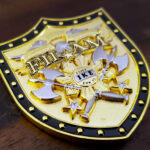
Not every coin from a ship is the ship’s coin. A carrier the size of USS Dwight D. Eisenhower carries thousands of people, and inside that crew sit departments, chief’s messes, divisions, and heritage and affinity associations, many of which order coins of their own. This one is a shield-shaped coin in a bright gold finish, carrying a group emblem embossed and painted on the back and sculpted crossed axes, stars and a ribbon in 3D relief on the front.
Ship coin, department coin, or group coin
These three things get confused constantly, and they are ordered by different people for different reasons.
- The ship’s coin represents the command. It carries the ship’s name, hull number, seal and motto, it is approved through the command, and it is what the ship gives to visitors and to other commands. There is normally one.
- A department or division coin belongs to a part of the crew: supply, reactor, air, medical, a chief’s mess. It usually carries the ship plus the department’s own identity, and it recognizes people within that department.
- A group or association coin belongs to an organization of crew members formed around something other than their job, such as a heritage association, a professional society, or a command-sanctioned club. It carries the group’s emblem, and the ship appears as the setting rather than the subject.
Why it matters before artwork starts: a group coin that leans too hard on the ship’s seal and motto starts to look like an unofficial ship coin, which is a problem nobody wants. The cleanest approach is the one this coin takes, with the group’s own emblem given the whole of one face and the ship named rather than reproduced in full command heraldry.
Check the approval path for a group coin
A ship’s seal and official heraldry belong to the command, not to any group aboard. If a coin uses the ship’s crest, that is a command decision. If a coin uses only the group’s own emblem and the ship’s name in text, the bar is lower, but it is still worth a conversation with the chain of command rather than an assumption. This is the single thing we would ask a group to confirm before we cut a die, because it is cheap to check and expensive to get wrong.
Keep individual names off a group coin. A group’s membership changes constantly on a ship with a rotating crew. A coin carrying the group’s emblem can be reordered for years; one carrying a roster or an officeholder’s name cannot.
Shield shapes and a gold field
A shield suits an emblem better than a circle does. Most organizational emblems are drawn to fill a shield, a crest, or a patch outline rather than a disc, so putting one on a round coin leaves awkward empty arcs at the sides. Cutting the coin to a shield lets the emblem sit the way it was designed, and it reads as heraldry rather than as currency.
A bright gold finish is a deliberate choice with one trade-off. Polished gold plating reads as formal and celebratory, and against it enamel colors look saturated and rich, which is why presentation coins so often use it. The cost is that a bright finish shows handling: fingerprints immediately and fine scratches over time. For a coin that will mostly be displayed or kept, that is a fair trade. For a coin that will live in a working pocket, an antique or satin finish holds up better.
Mixing embossed-and-painted with bare sculpted relief, as this coin does across its two faces, is a good way to give each side its own character without needing two completely different designs. One face carries the color, the other carries the depth.
USS Dwight D. Eisenhower
USS Dwight D. Eisenhower (CVN-69) is the second Nimitz-class nuclear-powered aircraft carrier, commissioned on 18 October 1977 and homeported at Norfolk, Virginia. She is named for the 34th President of the United States and General of the Army, and she is known throughout the fleet as the Ike. The ship was originally to be named simply USS Eisenhower; the name was changed to its present form on 25 May 1970, before she was launched.
One point of terminology worth knowing, because it comes up on commemorative pieces. The USS prefix stands for United States Ship and applies only while a vessel is in commission. A coin marked for a decommissioned ship should properly drop the prefix, which is why veterans’ association coins for older ships often read differently from coins made while the ship was serving.
Ordering a coin for a group aboard ship
Bring the group’s emblem, confirmation of your approval path, and a view on where the coins will end up. That last point decides the finish, which is the decision most often made on looks alone and regretted later. We will show you the shield outline and both faces at actual size before anything is cut. You can see more Navy challenge coins we have produced, including the USS Duarte coin and the Old Salts Chief’s Mess coin, or send artwork through the free quote form.
Frequently Asked Questions
What is the difference between a ship’s coin and a group coin?
A ship’s coin represents the command, carries the ship’s name, hull number, seal and motto, and is approved through the command for official presentation. A group coin belongs to an organization of crew members formed around something other than their job, carries that group’s own emblem, and treats the ship as the setting rather than the subject. Departments and chief’s messes sit between the two, usually combining the ship with their own identity.
Can a group aboard a ship order its own challenge coin?
Yes, and many do. What needs checking is the artwork rather than the order. A ship’s official seal and heraldry belong to the command, so a coin using them is a command decision. A coin using only the group’s own emblem with the ship named in text has a lower bar, but confirming it with the chain of command first is cheap insurance against an expensive reprint.
Why use a shield shape instead of a round coin?
Because most organizational emblems are drawn to fill a shield, crest, or patch outline rather than a circle. Placing one on a round coin leaves awkward empty arcs at the sides, whereas a shield-shaped coin lets the emblem sit the way it was designed and reads as heraldry rather than as currency.
Is a bright gold finish a good choice?
It depends where the coin will end up. Polished gold reads as formal and celebratory and makes enamel colors look saturated, which suits presentation and display pieces. It also shows fingerprints immediately and accumulates fine scratches with handling. For a coin that will live in a working pocket, an antique or satin finish wears better.
Should a group coin list members’ names?
No. Membership on a ship with a rotating crew changes constantly, so a coin carrying a roster or an officeholder’s name is out of date within a year and cannot be reordered. A coin carrying only the group’s emblem can be reordered from the same die indefinitely.
What does USS actually mean?
USS stands for United States Ship, and it applies only while a vessel is in commission. Once a ship is decommissioned the prefix no longer properly applies, which is why veterans’ association coins for older ships are often worded differently from coins produced while the ship was in service. It is worth getting right on a commemorative piece.
What is USS Dwight D. Eisenhower?
USS Dwight D. Eisenhower (CVN-69) is the second Nimitz-class nuclear-powered aircraft carrier, commissioned on 18 October 1977 and homeported at Norfolk, Virginia. She is named for the 34th President of the United States and General of the Army Dwight D. Eisenhower, and is known throughout the fleet as the Ike. Her name was changed from the originally proposed USS Eisenhower on 25 May 1970.
More Navy Projects