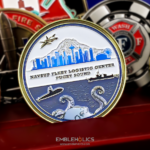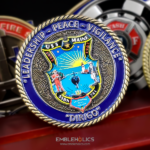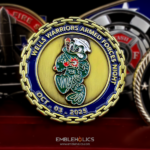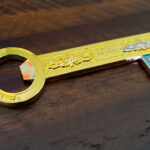
A two tone challenge coin uses two different plating metals on one piece, and this USS Dewey coin is the clean version of it: gold on the front, silver on the reverse, and no paint anywhere. Every bit of contrast on it comes from metal color, relief depth and surface finish. It is also key-shaped, with a bottle opener built into the outline.
A Coin With No Paint
Most coins reach for enamel the moment the design needs separation. A coin with no paint has to get all of it from the metal, and there are exactly three axes available.
- Metal color. Warm against cool. Gold against silver, or copper against nickel.
- Relief depth. High against low. Raised elements catch light, recessed ones hold shadow.
- Surface finish. Polished against brushed or antiqued, which changes how a surface behaves under light without changing its height.
Three axes is more than enough for a clear design, and a coin built on them has one advantage paint cannot match: nothing on it can chip. A painted coin carried in a pocket for ten years looks worn in a way that reads as damage. An unpainted one just looks old, which on a ship’s coin is the point.
The constraint is that engraved detail needs the finish to work with it. Fine lines on a bright polished surface can vanish in reflection at some angles, so an unpainted coin with a lot of engraving usually wants an antique or satin finish on at least the busier face. See antique versus polished challenge coin finish.
How Two Tone Plating Actually Works
Plating is a bath, so a coin that comes out in two metals has been masked between two operations. That one fact explains every rule about two tone coins.
Front and back is the easy boundary. The rim is a natural physical edge, so masking one face and plating the other is reliable and repeatable. This is why most two tone coins are split by face, and why it is the version to ask for if you are unsure.
Two metals on the same face is possible, with conditions. The areas have to be reasonably large and clearly separated, ideally by a raised line or a recess that gives the mask an edge to sit against. A central device in gold on a silver field works. A gold ring around a silver inner panel works.
Interlocking fine detail in two metals does not work. If the two colors weave in and out of each other at the scale of engraved lines, there is nowhere clean to put a mask, and the result is bleed at the boundaries. This is the most common two tone request that has to be redesigned.
Two tone also costs more than single plating, because it is two plating runs plus the masking between them. On a 50 coin order that difference is noticeable, and it is worth asking for both prices before deciding. The full range is set out in challenge coin plating options.
Why Gold on the Front and Silver on the Reverse
The split on this coin is not arbitrary, and if you are ordering a two tone coin it is worth getting the direction right.
Warm colors advance and cool colors recede. That is true of metals as much as of paint, so a gold face reads as nearer and more prominent than a silver one, which makes gold the natural choice for whichever side you want treated as the front.
There is a second, less visual reason. Gold reads as ceremonial and silver reads as workmanlike, which is a distinction people pick up without being told. A coin with one of each gets to be both things at once: a presentation piece on one side and a working object on the other. Doing that with paint would require a color decision that dates; doing it with metal does not.
If you are wondering what the gold on a coin actually is, see is a gold challenge coin real gold.
The Shape Came From the Function
This coin is key-shaped, and the shape is a consequence rather than a decision. A bottle opener needs a straight edge to brace against the cap and a notch set back from it. A key silhouette provides both, because a key is already a shaft with a notched head, so the function and the outline agree instead of fighting.
That is the right order to work in. Decide whether the piece has a job to do, then choose a shape that accommodates it. Designing a silhouette first and cutting an opener into it afterwards produces a weak notch and a shape that looks compromised. Opener pieces are also quoted separately from challenge coins and carry their own minimum quantities, so ask when you request a price. For more on these, see the dog tag bottle opener.
USS Dewey and Her Namesake
USS Dewey (DDG 105) is an Arleigh Burke-class guided-missile destroyer, the fifty-fifth of her class, built at Ingalls Shipbuilding in Pascagoula, Mississippi. She was authorized on 13 September 2002, launched on 26 January 2008 and commissioned on 6 March 2010. Her motto is Dynamis Ex Cardias, the will to fight from the heart.
She is named for Admiral of the Navy George Dewey, the victor at the Battle of Manila Bay in the Spanish-American War.
A ship with a Latin motto is carrying a ready-made inscription, and on an unpainted coin a motto is one of the few elements that works perfectly in bare engraved metal, because lettering needs contrast rather than color. See more Navy challenge coins and the USS Maine coin.
Design a Two Tone Coin
Send your ship’s crest, insignia and motto, and tell us which face you want treated as the front. If you want two metals, say whether you want the split by face or within a face, because that decides how the artwork has to be laid out.
Professional artwork is free with unlimited revisions, the minimum order is 50 coins, and nothing goes into production until you approve a digital proof. Standard production runs about 45 to 50 days after final artwork approval, rush production is available on many projects, and shipping within the continental United States is included. Embleholics is veteran-owned, SDVOSB and registered in SAM.gov.
Frequently Asked Questions
What is a two tone challenge coin?
A two tone challenge coin is plated in two different metals, most commonly gold and silver. Because plating is a bath, the coin is masked between two plating runs, which is why the two metals need a clean physical boundary such as the rim between the front and the back.
Can a coin have gold on one side and silver on the other?
Yes, and that is the most reliable way to do two tone. The rim gives the masking a natural edge, so the result is consistent from coin to coin. If you are unsure how to split the metals on a two tone coin, splitting by face is the version to ask for.
Can two metals be used on the same face of a coin?
Yes, if the areas are reasonably large and clearly separated, ideally by a raised line or a recess the mask can sit against. A gold central device on a silver field works well. What does not work is two metals interlocking at the scale of engraved line work, because there is nowhere clean to place a mask and the colors bleed at the boundaries.
Does two tone plating cost more?
Yes, because it is two plating runs with a masking step between them rather than one. The difference is noticeable at minimum order quantities, so it is worth asking for both the single and two tone price before deciding.
Can a challenge coin be made without any paint or enamel?
Yes, and many of the best-wearing coins are. An unpainted coin takes its contrast from three things: metal color, relief depth and surface finish. The advantage is that nothing can chip, so the coin ages rather than looking damaged. The requirement is that fine engraving needs an antiqued or satin finish on the busier face, since bright polished metal can swallow shallow lines in reflection.
Which metal should go on the front of a two tone coin?
Gold, in most cases. Warm metals read as nearer and more prominent than cool ones, so a gold face naturally presents as the front. Gold also reads as ceremonial where silver reads as workmanlike, so a coin with one of each can be a presentation piece on one side and a working object on the other.
Why would a coin be shaped like a key?
Because a bottle opener needs a straight edge to brace against the cap and a notch set back from it, and a key silhouette already has both. The sensible order is to decide whether the piece has a function first and then choose a shape that accommodates it, rather than designing an outline and cutting an opener into it afterwards, which produces a weak notch.
Who was USS Dewey named after?
USS Dewey (DDG 105) is named for Admiral of the Navy George Dewey, the victor at the Battle of Manila Bay during the Spanish-American War. She is the fifty-fifth Arleigh Burke-class guided-missile destroyer, was built at Ingalls Shipbuilding in Pascagoula, Mississippi, and was commissioned on 6 March 2010. Her motto is Dynamis Ex Cardias.
More Navy Projects