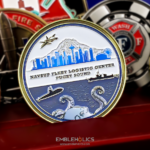
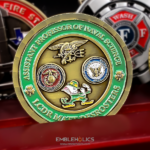
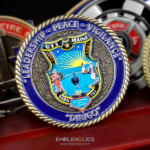
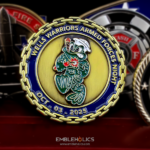
An aircraft carrier is a town. Around five thousand people live aboard when the air wing is embarked, organized into departments, squadrons and divisions that each have their own identity, and that scale changes how coins work. This one was made for the crew of USS Carl Vinson (CVN-70), the third Nimitz-class carrier, and its outline combines three things at once: an octopus, an eagle and the letter V.
One ship, many coins
A carrier will have a dozen or more coins in circulation at any time, and they are not competing with each other. Understanding the layers is the difference between ordering the right coin and ordering a duplicate of one that already exists.
- The ship’s coin. One per ship, carrying the name, hull number, seal and motto. The commanding officer’s presentation piece, ordered in volume and reordered for the life of the ship.
- Department coins. Air, reactor, engineering, supply, medical, weapons. Each department is the size of a small command in its own right and most have their own.
- Squadron coins. The embarked air wing’s squadrons bring their own, and those belong to the squadron rather than to the ship.
- Mess and association coins. The chief’s mess, the wardroom, the first class association and any heritage or affinity groups aboard.
- Event coins. Deployments, port visits, milestones, change of command. Finite by design.
The practical advice is to establish which layer you are ordering for before anything else. A department ordering what it thinks is a ship’s coin ends up with something that competes with the real one and pleases nobody. The quantities are also wildly different: a ship’s coin is a standing order in the thousands over time, a department coin is a few hundred, and a mess coin is a few dozen.
Building a shape from several ideas
This coin’s outline merges an octopus, an eagle and a letter, which is more ambitious than it sounds. Combining elements into a single silhouette fails when they read as separate objects stuck together, and succeeds when one form gives the overall shape and the others resolve into it.
Using a letter as structure is the interesting part. A monogram or initial is a strong device on a coin because it is geometric, it reads at silhouette, and it gives the organic elements something to organize around. A V in particular gives two diagonals that wings or limbs can follow naturally, which is presumably why it worked here.
Three rules for a combined shape:
- One element dominates. Decide which form carries the outline and let the others sit inside or wrap around it.
- Connect, do not abut. Elements that overlap and interlock read as one object. Elements that merely touch read as two.
- Protect the extremities. Wings, limbs and the points of a letter are all thin projections and all need thickening before they are cut.
Quantity on a ship this size
A carrier crew is large enough that the usual rules of thumb stop applying. A squadron orders for a known group; a carrier orders for a population that rotates continuously.
For a ship’s coin, order for the year rather than the event. The unit price improves substantially at carrier-scale quantities, and because a ship’s coin carries no dates it can be struck from the same die indefinitely. Splitting a year’s requirement into four orders pays the setup four times for no benefit.
For anything below ship level, size to the actual group. A department of two hundred does not need a thousand coins, and the temptation to order at ship scale for a departmental budget is how boxes end up in a storeroom.
About the ship
USS Carl Vinson (CVN-70) is the third Nimitz-class aircraft carrier. Her keel was laid at Newport News Shipbuilding on 11 October 1975, she was launched on 15 March 1980, and she was commissioned on 13 March 1982 after more than seven years of construction. She was at sea during the September 11 attacks and launched strikes in the opening of Operation Enduring Freedom.
Her namesake is unusual. Carl Vinson was a long-serving congressman from Georgia and a central figure in building the modern Navy, and he was alive to see the ship named for him, which was rare at the time and remains uncommon. For a crew, a living namesake is a genuine part of the ship’s identity and worth reflecting in a design.
Ordering a carrier coin
Tell us which layer the coin belongs to: the ship, a department, a squadron, a mess or an event. That answer sets the register, the imagery and the quantity, and it is the question most carrier orders arrive without having settled. If you want a combined or figurative shape, send the elements and we will show you the resolved outline before any die work. You can see more Navy challenge coins, including the USS Ronald Reagan CVN-76 coin and the USS Nimitz coin, or send your details through the free quote form.
Frequently Asked Questions
How many different coins does an aircraft carrier have?
Usually a dozen or more at any one time, and they do not compete. There is the ship’s own coin, department coins for air, reactor, engineering, supply, medical and weapons, squadron coins from the embarked air wing, mess and association coins for the chief’s mess, wardroom and first class association, and finite event coins for deployments and milestones.
Which layer should our coin be?
Decide before any artwork. A department ordering what it treats as a ship’s coin produces something that competes with the real one and satisfies neither. The layer also sets the quantity: a ship’s coin is a standing order reordered over years, a department coin is a few hundred, and a mess coin is a few dozen.
How many coins should a carrier order?
For the ship’s coin, order against a year rather than an event. The unit price improves significantly at that scale, and since a ship’s coin carries no dates it can be struck from the same die indefinitely, so splitting the year into four orders pays the setup four times for nothing. Below ship level, size to the actual group.
Can a coin’s shape combine several different elements?
Yes, if one of them carries the outline. Combined shapes fail when the elements read as separate objects joined together and succeed when they overlap and interlock into a single form. Decide which element dominates, connect rather than abut, and thicken every thin extremity before the profile is cut.
Does a letter or monogram work as part of a coin shape?
Well, and it is underused. A letter is geometric, reads at silhouette, and gives organic elements such as wings or limbs something to organize around. The main consideration is that the points and terminals of a letterform are thin projections like any other and need the same thickening.
What is USS Carl Vinson?
USS Carl Vinson (CVN-70) is the third Nimitz-class aircraft carrier. Her keel was laid at Newport News Shipbuilding on 11 October 1975, she was launched on 15 March 1980 and commissioned on 13 March 1982. She was at sea during the September 11 attacks and took part in the opening strikes of Operation Enduring Freedom.
Who was Carl Vinson?
Carl Vinson was a long-serving congressman from Georgia who was central to the expansion of the modern United States Navy. He was still living when the carrier was named in his honour, which was unusual at the time and remains uncommon. A living namesake tends to become a real part of a ship’s identity, which is worth reflecting in a crew’s coin.
More Navy Projects