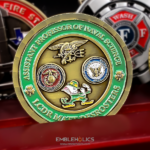
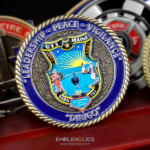
Luxurious and elegant on a minimalist brief, with very few nonessential decorations. The edge is smooth, with no carved lines or patterns. The rims are thin on both sides so the faces appear larger. Both centers carry engraved insignias, the Navy’s and NAVINFO’s. This USN Office of Information coin was made for the Chief of Navy Information.
The Navy Office of Information
NAVINFO was founded in 1918 and handles the Navy’s public communication, including an unusual function worth knowing about.
The office works with entertainment industry professionals to make sure Navy technology, policies and personnel are portrayed accurately in popular culture, from concept through post-production. Productions that meet its criteria and agree to its collaboration requirements get access to accurate information and, in some cases, cooperation.
That is a specific and often misunderstood role. The office is not writing scripts; it is the point of contact that decides whether a production gets Navy support and ensures what reaches the screen reflects how the service actually operates. Given how much of the public’s impression of the Navy comes from film and television rather than from direct contact, it is a more consequential job than its size suggests.
For a coin, that creates an interesting audience. A NAVINFO coin goes to public affairs officers, journalists and people in the entertainment industry as well as to other sailors, which is about as broad a mix as any Navy command produces.
Minimalism as a Luxury Register
Luxurious and minimalist sound contradictory and are not, provided the execution holds.
Luxury comes from material and finish. On a coin with almost nothing on it, what the viewer notices is the metal, the quality of the plating and the crispness of the cut. Those are the things that read as expensive, and they are the things a busy design obscures.
Space is the signal. A face with one centered element and a lot of clear metal reads as confident. Filling the space, however well, reads as getting value for money.
And there is nowhere to hide. This is the trade. A minimal coin exposes every flaw in the strike and the finish, so the approach only produces a luxurious result if the production is genuinely good. A minimal coin made cheaply looks cheap in a way a busy one does not.
That is the honest summary of this brief: minimalism does not reduce the cost, it relocates it from the artwork into the manufacture. More in our Minimal Design FAQ.
See antique vs polished finishes.
Thin Rims
Narrowing the raised border is a small specification with a disproportionate effect.
The rim is the raised ring around each face. It protects the design by taking contact when the coin is set down or dropped, and it frames the content. A standard rim is comfortably wide; a thin one gives that space back to the face.
The result is that the coin reads as larger than it measures. The usable area extends closer to the physical edge, so a centered element can be bigger or can sit in more open space without the composition feeling cramped.
The cost is protection. A thin rim means the face sits closer to the contact surface, so a coin that gets dropped or carried loose with keys is marginally more exposed. For a presentation piece going to senior recipients and likely kept, that is a reasonable trade, and for a working pocket coin a standard rim is the safer specification.
Engraved Insignia Without Color
Both faces carry engraved insignia and no paint, which is the choice that suits this coin’s register.
Color would break the minimalism. Enamel is the single most visually assertive thing that can go on a coin. On a piece built around restraint, even one color becomes the subject.
Engraving shows the manufacture. Cut line work puts the precision of the die on display, which is exactly what a coin trading on quality of execution wants.
And official insignia have defined forms. The Navy’s and NAVINFO’s marks are specified, and engraving reproduces outline and line weight faithfully without the color boundaries that paint requires.
The requirement is depth and a suitable finish. Engraving reads through shadow alone, so the cut has to be deep enough to cast one, and the plating has to be chosen with that in mind. A high polish reflects light across shallow line work and flattens it, which is the one way this approach fails.
See engraving and finish options.
Order a Command or Public Affairs Coin
Professional artwork is free with unlimited revisions, and nothing goes into production until you approve a digital proof. The challenge coin minimum is 50 pieces, standard production runs about 45 to 50 days after final artwork approval, rush production is available on many projects, and shipping within the continental United States is included. Embleholics is veteran-owned, SDVOSB and registered in SAM.gov.
Two suggestions for a minimalist coin. Budget for the finish rather than the artwork, because a restrained design relocates the cost into manufacture and a minimal coin made cheaply looks cheap. And if the design relies on engraving alone, confirm the plating suits it, since a high polish reflects light across shallow line work and removes the shadow the detail depends on. Request a free quote to begin.
Frequently Asked Questions
What does the Navy Office of Information do?
It handles the Navy’s public communication and works with entertainment industry professionals to ensure Navy technology, policies and personnel are portrayed accurately, from concept through post-production.
Can a minimalist coin look luxurious?
Yes, because luxury on a coin comes from material, plating and the crispness of the cut. A busy design obscures exactly the qualities that read as expensive.
Is a minimalist coin cheaper to produce?
No. It relocates the cost from artwork into manufacture. A restrained design exposes every flaw in the strike and the finish, so it only works if the production is genuinely good.
What do thin rims do?
They give space back to the face, so the coin reads as larger than it measures and a centered element can sit in more open space without the composition feeling cramped.
What is the drawback of a thin rim?
Less protection. The face sits closer to the contact surface, so a coin carried loose or dropped is marginally more exposed than one with a standard rim.
Why leave color off a minimalist coin?
Because enamel is the most visually assertive element available. On a piece built around restraint, even a single color becomes the subject of the design.
Does engraving suit official insignia?
Yes. Official marks have defined outlines and line weights, which engraving reproduces faithfully without needing the color boundaries that painted versions require.
What finish suits an engraved coin with no color?
One that preserves shadow, such as an antique or satin plating. A high polish reflects light across shallow cut lines and flattens the detail they depend on.
More Navy Projects