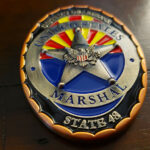
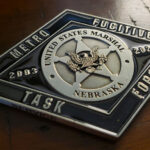
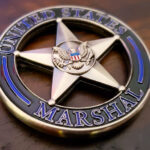
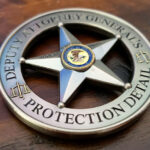
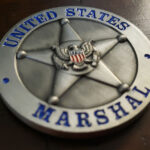
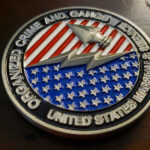
The front of this coin is almost entirely bare metal: a Marshal star badge with only the rim inscriptions and the eagle and shield at the center picked out in color. The reverse is the opposite, with the unit’s logo fully colored in glossy paints. It was made for the United States Marshals Service Organized Crime and Gangs unit.
Deciding How Much to Paint
Paint coverage is the decision customers think least about and that changes a coin’s character most. It is worth treating as a deliberate choice rather than a default.
Full coverage reads as an illustration. With no bare metal showing, the coin becomes a picture in a metal frame. That suits busy artwork, where unpainted gaps between elements would look like holes rather than breathing room.
Minimal coverage reads as a medal. Bare metal with a few picked-out elements is the register of official awards and badges. It looks institutional rather than commercial, and it is what a federal agency generally wants.
And partial coverage directs the eye. This is the mechanism on this coin’s front face. When only two elements on a bare face carry color, those two elements are where everyone looks. The agency chose the inscriptions and the central device, which is to say the words and the seal, and nothing else competes with them.
The cost side is simple: each distinct color is a separate fill, so coverage drives the quote. But the reason to restrict paint is usually not budget. It is that restraint is doing something no amount of color could.
See enamel and plating options.
Two Different Treatments on One Coin
The faces here are deliberately mismatched: one restrained, one fully colored. That is less common than a consistent treatment and it solves a real problem for a sub-unit inside a large agency.
The agency face has to be formal. A Marshal star is an official device, and an official device rendered in bright enamel across its whole surface starts to look like merchandise. Bare metal with minimal color keeps it in the register the agency uses for its own badges and seals.
The unit face can be itself. A unit logo is the team’s own device rather than the agency’s, so it is not bound by the same conventions. Full glossy color gives it energy that the agency face cannot have.
Put together, the coin says both things without either compromising. One face is the institution; one face is the people. A consistent treatment across both would have forced one of them into the wrong register.
It also means the coin reads differently depending which way it sits, which is a small thing that makes an object more interesting to hold.
A Star Badge as the Front Face
The Marshal star appears here as a device on a coin rather than as the coin’s outline, which is the alternative to cutting the shape.
Keeping a round coin and putting the badge on it has two advantages. The coin fits standard capsules and display cases, which matters for a presentation piece. And the area around the badge is available for the rim inscriptions, where a cut star has no room for text at all because its points cannot carry artwork.
The trade-off is immediacy. A coin cut to a star shape is identifiable before anything is read. For the other approach, see a marshal star challenge coin cut to the badge outline.
One note on official devices. A federal badge or seal cannot be simplified, restyled or adapted the way a logo can. The only decisions available are its size, its position and what surrounds it, which is why the design work on a coin like this goes into layout and paint coverage rather than into the device itself.
Coins for a Specialized Federal Unit
The Marshals Service is a federal law enforcement agency within the Department of Justice and the enforcement arm of the federal courts, handling fugitive apprehension, judicial protection, prisoner transport, witness protection and the management of seized assets.
An Organized Crime and Gangs unit sits inside that as a specialized team, and specialized teams are the better coin level for three reasons.
The unit has an identity the agency does not supply. Agency insignia is identical nationwide. A unit logo belongs to the people in that team.
The work is multi-agency. Organized crime and gang investigations routinely involve task forces, local departments and other federal agencies, which produces the exchanges where coins are handed over.
And the quantity suits an order. A specialized unit is a group that fits comfortably inside a 50 piece minimum with spares.
See more US Marshals challenge coins, a task force challenge coin and a narcotics unit challenge coin.
Order a Coin for Your Unit
Professional artwork is free with unlimited revisions, and nothing goes into production until you approve a digital proof. The challenge coin minimum is 50 pieces, standard production runs about 45 to 50 days after final artwork approval, rush production is available on many projects, and shipping within the continental United States is included. Embleholics is veteran-owned, SDVOSB and registered in SAM.gov.
Two things worth deciding at the quote stage. How much of each face you want painted, since that single choice determines whether the coin reads as a medal or as an illustration and it is not a styling detail to settle later. And for any official badge or seal, send the agency’s approved artwork files rather than an image from elsewhere, because an official device has to be exact and we produce from what the customer supplies. Request a free quote to begin.
Finished Coin (Front)
Finished Coin (Back)
Frequently Asked Questions
What is a partially painted challenge coin?
It is a coin where most of the surface is left as bare metal and only selected elements carry color. The restraint directs the eye: when two elements on a bare face are colored, those two are where everyone looks.
How much of a coin should be painted?
It depends on the register you want. Full coverage reads as an illustration and suits busy artwork. Minimal coverage reads as a medal and suits official or institutional pieces. Partial coverage is a way of directing attention.
Does less paint mean a cheaper coin?
Yes, since each distinct color is a separate fill and coverage drives the quote. But budget is usually not the reason to restrict paint; the reason is that restraint achieves something extra color cannot.
Can the two faces of a coin be treated differently?
Yes, and it can solve a real problem. An official agency device often needs a formal, minimally painted treatment, while a unit’s own logo can take full glossy color. Mismatching the faces lets each sit in the right register.
Why not render an official badge in full color?
Because an official device in bright enamel across its whole surface starts to look like merchandise rather than an institutional emblem. Bare metal with minimal color keeps it in the register the agency uses for its own badges and seals.
Should a badge be the coin’s shape or a device on it?
A device on a round coin keeps standard packaging usable and leaves the surrounding area free for rim inscriptions, which a cut star cannot carry at all. Cutting the shape gives more immediate recognition.
Can an official seal be adapted for a coin?
No. A federal badge or seal cannot be simplified, restyled or adapted the way a logo can. The available decisions are its size, position and surroundings, which is why the design work goes into layout rather than the device.
Why order at unit level rather than agency level?
Because agency insignia is identical nationwide while a unit logo belongs to the people in that team. Specialized units also work across agencies constantly, which is where coins get exchanged, and they fit a 50 piece order comfortably.
More Marshals Projects