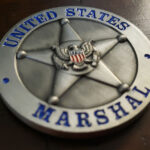
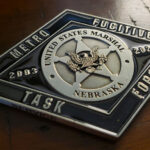
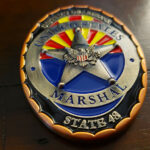
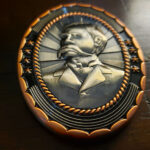
The United States Marshals Service is organized around the courts rather than around its own operational map. There are 94 federal judicial districts, and each one has a United States Marshal. That makes the district the natural unit of identity for a coin, which is why this one belongs to the District of Arizona rather than to a city, a region or a task force. It is an oval coin with both faces engraved, including a Marshals badge.
A Coin for a Judicial District
This is an unusual organizing principle and it is worth understanding, because it decides what belongs on the coin.
Most federal agencies divide the country up for their own convenience, into regions, sectors or field offices drawn around where the work is. The Marshals Service does not. Its districts are the federal judicial districts, so the boundaries are the courts’ boundaries, and a district office exists because a federal court exists.
Two things follow for a design.
The state is the right device. Because judicial districts are drawn within state lines rather than across them, a state outline or a state name identifies a district accurately in a way it would not for an agency with its own regional map. That is why district coins commonly carry the state as well as the star.
The office is a presidential appointment. Each of the 94 United States Marshals is appointed by the President and confirmed by the Senate. A district coin therefore represents a Senate-confirmed office rather than a management layer, which is a reasonable argument for treating it formally: a seal, a star, a state and clean lettering rather than mascots or humor.
See the service-wide version of this on the US Marshal challenge coin, and other districts on the Nebraska and Maryland pages.
A Badge on a Coin Is Not a Badge-Shaped Coin
This coin has a Marshals badge engraved on it, and that is entirely different from a coin cut to the shape of a badge. The distinction is worth being precise about, because it is the one place federal and law enforcement coins go wrong.
Federal insignia is protected by statute as well as by agency policy, and the concern behind that is anything that could be mistaken for a credential. A coin whose outline is the badge’s outline, at roughly the badge’s size, carrying the badge’s exact artwork, moves toward that territory. A badge depicted inside a coin does not, because the coin announces itself as a coin before anything on it is read.
The oval outline here is doing precisely that job. An oval is unmistakably a coin shape and unmistakably not a badge shape, so the badge artwork inside it is read as a picture of a badge rather than as an attempt at one. If you want a badge on a coin, that is the way to do it, and it is a good reason not to reach for a shaped outline on this kind of piece.
There is more on the statutory position and on seals versus badges on the ATF coin page.
The Oldest Badge in Federal Law Enforcement
The Marshals have the strongest heritage claim in federal law enforcement, and it is the most underused asset on a district coin.
The office was created by the Judiciary Act of 1789, signed by President George Washington on 24 September 1789, which makes United States Marshals the original federal law enforcement officers. Everything else in federal law enforcement is younger, in most cases by well over a century.
Today the service is a bureau of the Department of Justice and the enforcement arm of the federal courts, responsible for the security of federal court facilities and the protection of the federal judiciary, and for apprehending federal fugitives.
A founding date of 1789 is an exceptional thing to be able to put on a coin. It does not date, it belongs equally to all 94 districts, and it needs no explanation to anyone.
Engraving Both Faces
Both sides of this coin are engraved rather than sculpted in relief, and for this subject matter that is the correct choice.
The rule is to match the technique to what the subject actually is. Flat artwork is engraved and solid objects are sculpted. A badge, a star, a seal and lettering are all flat heraldic artwork, designed to be read as two-dimensional devices, so engraving keeps them crisp and correct. Pushing a badge into deep relief means inventing depth it never had, which makes it look like a casting of a badge rather than the device itself.
Engraving also suits a piece that will be handled. Cut lines sit below the surface, so they are protected from the wear that catches raised detail first.
Order a Coin for Your District or Office
Send the approved seal or star artwork and the district name, and confirm the authorization route before artwork begins. If you want a badge on the coin, keep the outline a conventional coin shape, and we will lay the badge out inside it.
Professional artwork is free with unlimited revisions, the minimum order is 50 coins, and nothing goes into production until you approve a digital proof. Standard production runs about 45 to 50 days after final artwork approval, rush production is available on many projects, and shipping within the continental United States is included. Embleholics is veteran-owned, SDVOSB and registered in SAM.gov. See more US Marshals challenge coins.
Finished Coin (Front)
Finished Coin (Back)
Frequently Asked Questions
What is a US Marshal district coin?
A US Marshal district coin belongs to one of the 94 federal judicial districts, each of which has its own United States Marshal. Because the districts follow the federal courts’ boundaries and sit within state lines, these coins commonly carry the state name or outline alongside the Marshals star.
How many US Marshals are there?
There are 94, one for each federal judicial district. Each United States Marshal, along with the Director of the Marshals Service, is appointed by the President and confirmed by the Senate.
Why do Marshals district coins use the state rather than a region?
Because the districts are judicial districts rather than the agency’s own regional divisions, so they are drawn within state boundaries rather than across them. That makes a state name or outline an accurate identifier for a district, which is not true for agencies that divide the country into their own regions or sectors.
Can a US Marshal badge be put on a challenge coin?
Yes, with the agency’s authorization, and the important point is that a badge depicted on a coin is not the same as a coin shaped like a badge. Keeping the coin to a conventional outline such as a round or oval shape means the piece reads as a coin before the artwork is read, so the badge is understood as a picture of a badge rather than an imitation of one.
Why is an oval a good outline for a coin carrying a badge?
Because an oval is unmistakably a coin shape and unmistakably not a badge shape. That removes any ambiguity about what the object is, which is exactly what you want when the artwork inside it is a credential device.
What is the oldest federal law enforcement agency in the United States?
The United States Marshals. The office was created by the Judiciary Act of 1789, signed by President George Washington on 24 September 1789, making United States Marshals the original federal law enforcement officers.
Should a badge or seal be engraved or sculpted on a coin?
Engraved. Badges, stars, seals and lettering are flat heraldic artwork designed to be read as two-dimensional devices, so engraving keeps them crisp and correct. Pushing a flat device into deep relief means inventing depth it never had, and it ends up looking like a casting of the device rather than the device itself.
Does engraving wear better than raised relief?
On a coin that gets handled, generally yes. Engraved lines sit below the surface, so they are protected from the rubbing and knocks that reach raised detail first. Raised relief has more presence, which is why it suits presentation pieces more than everyday carry.
More Marshals Projects