An anniversary coin is the one kind of coin that is supposed to be tied to a single year. Every other piece of advice on this site says to keep a design undated so it can be reordered. This is the exception, and it changes how you order.
There Is No Second Run
This is the whole thing to understand about an anniversary coin, and it is where most organizations get caught.
A coin marked with a milestone year cannot be reordered once the year passes. A standing unit coin can be made again in five years’ time and still be correct. A twentieth anniversary coin made again in five years is wrong, because by then it is the twenty-fifth.
Three consequences, and they all point the same way:
Order more than you think you need. Work out who is getting one, then add the people who will ask later: alumni, retirees, visitors, families, the person who was on leave that week. On a standing coin you can top up. Here you cannot.
Keep some back. Organizations that run anniversary coins well hold a reserve rather than distributing the whole run on the day. A coin that turns up five years later for someone who was there is worth far more than one handed out at the event to someone who was not.
Get the dates right. Both of them. The founding year and the anniversary year, and the arithmetic between them. This is a record, and a record with the wrong numbers on it cannot be corrected.
It also means the design can be as specific as you like. Tie it to the year, name the milestone, use the number as the subject. All the usual warnings about dating a coin do not apply, because being dated is the point.
Make the Number the Subject
The most common mistake on an anniversary coin is treating the number as a caption.
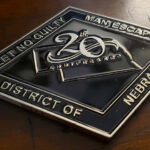
On a standing coin the organization’s emblem is the subject and everything else supports it. On an anniversary coin that order should reverse. The milestone is why the coin exists, so the numeral belongs at the centre of a face, sized to be the first thing read, with the emblem and the name in support.
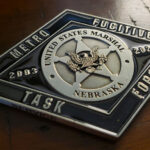
This coin does that. One face carries the badge, and the reverse gives the anniversary inscription its own face in embossed metal rather than squeezing it around a rim.
Two practical notes. A numeral is a simple bold form, which means it holds up at depth better than almost any other element, so an anniversary number is a good candidate for the deepest relief on the piece. And round numbers read better than odd ones for a reason beyond tradition: 20, 25, 50 and 100 are two or three characters, and a number like 23 looks like a caption no matter how large you set it.
A Diamond Instead of a Circle
The shape here is a rhombus, which is a square stood on its corner, and it is one of the less common formats.
What it gives you. A diamond has a point at the top, which draws the eye upward in a way no round coin can, and it reads as a badge or a shield rather than as a token. For a law enforcement district marking a milestone, that register is right.
What it costs you. Four corners, and on a diamond they are sharper than on a square because the angles are not right angles. The top and bottom points in particular are the outermost metal on the piece and the first to take wear, so they are radiused and artwork is kept away from them.
And the usable area is smaller than it looks. A diamond’s widest span is corner to corner, but the usable field is the square inside it. Artwork that runs toward the corners runs into the points, which means the design sits in a smaller area than the overall size suggests.
See custom shaped challenge coins for the other formats.
Glossy Black With Bare Metal Showing
The finish pairs a glossy black field with areas where the base metal is left bare, and that is a sound combination for a piece like this.
Black makes bare metal read as bright. A dark glossy field is the strongest background available for raised metal, which means the star and the inscription read without any second color being introduced.
Leaving metal bare costs nothing and looks deliberate. Unpainted raised areas against a painted field are a contrast of material rather than of color, and that reads as made rather than decorated.
The trade is that gloss shows marks. A glossy black field picks up fingerprints and fine scratches more readily than a matte one. On a coin that will be kept rather than carried, which is what an anniversary coin usually is, that is an acceptable cost.
See plating options and antique and polished finishes.
About the District
The United States Marshals Service is the oldest federal law enforcement agency in the country and serves as the enforcement arm of the federal courts. It is organized by federal judicial district, and this coin marks the twentieth anniversary of the District of Nebraska’s.
The district structure is worth understanding if you are ordering at that level, and we cover it on our US Marshals district coin page: there are 94 federal judicial districts, each with its own United States Marshal appointed by the President and confirmed by the Senate.
On the star: the Marshals Service is identified by a star, which is also the form its badge takes, and that makes it an unusual case among federal agencies. A district with a question about using its own device should put it to the agency rather than to a vendor. We cover the general position on federal insignia on our federal law enforcement coin page.
See more US Marshals challenge coins.
Order an Anniversary Coin
Free professional artwork, unlimited revisions and a digital proof before anything is produced. Free shipping within the continental US, a 50-coin minimum, and most orders complete 45 to 50 days after artwork approval, with rush production available. Embleholics is veteran-owned, an SDVOSB, and registered in SAM.gov.
Two things worth doing before you ask for a quote. Work out your quantity generously, because there is no second run on a dated coin. And start earlier than you would for a standing coin: artwork, proof and production take 45 to 50 days after approval, and an anniversary has a date it cannot move.
See more commemorative challenge coins.
Finished Coin (Front)
Finished Coin (Back)
Frequently Asked Questions
What is an anniversary challenge coin?
An anniversary challenge coin marks a milestone year for an organization and carries that year on it. Unlike a standing coin it cannot be reordered after the year passes, which makes the quantity decision more important than the design one.
How many anniversary coins should you order?
More than the headcount. Work out who is getting one at the time, then add the people who will ask later, including alumni, retirees, visitors and anyone absent on the day. There is no opportunity to top up once the year has gone.
Should you keep some anniversary coins back?
Yes. Organizations that run these well hold a reserve rather than distributing the whole run at the event, because a coin that reaches someone years later who was actually there is worth more than one given on the day to someone who was not.
Should the anniversary number be the main element?
Yes. The milestone is why the coin exists, so the numeral belongs at the centre of a face at a size that makes it the first thing read, with the emblem and the organization’s name in support rather than the other way round.
Why do round-number anniversaries work better on a coin?
Partly tradition and partly typography. Numbers like 20, 25, 50 and 100 are two or three characters and can be set large enough to be the subject, while a number like 23 reads as a caption however large it is.
Can a challenge coin be diamond shaped?
Yes. A rhombus is a square stood on its corner, and it reads as a badge or shield rather than a token, with a point at the top that draws the eye upward. The points are the outermost metal, so they are radiused and artwork is kept clear of them.
Is a diamond-shaped coin smaller than it looks?
The usable field is, yes. The widest span is corner to corner but the artwork has to sit within the square inside the diamond, so the design area is smaller than the overall dimensions suggest.
Why use glossy black with bare metal?
A dark glossy field is the strongest background for raised bare metal, so the artwork reads brightly without introducing a second color. The trade is that gloss shows fingerprints and fine scratches, which matters less on a coin that will be kept rather than carried.
How far ahead should you plan an anniversary coin?
Allow 45 to 50 days of production after artwork approval, plus the artwork and proof stages before that. An anniversary has a fixed date, so starting a couple of months earlier than feels necessary is the safe approach.
More Marshals Projects