A law enforcement task force challenge coin is a custom coin made for a team drawn from more than one agency. It carries the task force’s own identity rather than any single department’s seal, so every member can carry it regardless of which agency employs them.
What Is a Safe Streets Task Force?
Safe Streets Task Forces are FBI-led teams that bring federal, state and local officers together with prosecutors to work violent crime and gang investigations over the long term rather than case by case.
The model is straightforward. Local officers know the neighborhoods and the people. Federal agencies bring resources, jurisdiction that crosses state lines, and the ability to bring federal charges. Putting both on one team, working the same investigation for months or years, produces results neither side reaches alone.
There are Safe Streets Task Forces in FBI field offices across the country, each shaped by the crime problems in its own city. That local character is exactly why their coins look so different from one another.
How Do You Design a Coin for a Multi-Agency Task Force?
This is the question that makes task force coins genuinely different from unit coins, and it has no obvious answer.
A police department coin carries the department’s seal. A federal agency coin carries the agency’s. A task force has neither, because its members belong to different organizations. A sheriff’s deputy, a city police officer, a state trooper and a federal agent might all be on the same team, and a coin carrying only one of those agencies’ marks tells three of them they are guests.
Teams solve it four ways.
An emblem of their own. The task force designs something that belongs to the team rather than to any member agency. This is the most common answer and it produces the most distinctive coins in this category.
Agencies represented equally. Every participating agency’s mark appears, arranged with none dominant. Honest, and it works, though it requires clearance from each agency and the design gets crowded quickly.
Geography instead of agency. The city, county or region everyone shares becomes the identity. A skyline, a state outline, a district name.
An image the team chose. An animal, a figure, a piece of iconography with meaning inside the team and no official standing anywhere. These are usually the coins people actually keep.
The last approach is the most common and the reason is practical rather than aesthetic. An unofficial emblem needs no agency’s approval, belongs to nobody’s chain of command, and means something specific to the people who chose it. The coin on this page is an example.
Who Orders Task Force Challenge Coins?
Standing task forces order for their own members, usually when a team forms or when a long investigation closes.
Temporary and surge operations order coins for the duration of an assignment. These are often smaller runs, and the design frequently carries the operation name and dates, since the team will not exist afterward.
Joint operations between departments order coins that mark a specific partnership rather than a permanent structure.
The most recurring order in this category comes from individual assignments ending. Local officers detailed to a federal task force are Task Force Officers, or TFOs: state, local or tribal officers who stay employed by their home department while being deputized with federal authority for the length of the assignment. When a TFO’s rotation ends, they go back to their own department carrying the coin from a team they will not be on again. Task forces that run TFO rotations order coins on that rhythm, and every rotation is a new one.
You will find related work in the gallery, including narcotics task force coins, criminal investigator coins and ATF field division coins.
What Goes on a Task Force Coin?
The vocabulary is narrower than it looks, because most of these coins are solving the same problem.
Task force emblems sit at the center where an agency seal would normally go. City and regional identifiers do a lot of work, since geography is often the only thing every member shares. Participating agency marks appear where authorized, usually arranged around the edge rather than centered.
Unit mottos and operation names go on the reverse. Dates matter more here than on unit coins, because task forces and operations have start and end points that a permanent unit does not.
Custom outlines and cut-outs are common. So is color against blackened or antiqued metal, which reads closer to the equipment this audience carries than a bright polished finish does. You can see the broader category on the FBI challenge coins page and across our federal law enforcement coins.
About This Safe Streets Task Force Coin
The team came to us wanting a round coin that did not behave like one.
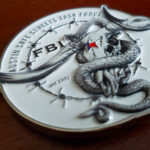
The front carries a relief of a rattlesnake coiled over a bull’s skull, with the horns breaking past the edge of the coin rather than sitting inside it. The reverse is engraved: a robed figure carrying a scythe, standing in front of the field office building.
The horns are the manufacturing problem. An element that leaves the circle has no rim protecting it, which changes the piece in two ways. In production, the die has to hold a projecting form that is unsupported at its extremity, where a round edge would normally carry the pressure. In use, that projection is the first thing to catch on a pocket or a desk drawer, so the relief depth and the transition where the horn leaves the coin body have to be right or the coin will not survive being carried. Getting an element to break the edge is easy. Getting it to survive ten years of being carried is not.
The design went through digital mock-ups before anything was cut, which is how the projecting elements and the fine engraving on the reverse were resolved before tooling. Color was applied by paint, with a protective coating over it for durability.
The iconography was the team’s own choice, and that is the point of it. It is not any agency’s mark, it needed nobody’s approval, and it belongs to the people who chose it.
Can We Use an Agency Seal on a Task Force Coin?
Agency seals, badges and insignia are protected, and using one on a coin requires authorization from that agency.
On a task force coin this carries extra weight, because a design showing three or four participating agencies needs clearance from each of them, not just from the one leading the task force. That is a real reason many teams choose an emblem of their own instead: it removes the approval problem entirely.
We work from artwork the customer is authorized to supply, and we will raise it if a design appears to include a mark the customer may not control. It is worth resolving before artwork begins rather than at proof stage.
Design a Coin for Your Task Force
Artwork is free and revisions are unlimited. You receive a digital proof and production starts only after you approve it, which matters on designs with projecting elements or cut-outs where the shape needs settling before tooling.
Orders start at 50 coins, shipping within the continental United States is included, and most orders are complete in 45 to 50 days after artwork approval. Rush production is available if you are working to an operation close-out or a TFO rotation date.
Embleholics is veteran-owned, based in Port Orchard, Washington, and registered in SAM as a Service-Disabled Veteran-Owned Small Business under UEI F3AGRUW5RT53, which matters if the order runs through a government purchasing process. Request a quote and you will hear back within 24 hours.
Frequently Asked Questions
What is a Safe Streets Task Force?
A Safe Streets Task Force is an FBI-led team combining federal, state and local law enforcement officers with prosecutors to work violent crime and gang investigations over the long term. Field offices across the country run their own.
What is a law enforcement task force coin?
A task force coin is a custom coin made for a team drawn from more than one agency. It usually carries the task force’s own identity rather than a single department’s seal, so every member can carry it.
How do you design a coin for a team from several agencies?
Most teams create an emblem of their own, represent every participating agency equally, use the city or region they share, or choose an image with meaning inside the team. The first and last need no agency approval.
Who orders task force challenge coins?
Standing task forces, temporary and surge operations, joint operations between departments, and Task Force Officers at the end of an assignment. TFO rotations are the most recurring order, since each one produces a new coin.
What is a Task Force Officer?
A Task Force Officer, or TFO, is a state, local or tribal law enforcement officer assigned to a federal task force. They remain employed by their home department while being deputized with federal authority for the length of the assignment.
What goes on a task force challenge coin?
Task force emblems, city and regional identifiers, participating agency marks where authorized, unit mottos, operation names and dates. Custom outlines and color against blackened or antiqued metal are both common.
Can a coin be made with a shape that breaks the round edge?
Yes. Elements can project past the coin’s outline, as the horns do on the coin shown here. The projecting form has no rim protecting it, so relief depth and the transition point are settled at proof stage.
Can we use our agencies’ seals on a task force coin?
Only with authorization from each agency whose mark appears. A design showing several agencies needs clearance from all of them, not only from the agency leading the task force.
What is the minimum order?
The minimum order on coins is 50. Most orders are complete in 45 to 50 days after artwork approval, and rush production is available if you are working to an operation close-out or a rotation date.
More Law Enforcement Challenge Coins Projects