The U.S. Army Criminal Investigation Division, known as CID, is the Army’s independent federal law enforcement agency responsible for investigating felony-level crime affecting the Army. It is led by a civilian director and headquartered at Marine Corps Base Quantico in Virginia.
What Is Army CID?
The U.S. Army Criminal Investigation Division (CID) investigates felony-level crime affecting the Army. Its special agents are federal law enforcement officers, both military and civilian, and the agency holds investigative autonomy: it looks into allegations and hands its findings to the appropriate command and legal authority, rather than charging anyone itself.
CID is headquartered at Marine Corps Base Quantico, Virginia, and reports through its own chain of command to the CID Director, who reports to the Under Secretary of the Army and the Secretary of the Army.
The current structure dates from 17 September 2021. On that date, the fiftieth anniversary of the organization’s establishment as a major Army command in 1971, it was renamed from the Criminal Investigation Command to the Criminal Investigation Division, and authority passed from the Provost Marshal General to a civilian director. The agency now sits outside the military police chain of command entirely, which is the substance of the change rather than a matter of paperwork.
The name itself is older than either arrangement. A Criminal Investigation Division was first organized in 1918, when General John Pershing directed the Provost Marshal General of the American Expeditionary Forces to form one for detecting and preventing crime in occupied territory. The 2021 renaming returned the organization to a title it had carried a century earlier.
Is Army CID Military Police?
No, not any more, and the distinction matters more than it used to.
CID agents are federal law enforcement officers. Military police are soldiers performing a military police function. The two communities work alongside each other constantly and are routinely confused from the outside, but since 2021 they answer to different people: CID reports to a civilian director, and the Provost Marshal General no longer sits above it.
The confusion is understandable, because the original 1918 Criminal Investigation Division was formed inside the Military Police Corps, and for most of the twentieth century the same officer led both. That is no longer the case.
If you came here looking for military police coins rather than investigator coins, the Military Police Corps coins in the gallery are the right place to start.
Who Orders Criminal Investigator Challenge Coins?
Criminal investigation organizations order coins at several levels, and the pattern is different from a line unit.
Field offices and resident agencies order coins carrying the office or city, often given to visiting agents and to partners from other agencies. Specialized units and task forces order their own, particularly where a team is drawn from several agencies and a coin is the only shared insignia anyone can wear.
Training and academy classes are the most reliable orders in this category. Every class wants its own coin, classes run on a schedule, and the design usually carries a class number that changes each time. A single academy can generate coins year after year without anyone having to make a fresh case for it.
Individual agents order at retirement and on transfer, usually in smaller quantities and often with a personal inscription on the reverse.
The same holds across the sibling organizations. NCIS, Air Force OSI and the federal agencies that work alongside them all run academies, field offices and task forces on the same rhythm, and the gallery already includes task force coins and HSI special agent coins alongside broader federal law enforcement coins.
What Goes on a Criminal Investigator’s Coin?
Investigator coins tend to look restrained next to unit coins, and that is deliberate.
Agency insignia and badge motifs sit at the center where authorized. Office and city identifiers, unit and task force names, dates of service and mottos fill the reverse. Personal coins often carry a name, a badge number or a span of service.
Finish choices run darker than average. Subdued and blackened treatments are common, partly because they match the credential and badge aesthetic this audience already carries, and partly because a bright polished coin reads as ceremonial in a community whose work is not.
Format is where investigator coins most often depart from the norm. A round coin is not a requirement, and rectangular, badge-shaped and credential-shaped pieces all appear. The CID coin below is one of them, and its whole design argument rests on the shape.
Finished Coin (Front)

Finished Coin (Back)
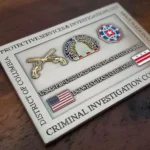
About This Card-Shaped CID Coin
The customer came to us with an idea that was not a coin in the usual sense. They wanted a rectangle, roughly the proportion of a business card, rather than a round piece.
The front carries nothing but the letters CID, etched and painted in black. No seal, no border device, no color beyond the black fill. The back is where the work went: small logos, flags and lettering, all engraved at fine scale across a flat field.
The restraint is the point, and it suits this client specifically. A coin that reads like a credential rather than a souvenir makes sense for an agency whose people carry credentials for a living. Handing someone a metal card with three letters on it is a different gesture from handing them a polished disc, and the customer understood that before we did.
A rectangular format is also harder to make well than a round one. A round die has no corners, and a circle is forgiving because the eye has no reference point for where the curve should sit. A rectangle has four corners and four straight edges, and any inconsistency in a corner radius or an edge line is immediately visible because the shape is one everybody already knows. Combine that with fine engraving on the reverse, where a shallow cut on a small flag or letterform disappears entirely, and the tolerance on this piece was narrow throughout.
You can see more custom Army challenge coins across the gallery, though few of them look anything like this one.
Can We Use an Agency Badge or Seal on a Coin?
Agency badges, seals and insignia are protected, and using one on a coin requires authorization from the agency itself.
For most orders this is straightforward, because the coin is being commissioned by the office or unit that holds the insignia, and approval is an internal step rather than an external request. Where a design is being ordered by an association, a class or an individual, it is worth confirming clearance before artwork begins rather than after.
We work from artwork the customer is authorized to supply, and we will raise it if a design appears to include a mark the customer may not control. Federal law enforcement buyers deal with this routinely and generally prefer the question asked early.
Design a Coin for Your Office or Unit
Artwork is free and revisions are unlimited. You receive a digital proof and production starts only after you approve it, which matters more than usual on a non-round format where the shape has to be settled before tooling is cut.
Orders start at 50 coins, shipping within the continental United States is included, and most orders are complete in 45 to 50 days after artwork approval. Rush production is available if you are working to an academy graduation or a retirement date.
Embleholics is veteran-owned, based in Port Orchard, Washington, and registered in SAM as a Service-Disabled Veteran-Owned Small Business under UEI F3AGRUW5RT53, which matters if the order runs through a government purchasing process. Request a quote and you will hear back within 24 hours.
Frequently Asked Questions
What is Army CID?
The U.S. Army Criminal Investigation Division, known as CID, is the Army’s independent federal law enforcement agency. It investigates felony-level crime affecting the Army and is headquartered at Marine Corps Base Quantico, Virginia.
What does CID stand for?
CID stands for Criminal Investigation Division. The name dates to 1918, when a criminal investigation division was first organized within the Military Police Corps, and it was readopted as the organization’s formal title in 2021.
Is Army CID military police?
No. CID special agents are federal law enforcement officers and the agency reports to a civilian director rather than the Provost Marshal General. The two communities work alongside each other but have been separate chains of command since 2021.
Where is Army CID headquartered?
Army CID is headquartered at Marine Corps Base Quantico in Virginia, with field offices and resident agencies at Army installations in the United States and overseas.
Who orders criminal investigator challenge coins?
Field offices and resident agencies, specialized units and task forces, training and academy classes, and individual agents at retirement or on transfer. Academy classes are the most recurring order, since each new class wants its own coin.
What goes on a CID challenge coin?
Agency insignia and badge motifs where authorized, office or city identifiers, unit and task force names, dates of service and mottos. Subdued and blackened finishes are common because they match the credential aesthetic agents already carry.
Can a challenge coin be made in a rectangular or card shape?
Yes. A coin can be produced as a rectangle, a badge outline or another non-round format, as the CID coin on this page was. The shape is confirmed at proof stage before tooling is cut.
Can we put an agency badge on a challenge coin?
Only with authorization from the agency. Most orders are placed by the office or unit that holds the insignia, so approval is an internal step. We work from artwork the customer is authorized to supply.
What is the minimum order?
The minimum order on coins is 50. Most orders are complete in 45 to 50 days after artwork approval, and rush production is available if you are working to an academy graduation or a retirement date.
More Army Projects