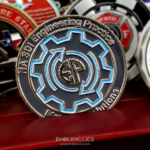
Clean and simple, with minimal graphics and no engraving or embossing anywhere on it. The surfaces are coated in white paint as a background. One face carries a map of Texas painted in three colors. The other carries the tennis officials logo inside an olive wreath, which stands for sportsmanship. This tennis officials challenge coin was commissioned by USTA Texas.
A Coin With No Relief At All
Leaving out engraving and embossing entirely is an unusual decision on a struck coin, and it produces something distinctly different.
It reads as graphic design rather than metalwork. A flat painted surface looks like a printed object, which is modern and clean in a way sculpted relief never is.
Artwork transfers without translation. Most logos are designed flat, and converting them to relief means deciding what is raised, how deep and where the shadows fall. A flat coin skips that entirely, so the mark appears as the organization drew it.
Color does all the work. With no depth to create contrast, the palette carries the whole design. That is simpler and it raises the stakes on getting the colors right.
And it is legible at a distance. Flat color reads across a room where shallow engraving does not, which suits an object handed out at tournaments and events.
The honest trade-off is that it feels less like a traditional coin in the hand. Weight is still there, but the surface interest is not, and anyone expecting a sculpted piece will notice. For an organization that is not military and does not want to borrow military conventions, that is often the right answer rather than a compromise.
See 2D vs 3D challenge coins and enamel and finish options.
Why a White Background Is a Difficult Choice
White is the hardest color to execute well on a coin, and it is worth knowing why before choosing it.
Dark fills are forgiving. Small variations in depth, minor contamination and slight unevenness all vanish against black or navy. White hides nothing. Every imperfection in the fill shows, and the color sits over bare metal that will tint it if the coverage is thin.
It is also the color most likely to discolor with handling, since anything transferred to the surface is visible against it in a way it would not be against a dark ground.
What makes it worth the difficulty is that white is the only background that lets other colors appear at their true value. A color over metal picks up warmth from the base. A color over black deepens. Over white, three colors on a map look like exactly those three colors, which matters when an organization’s palette is the point.
The practical note is to check the white on a physical proof under daylight rather than on screen, because coverage and evenness are the two things a rendering will not show.
Sports Officials as a Coin Audience
Officials are a better fit for a coin than almost any other role in sport, for reasons that have nothing to do with the game.
They work alone and get no credit. The job succeeds when nobody notices it and fails loudly. Internal recognition is the only recognition available, which is the same logic behind most of the strongest coin programs.
They are a dispersed, certified group. Officials are trained, graded and licensed, then sent out individually to events across a state. They rarely all gather, and the credential is the thing they share.
Most of them are volunteers or part timers. There is no salary doing the work of recognition, so a tangible token carries more weight than it would in a paid profession.
And tournaments create the handover. Sectional events, championships and certification clinics are natural occasions to present something.
The olive wreath on the reverse is the right symbol for this. It comes from the ancient games, it means honor rather than victory, and for officials specifically it points at conduct rather than winning, which is the thing they are responsible for.
Using a State Outline
A state map is one of the most effective devices available to any organization that operates statewide, and Texas is the easiest case.
A state shape works because it is recognized instantly, it has a clear silhouette, and it says the scope of the organization without a word of text. For a sectional body covering an entire state, that is more useful than a logo repeated twice.
Two practical points. The outline should be simplified rather than geographically precise, because coastline and river borders carry fine detail that a die cannot hold and nobody checks. And a state shape filled with color needs a clean boundary, since the outline is the entire recognition and a soft edge undermines it.
See also a state shaped challenge coin.
Order a Sports or Officials Coin
Professional artwork is free with unlimited revisions, and nothing goes into production until you approve a digital proof. The challenge coin minimum is 50 pieces, standard production runs about 45 to 50 days after final artwork approval, rush production is available on many projects, and shipping within the continental United States is included. Embleholics is veteran-owned, SDVOSB and registered in SAM.gov.
Two suggestions. If the design uses a white or pale background, ask for a physical proof and check it under daylight, since coverage and evenness are the two things that will not show in a digital rendering. And if the coin is going to officials rather than players, let the symbolism point at conduct rather than victory, because that is the part of the sport they are responsible for. Request a free quote to begin.
Frequently Asked Questions
Can a challenge coin be made with no engraving or embossing?
Yes. A fully flat painted coin reads as graphic design rather than metalwork, and it lets a logo appear exactly as the organization drew it without being translated into relief.
What is lost by leaving out relief?
Surface interest in the hand. The weight is still there, but anyone expecting a sculpted piece will notice the difference. For a non-military organization that is often the right choice rather than a compromise.
Why is white a difficult background color?
It hides nothing. Variations in fill depth, minor contamination and thin coverage all show, where a dark fill would conceal them. It also discolors with handling more visibly.
Why use white anyway?
Because it is the only background that lets other colors read at their true value. Colors over metal pick up warmth and colors over black deepen, while colors over white look like themselves.
How should a white coin be proofed?
On a physical sample under daylight, not on a screen. Coverage and evenness are the two failure points, and neither shows in a digital rendering.
Why do sports officials suit a coin program?
The work succeeds unnoticed and fails loudly, officials are dispersed across a state and rarely gather, and many are volunteers. Recognition has to come from inside the group.
What does an olive wreath represent?
Honor rather than victory, dating to the ancient games. For officials in particular it points at conduct and sportsmanship, which is what they are responsible for rather than the result.
How should a state outline be drawn on a coin?
Simplified rather than geographically precise. Coastlines and river borders are fine detail a die cannot hold, and the boundary needs to be clean because the outline is the whole recognition.
More Corporate Projects