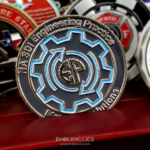
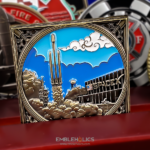
A QR code challenge coin carries a scannable code struck into the metal itself. This one was made for a foundation that funds treatment and research for veterans with post-traumatic stress, with the code engraved into the reverse over a basketball texture and sized so that a phone camera can still read it.
Putting a QR Code on Metal
This is the newest thing happening in coin design and the one most often done badly. A code either works or it does not, and there is no partial credit, so it is worth understanding what makes the difference before committing to a die.
Contrast is the whole problem. A phone camera reads a code by distinguishing dark modules from light ones. Metal reflects, and a code cut into bare polished metal can throw a highlight straight across itself under exactly the lighting someone is most likely to scan it in. The fix is to kill the reflection in one of the two tones: a matte fill, a darkened recess, or a colored enamel in the engraved cells against a lighter field.
Size has a floor, and the URL sets it. Each module of the code has to survive the strike as a distinct square. A code built from a long web address has more modules, which means either a physically larger code or modules too small to resolve. There is no way around that arithmetic.
So shorten the address before the artwork, not after. This is the single most useful thing on this page and almost nobody does it. Fewer characters means fewer and larger modules, which strike more cleanly and scan from further away and in worse light. It costs nothing and it is the difference between a code that works at arm’s length and one that needs three attempts.
The quiet zone is not optional. A code needs a clear margin around all four sides, and a scanner will fail without it. That means the code cannot be pushed out to the rim or crowded by lettering, and the surrounding design has to be planned around it.
A background texture can work, within limits. This coin runs a basketball texture beneath the code and stays scannable, which is only possible because the texture is low contrast relative to the code itself.
And the coin will outlive the link. This is the one that causes regret. Point the code at a domain the organization controls and can redirect, never at a campaign page, a third-party platform or a URL with a date in it. A coin with a dead QR code is worse than a coin without one, because it advertises neglect every time someone tries it.
A Code Over a Texture
The reverse of this coin carries a basketball texture, and the code is engraved over it with the texture still visible underneath.
That works because of how a camera sees the surface. A subtle repeating texture reads as a flat mid-tone to a scanner, so the dark modules of the code still separate cleanly from the light cells around them. The texture registers to the human eye and effectively disappears to the camera.
What would break it is a background with contrast of its own. An image with dark and light areas, a photograph, a gradient or a logo behind the code gives the scanner competing edges to resolve, and the read fails. The rule for a buyer is simple: a background behind a code has to be texture rather than imagery, and it has to be uniform across the entire area the code occupies, including the quiet zone.
An Embossed Logo on a Sports Field
The front carries the foundation’s logo, embossed and colored, over a textured background built from sports imagery including basketballs and golf balls.
The logo dominates because it is separated from its background three different ways at once. It is raised, so it catches light where the field does not. It is colored, where the field is not. And it is smooth, where the field is textured. Height, color and finish all pushing in the same direction is the most reliable way to make one element lead, and it is far more effective than simply making the logo bigger.
The two faces are designed for different reading distances, which is a neat piece of thinking worth pointing out. The front is built to be recognized across a room. The back is built to be read at arm’s length by a camera lens. One object, two viewing distances, and each face optimized for its own.
Coins That Raise Money
A code changes what a coin is for. Without one, a coin is a keepsake that someone puts in a pocket. With one, it is also a route to a donation page, a sign-up form or a story, and somebody handed one at an event can act on it before they have walked away.
That makes it a genuinely useful tool for a nonprofit, with three conditions:
Point the code somewhere worth arriving at. A homepage wastes the scan. A specific page that continues the conversation the coin started does not.
Make the destination work on a phone. It is the only device the link will ever be opened on, so a page that needs a desktop browser has failed before it loads.
Track the link. A coin is one of very few physical objects whose effect you can actually measure, and most organizations never set that up.
The foundation this coin was made for raises money for treatment programs and funds clinical research for veterans living with post-traumatic stress, working alongside established partners that provide treatment, job placement and family services. For other work in the same area, see another veterans foundation coin.
Order a Coin With a QR Code
Professional artwork is free with unlimited revisions, and nothing goes into production until you approve a digital proof. The challenge coin minimum is 50 pieces, standard production runs about 45 to 50 days after final artwork approval, rush production is available on many projects, and shipping within the continental United States is included. Embleholics is veteran-owned, SDVOSB and registered in SAM.gov.
Three things to bring if your coin carries a code. Send the shortest version of the address you can make. Use a domain you control, so the destination can be changed later without reissuing the coin. And ask for a physical proof, because a QR code is the one design element that either functions or does not, and a screen will not tell you which. See more organization challenge coins or request a free quote.
Frequently Asked Questions
Can you put a QR code on a challenge coin?
Yes, with three conditions. The code needs real contrast between its dark and light areas, which usually means a matte or darkened fill rather than bare polished metal. It needs to be physically large enough for every module to survive the strike. And it needs a clear quiet zone on all four sides.
Will an engraved QR code actually scan?
It will if the contrast is handled properly. A phone camera distinguishes dark modules from light ones, and polished metal can throw a highlight across the code that wipes out that distinction. Killing the reflection in one tone, with a matte fill or colored enamel in the engraved cells, is what makes an engraved code reliable.
How small can a QR code be on a coin?
There is no single figure, because the minimum is set by the complexity of the code rather than by the coin. Every module has to strike as a distinct square, so a code encoding a long address needs more modules and therefore more physical space than one encoding a short address.
Does the URL length affect the QR code?
Significantly, and this is the most useful thing to know. A longer address produces more modules, which means each module is smaller at the same code size and the whole thing becomes harder to scan. Shortening the address before the artwork is drawn is free and makes the code substantially more robust.
Can a QR code sit over a background image?
Over a texture, yes. Over an image, no. A subtle repeating texture reads as a flat mid-tone to a scanner and the code still resolves, which is how this coin works. A background with contrast of its own, such as a photograph or a gradient, gives the scanner competing edges and the read fails.
What happens if the link stops working?
The code keeps pointing at a dead page, permanently, because the metal cannot be changed. The way to avoid it is to point the code at a short address on a domain the organization controls, so the destination can be redirected later without reissuing the coin. Never use a campaign URL or a third-party link.
Should a QR code be colored or bare metal?
Colored or matte-filled is more reliable than bare metal. The code depends on clean separation between its dark and light areas, and a bare polished surface reflects light in a way that can erase that separation under ordinary indoor lighting. Filling the engraved cells gives the scanner something consistent to read.
Can a coin link to a donation page?
Yes, and it is one of the better uses for a code on a coin. Someone handed a coin at an event can scan and donate before they have left the room. Point it at a specific page rather than a homepage, make sure that page works properly on a phone, and track the link so you can see what the coins actually did.
More Corporate Projects