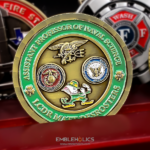
Two mascots, one per face, treated completely differently. The college side is engraved and filled with glossy paint across the whole image. The Navy side carries a skull in a peaked cap with color only on the hat and the rest of the metal left bare. This college football Roll Tide Challenge Coin was made for a Navy customer who wanted their service and their team on the same piece.
Service and Team on One Coin
Pairing a military identity with a sports allegiance is a more common request than it looks, and it works because the two are genuinely parallel.
Both are chosen loyalties people keep for life. Someone’s branch and someone’s team are two of the few affiliations that survive every change of job, city and circumstance. Putting them on the same object is accurate rather than arbitrary.
They are the two things people lead with. In a wardroom, a shop or a deployment, where you served and who you support are the conversation starters. A coin carrying both is a conversation in metal.
The service connection is often real. Plenty of people serve from a state where the university is the dominant institution, and plenty of service members are alumni. The pairing is usually a biography rather than a novelty.
And it is personal rather than official. No command issues a coin with a football team on it. This is a private piece, which means the register can be lighter than a unit coin’s.
See also Navy challenge coins.
Full Color Against Bare Metal
The strongest decision on this coin is treating the two faces in opposite ways, and it is worth copying for any design holding two unlike things.
It gives each face its own register. A team mascot belongs in bright glossy color, because that is how sports identity works. A military mascot in bare engraved metal reads as institutional and serious. Making both the same would have flattened the difference.
The single colored element is the hinge. Color only on the hat means the Navy side is not entirely monochrome, so the two faces share a thread without matching. One accent is enough to connect them.
It establishes a front without ranking the subjects. The painted face reads as the front by being louder, while the bare face reads as the more considered one. Neither is subordinate.
And it halves the paint. Dropping color from most of one side is a real reduction in finishing work, which matters on any run.
See 2D vs 3D challenge coins and enamel and finish options.
Skull Mascots in Military Design
A skull in a service cap is a long standing piece of military visual shorthand, and it behaves differently from a civilian mascot.
The skull is not decoration here. Military units have used it for generations as a plain acknowledgment of what the work can involve, and putting a service cap on it specifies the branch while keeping the register dark. It is understood instantly by anyone who has served and frequently misread by anyone who has not.
For a coin it has practical advantages. A skull is one of the most legible forms at small scale, because the eye recognizes the shape from very little information. It needs almost no detail to read, which is the opposite of most mascots.
The design restraint that makes it work on this coin is leaving it unpainted. A skull in bare metal is understated. The same skull in full color would tip into novelty, which would have put both faces in the same register and lost the contrast the design is built on.
Collegiate Marks and Licensing
This has to be said directly, because it is the single most important thing to understand about a coin like this.
University names, nicknames, mascots, logos and slogans are protected trademarks, and collegiate licensing is among the most actively enforced areas of trademark law in the United States. Most universities administer their marks through a licensing agency, and the use of a team mascot or a school slogan on a manufactured product normally requires a license, even in small quantities and even when the piece is not being sold.
Three practical points for anyone considering a coin like this.
A personal piece is not automatically exempt. The common assumption is that a small private run for one person’s own use is fine. That is not a reliable position, and it is worth checking rather than assuming.
The licensing route is usually straightforward to ask about. Universities and their licensing agencies publish contacts, and the answer to a direct question arrives faster than most people expect.
An unofficial design avoids the question entirely. A coin in a school’s colors, referencing a state or a region rather than a protected mark, carries the same meaning for the person holding it with none of the exposure. For most individual buyers this is the better route.
Embleholics manufactures from artwork a customer supplies and does not hold or grant collegiate licenses.
Order a Personal or Service Coin
Professional artwork is free with unlimited revisions, and nothing goes into production until you approve a digital proof. The challenge coin minimum is 50 pieces, standard production runs about 45 to 50 days after final artwork approval, rush production is available on many projects, and shipping within the continental United States is included. Embleholics is veteran-owned, SDVOSB and registered in SAM.gov.
Two suggestions. If a design uses a university’s mascot, nickname or slogan, settle the licensing question before artwork, and consider an unofficial design in the school’s colors instead, which carries the same meaning with none of the exposure. And if a coin holds two unlike subjects, treat the two faces differently rather than matching them, because the contrast is what makes the pairing read as deliberate. Request a free quote to begin.
Frequently Asked Questions
Can a challenge coin carry both a military and a sports identity?
Yes, and it is a common request. Branch and team are two of the few affiliations people keep for life, so putting them on one object reflects something real rather than being a novelty.
How do you handle two unlike subjects on one coin?
Treat the faces differently. Matching them flattens the difference, where opposite treatments let each subject sit in its own register and makes the pairing look deliberate.
What does a single accent color do?
It connects two otherwise unlike faces. One colored element on an otherwise bare side gives the two sides a shared thread without making them match.
Why leave a skull unpainted?
Because bare metal keeps it understated. The same skull in full color reads as novelty, which would put both faces in the same register and lose the contrast the design depends on.
Why does a skull work at small scale?
The eye recognizes the shape from very little information, so it stays legible with almost no detail. Most mascots need far more surface to read.
Do you need a license to put a college mascot on a coin?
Normally yes. University names, nicknames, mascots and slogans are protected trademarks, usually administered through a licensing agency, and collegiate marks are actively enforced.
Does a small personal run avoid the licensing question?
Not reliably. The assumption that a small private order is exempt is common and is not a safe position, so it is worth asking rather than assuming.
What is the alternative to a licensed design?
An unofficial piece using the school’s colors and a regional or state reference rather than a protected mark. It carries the same meaning for the owner with none of the exposure.
More Navy Projects