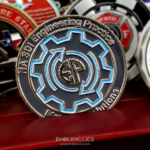
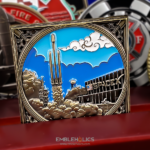
This coin is given as a merit prize. The base is a brushed brass colored metal, the organization’s logo is engraved on each face, the sculpted graphic designs are painted, and inscriptions are machined around the edge. It was made for the International Order of the Rainbow for Girls.
A Coin Given for Merit
A merit award coin is a specific thing, and it differs from both a membership coin and a presentation coin.
It is earned, not issued. Which means it has to feel like a prize. A coin everybody gets can be modest; a coin a few people get has to justify the distinction, and that usually comes from the quality of the object rather than from anything printed on it.
It represents the standard, not the recipient. The same coin goes to every member who meets the criteria, across years. So no names, no dates, no individual detail. The design has to be correct for whoever earns it next.
And the recipient is likely to be young. That is the part worth thinking about. For an adult a coin is one object among many. For an eleven or fifteen year old receiving a solid metal award for something they worked at, it may well be the first thing of its kind they have ever been given. That argues for substance over novelty: a well finished piece with real weight rather than a bright gimmick.
The quantity math suits it, too. A 50 piece minimum covers several years of merit awards for most local groups, which means one order and no reorder decision for a long time. All the more reason the design should carry nothing that will date.
See also academy graduation challenge coins and organization challenge coins.
Brushed Brass With Painted Sculpture
The combination here, a brushed brass base with sculpted elements picked out in paint, is a good default for an award piece and worth understanding.
Brushed brass reads as substantial. A warm metal with a soft directional texture looks like a traditional award rather than like merchandise. It also hides fingerprints and handling marks, which matters on an object that will be passed around and shown to people.
Painting only the sculpted areas gives the color a job. The paint sits in the relief, so it follows the form rather than sitting on a flat field. The result is that the color describes shape, which is a more sophisticated effect than filling flat cells.
And it ages well. A brushed finish softens with handling in a way most people find improves it, and paint protected within recesses lasts far longer than paint on raised surfaces.
The organization is known for its colors, and the paint is what carries that. Restricting it to the sculpted designs rather than flooding the faces means the coin is colorful without becoming a toy, which is the balance an award for young people has to strike.
See finish and plating options.
Inscriptions Machined Around the Edge
The edge of this coin carries machined inscriptions, which is an underused option and a smart one here.
Most coins treat the edge as a finish: smooth, reeded, diamond cut or rope. Putting text there instead turns it into a third surface with content on it.
It frees up the faces. Text on the edge is text not competing with the artwork. On a coin where both faces carry the logo and sculpted designs, there was no spare room on either, and the edge solved it.
It rewards handling. Edge text cannot be read at a glance. You have to pick the coin up and turn it, which is a small discovery and exactly the kind of detail that makes an object feel considered.
But it has to be short. The edge is a narrow band and a long run, so letter height is tightly constrained. A motto or an organization name fits; a sentence does not.
And it should be shallow and even. Edge text is cut into the thinnest part of the coin, so depth is limited. It reads by shadow, which means it works best on a brushed or matte surface rather than a polished one.
About the Organization
The International Order of the Rainbow for Girls is a Masonic youth service organization that teaches leadership through community service to members aged 11 to 20. Members take an oath to respect their parents, be involved in their church, be true friends, be patriotic and serve others, and the organization states that it welcomes everyone regardless of race, creed, color or national origin.
A youth organization within a larger fraternal structure has the same two-level shape that makes a two sided coin work well, and the same permissions consideration: emblems are generally governed by the parent body rather than by a local assembly. Clear the use through your own officers and your supreme or grand body before ordering.
See also masonic challenge coins and a state shaped challenge coin.
Order a Merit or Award Coin
Professional artwork is free with unlimited revisions, and nothing goes into production until you approve a digital proof. The challenge coin minimum is 50 pieces, standard production runs about 45 to 50 days after final artwork approval, rush production is available on many projects, and shipping within the continental United States is included. Embleholics is veteran-owned, SDVOSB and registered in SAM.gov.
Two suggestions. Leave names and dates off a merit coin, because the same award goes to different people over several years and a 50 piece order will cover many of them; a design with nothing time-specific on it never needs replacing. And if both faces are full, ask about edge inscriptions rather than squeezing text onto a face, since the edge is a surface most coins leave empty. Request a free quote to begin.
Frequently Asked Questions
What is a youth organization challenge coin?
It is a coin made for a youth group or service organization, often given as a merit or achievement award rather than issued to every member. The design carries the organization’s emblem and no individual detail, so it suits whoever earns it next.
How is a merit coin different from a membership coin?
A merit coin is earned by a few rather than issued to all, so it has to justify the distinction. That usually comes from the quality of the object, a substantial finish and real weight, rather than from anything printed on it.
Should a merit coin carry the recipient’s name?
No. The same award goes to different people across years, so a name or date forces a new die each time. A 50 piece order will cover many presentations if the design stays general.
Does it matter that the recipients are young?
It is worth considering. For a young person a solid metal award may be the first thing of its kind they have received, which argues for substance over novelty: a well finished piece with weight rather than a bright gimmick.
Why paint only the sculpted areas?
Because paint sitting in relief follows the form rather than filling a flat cell, so the color describes shape. It also lasts longer, since paint protected within a recess wears far more slowly than paint on a raised surface.
Can inscriptions go on the edge of a coin?
Yes, and it frees the faces for artwork. The constraint is length: the edge is a narrow band, so letter height is tightly limited. A motto or an organization name fits, a sentence does not.
Is edge text easy to read?
Not at a glance, which is part of its appeal. It reads by shadow rather than color, so it works best on a brushed or matte surface, and you have to pick the coin up and turn it to find it.
Do we need permission for a youth order’s emblem?
Generally the parent body governs the emblem and licenses it to local groups under its own rules, so clear the use through your officers and your supreme or grand body before ordering. We produce from artwork the customer is authorized to supply.
More Corporate Projects