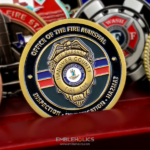
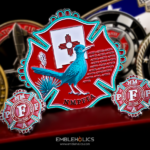
The base is left as uncoated metal, with no plating over it. The department’s logo is engraved into the front and the Quinault Indian Nation’s logo into the back, with both engraved areas filled using solid glossy paints. This Quinault fire department coin was made to reflect the culture and spirit of the Quinault people through its graphics and symbols.
Tribal Fire Departments
A tribal fire department is both a fire service and a department of a sovereign government, and a coin for one has to hold both.
It serves a nation, not a municipality. The department answers to tribal government rather than a city council, which is why the nation’s own emblem belongs on the coin alongside the department’s.
Coverage areas are often remote. Tribal lands frequently sit far from the nearest mutual aid partner, which means a department operates with longer response times, fewer resources and more self reliance than an equivalent suburban service.
The crews are usually from the community. Firefighters serving their own nation are protecting people they are related to, in a place their family has lived for generations. That is a different relationship from a city department’s.
And the department represents the nation externally. Mutual aid, state coordination and federal programs all put a tribal department in contact with other governments, which creates exactly the exchange situations coins exist for.
See also fire department challenge coins and a Native American challenge coin.
Reproducing a Tribal Emblem
This is the part that deserves the most care on a coin like this, and it is worth being direct.
The emblem is not a logo to be restyled. Elements in a tribal emblem frequently reference specific clans, animals, waters or histories. Simplifying a form because it would strike more easily can change what it means, so the question to ask is what can and cannot be altered rather than deciding on technical grounds alone.
The artwork has to come from the nation. An emblem redrawn from a photograph or a website image will be subtly wrong in its proportions, and the people receiving the coin see that emblem every working day. Approved files are the only reliable source.
Regional design traditions have their own rules. Northwest Coast design in particular uses specific line conventions, and a designer unfamiliar with them can produce something that matches the file technically and reads wrong to anyone who knows the form.
And the proof should be reviewed by someone who knows the tradition. Approving a layout is not the same as approving the rendering of a cultural form. Those are two different checks.
Authorization sits with the nation. Sovereign insignia work the same way abroad; see our Foreign Military Coin for the Jamaica Regiment. Embleholics produces from the artwork a customer supplies and does not grant permission on any government’s behalf.
See also a tribal government challenge coin.
Leaving the Base Metal Uncoated
Skipping plating entirely is an unusual choice and it produces a specific character.
The metal is itself. Plating applies a different metal over the base, which is how a coin becomes gold or chrome. Leaving it uncoated means the color is the actual alloy, which reads as honest and unfussy rather than finished.
It ages. Uncoated metal darkens and takes on a patina with handling, while plating stays as it was until it wears through. One of those improves and the other degrades.
And it lets the color fills carry everything. With a neutral uncoated base, the glossy paint in the engraved areas is the only color on the coin, so the emblems read without competition from a bright plating.
The trade-off worth knowing is that uncoated metal is less protected. Plating is a barrier as well as a color, so a bare coin is more exposed to tarnish and marking over time. Whether that reads as character or as wear depends on the piece, and on a coin in this register it reads as character.
See antique vs polished finishes.
Color Filled Engraving
Filling engraved recesses with solid glossy paint is a different technique from painting a raised surface, and it is the more durable of the two.
When color sits in a recess, the surrounding metal is higher than the paint. That means the metal takes the abrasion and the color is protected below the contact surface. Paint applied to a raised element has nothing shielding it and wears at the edges first.
Gloss is the right choice within that. A glossy fill sitting in a recess below a matte uncoated field creates two kinds of contrast at once, color against metal and shine against matte, which makes the emblems read strongly without needing more colors.
The execution point is fill level. Paint that sits too low looks sunken and collects dirt, and paint that overflows the recess loses the clean boundary the engraving created. Even fill to just below the surface is what makes the technique work, and it is a proof stage check.
Order a Tribal or Fire Department Coin
Professional artwork is free with unlimited revisions, and nothing goes into production until you approve a digital proof. The challenge coin minimum is 50 pieces, standard production runs about 45 to 50 days after final artwork approval, rush production is available on many projects, and shipping within the continental United States is included. Embleholics is veteran-owned, SDVOSB and registered in SAM.gov.
Two suggestions. Supply the nation’s approved artwork files rather than an image taken from a website, and ask what in the emblem may not be altered before any simplification is proposed. And have someone who knows the design tradition review the physical proof, not just the layout, since approving a composition is a different check from approving how a cultural form has been rendered. Request a free quote to begin.
Frequently Asked Questions
What goes on a tribal fire department coin?
Usually both the department’s logo and the nation’s emblem, because the department is a service of a sovereign government rather than a municipal agency.
How should a tribal emblem be handled on a coin?
As a cultural form rather than a logo. Elements often reference specific clans, animals or histories, so simplifying a shape for manufacturing reasons can change its meaning.
Where should the artwork come from?
The nation itself. An emblem redrawn from a photograph or website image will be subtly wrong in proportion, and the people receiving the coin see that emblem every day.
Who should review the proof?
Someone who knows the design tradition, in addition to whoever approves the layout. Approving a composition and approving the rendering of a cultural form are two different checks.
Why leave a coin’s base metal uncoated?
The color becomes the actual alloy rather than an applied plating, which reads as unfussy, and the metal develops a patina with handling instead of wearing through a surface layer.
What is the drawback of no plating?
Less protection. Plating is a barrier as well as a color, so uncoated metal is more exposed to tarnish and marking, which reads as character on some pieces and as wear on others.
Why fill engraved recesses with color rather than paint raised areas?
Durability. Color in a recess sits below the contact surface, so the surrounding metal takes the abrasion. Paint on a raised element has nothing shielding it and wears at the edges.
What should be checked on a color filled coin?
Fill level. Paint sitting too low looks sunken and traps dirt, while paint overflowing the recess loses the clean boundary the engraving created.
More Firefighters Projects