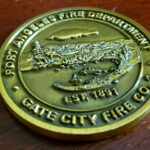
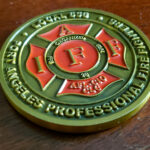
A single color challenge coin uses one applied color against bare metal. The Port Angeles Fire Department asked for a classic, timeless coin and got brushed dark brass with a raised view of the city on one face, a firefighter emblem on the other, and one red-orange accent.
One Color Does More Than Six
The department asked for a classic challenge coin design in one color. A single color challenge coin suits that request for four reasons:
- Every color is a decision. One accent against metal tells the eye where to look. With six, the eye has no clear place to start.
- Color competes with relief. Relief is the raised, sculpted part of the metal. It shows through light and shadow. Enamel (colored fill set into recessed areas) can flatten that detail.
- Each color adds a step. Each color needs its own recessed area (a cell) and adds another edge where two colors meet. Each edge is a spot where a small flaw can show.
- Color can date a design. Palette choices tend to look tied to their era. Bare metal usually doesn’t, which fits a department that asked for a timeless coin.
Here, the one color is a red-orange enamel on the firefighter emblem. The city face has no enamel at all.
A one color challenge coin is quieter. Set among brightly enameled coins, it may not draw the eye from across a table. If the coin’s job is to get noticed by strangers, more color is usually the better choice. If members will keep it, one color suits.
Brushed Dark Brass
A brushed finish challenge coin has fine lines running in one direction across the metal. The texture scatters light, so the coin tends to glare less. Fingerprints tend to be less visible, and small handling marks may blend into the grain.
A dark brass coin tends to look older than a nickel or bright gold coin. That suits a department whose history reaches back to 1891.
For other textures and metal colors, see our finish and plating options. Plating is the thin metal coating that gives a coin its base color.
Putting the City on the Coin
Fire departments across the country share a visual vocabulary: the Maltese cross, the helmet, the axes and the hydrant. A coin built only from those can look much like any other.
This coin uses the place. The front shows mountains rising behind a town, with a harbor, a vessel and a long spit of land reaching into the water below. Lettering around the rim names the department, which ties the Port Angeles Fire Department coin to one place.
On a city skyline challenge coin, relief gives depth and a horizon that catches light. A literal skyline with every rooftop can turn to visual noise at coin size, so the design usually simplifies the scene to the two or three shapes that identify the place. Here, the mountains, harbor and spit of land do that job. Our guide on what to put on a fire department challenge coin has more ideas.
A department’s patch or badge usually belongs to its city, so confirm approval with your chief or city before the artwork is final. We work from artwork you’re authorized to supply, and we can design around your department’s place and history without any official mark.
Gate City Fire Company Number 1
Port Angeles sits in Clallam County on the Olympic Peninsula. Its fire department began in February 1891 as Gate City Fire Company Number 1. The lettering on the coin reads GATE CITY FIRE CO. 1 and EST. 1891.
A founding date or original company name often makes strong lettering for a department coin. Today, the department offers station tours and puts fire prevention education at the center of its work.
You can see another Washington fire department coin in our gallery.
Order Coins for Your Department
Tell us whether the coin is for your crews or for the public, since that decides how much color it wants. Send your founding date and original company name too if you have them. Artwork is free, and you can revise it as often as you like. A digital proof comes before production.
We make firefighter challenge coins for departments and associations. The minimum is 50 coins. Shipping within the continental US is free, and rush production is available. We’re veteran-owned and registered in SAM.gov (the federal government’s vendor registration system) as a service-disabled veteran-owned small business (SDVOSB).
Request a free quote to get started.
Finished Coin (Front)
Finished Coin (Back)
Frequently Asked Questions
What is a single color challenge coin?
A single color challenge coin has one applied color, with bare metal making up the rest of the design. The color points to the one element you want seen first, and the raised metal does the rest.
Does using fewer colors make a coin cheaper?
Usually yes, because each color adds a production step. The saving is often smaller than expected, since the die cost (the one-time cost of making the steel mold that strikes the design) stays the same. Send your artwork and color plan for a quote.
Is one color enough for a fire department coin?
It can be, especially when members will keep the coin. One accent against metal gives a classic look. If the coin’s job is to catch the eye of strangers at an event, adding color is usually the better choice.
What is a brushed finish on a challenge coin?
A brushed finish is a pattern of fine parallel lines worked into the metal. It diffuses light, so glare is reduced, and small scuffs tend to blend into the grain.
Can you put a city skyline on a challenge coin?
Yes, as raised relief or engraving. Simplifying helps, since a detailed skyline can turn to visual noise at coin size. Choose a few shapes that identify the place, such as a mountain line or a harbor.
What should go on a fire department coin besides the emblem?
A view of your city, a founding date or an original company name can all work. Each makes the coin specific to your department. Our guide on what to put on a fire department challenge coin has more ideas.
Will a brushed coin show fingerprints?
Usually less than a polished coin does. The fine texture breaks up reflections, so fingerprints tend to be harder to see than on a mirror finish.
How many colors can a challenge coin have?
The number is flexible. Each color you add means another production step and another edge where colors meet, so many designs look best with fewer. Tell us the palette you have in mind and we’ll advise.
More Firefighters Projects