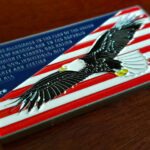
The coin is rectangular, shaped to the proportions of the Star Spangled Banner itself. It carries the Pledge of Allegiance as an inscription and a bald eagle as its other element. The design went through several layout options before the client chose one.
A Rectangle in Flag Proportions
Cutting a coin to flag proportions rather than making it round is a small decision that solves a specific problem.
A flag is a rectangle, so a rectangular coin is the flag. On a round coin a flag has to be cropped into a circle, drawn as a waving form, or set inside a frame. A coin cut to the right proportions is the shape itself, which means the outline is doing the identifying before any artwork is read.
It also suits a long inscription. This is the practical payoff. Text on a straight baseline does not distort, so it can be set smaller and still read than the same words curved around a rim. A rectangle gives you several straight lines stacked down the face, which is the only format in which a passage of any length works comfortably.
And it reads as a document rather than a token. For a coin whose content is a text, that is the correct register. A rectangle looks like something written; a disc looks like something minted.
Two production notes on any rectangle. The corners want a slight radius so they do not catch in a pocket or chip at the tips. And no standard capsule or display rack fits a rectangle, so packaging has to be specified separately. See custom shaped challenge coins.
Fitting a Full Passage of Text
The Pledge is 31 words, which is a substantial block for a coin, and the rules that govern it apply to any text coin.
Letter height decides everything, not word count. Fix the smallest readable letter height first and then see how many words fit, rather than fitting the words and discovering the size. A rectangle gives you more usable line length than a circle, which is why this passage works here and would not on a disc.
Line spacing matters more than on paper. Relief casts shadow in both directions, so tightly set lines of small type start to merge visually. Opening the leading is the single most effective fix when a block of text is not reading.
Typeface weight has to go up. Light faces and finely serifed ones lose their thin strokes first. A medium weight sans serif, or a serif with even stroke thickness, holds far better at small sizes.
And engraving beats embossing for density. Recessed lettering sits in a protected channel and keeps its edges, where raised lettering at the same size wears at the high points from pocket carry.
A dark fill in the recesses doubles the legibility. Bare engraved text relies on shadow alone, which is subtle. Filling the channels with a dark paint is worth doing on any coin whose text is the point.
See an engraved text challenge coin.
Public Domain Text, Which Simplifies Things
This is worth stating plainly, because it is the question that stops most text coins.
The Pledge of Allegiance was written in August 1892 by Francis Bellamy and first published in The Youth’s Companion on 8 September 1892. It is long out of copyright, which means anyone can reproduce it on anything without seeking permission.
That is not true of every passage people want on a coin. Prayers, creeds and poems written in the last century frequently have a named author and may still be protected, and the rules on selling an item carrying protected text are stricter than on giving one away. The practical advice for any text coin is to establish the authorship and the date before artwork begins, because that is a question better answered before a die is cut than after.
Other reliably public domain options include the national anthem, the Gettysburg Address, the preamble to the Constitution and the Bill of Rights. We produce from the text a customer supplies and we do not verify permissions on a customer’s behalf.
A Bald Eagle as the Other Element
An eagle is the standard companion to a patriotic inscription and a sound coin subject.
The head in profile is almost all silhouette: a hooked beak, a flat brow and a defined crown, which are large shapes that survive reduction. Feather detail is the part that disappears, so the working approach is to render feathers as a small number of directional strokes at the edges of the form and leave the interior smooth.
A head in profile generally reads better than a full bird at coin size, because a spread-winged eagle has thin primary feathers at the wingtips that soften into a blur, where a head has nothing fine in it at all.
See also a thank you for your service coin, which uses the same symbol set.
Why People Order These
A coin carrying a well known passage is not a unit coin. It is ordered because the words matter to the person giving it, and the point is to put them in a form somebody can keep.
That shapes two decisions. It should carry no dates, names or organizational marks, because it is given one at a time over years and anything specific shortens its life. And the quantity should be generous rather than tight, since a 50 piece order of an undated design will last as long as you keep giving them out.
See more commemorative challenge coins.
Order a Text Based Coin
Professional artwork is free with unlimited revisions, and nothing goes into production until you approve a digital proof. The challenge coin minimum is 50 pieces, standard production runs about 45 to 50 days after final artwork approval, rush production is available on many projects, and shipping within the continental United States is included. Embleholics is veteran-owned, SDVOSB and registered in SAM.gov.
Two things worth doing. Send the exact wording you want, since versions of well known passages vary and the one people expect is the one they grew up with. And look at the proof at actual coin size rather than enlarged on a screen, because small type is exactly where the difference between a design that works and one that does not shows up. Request a free quote to begin.
Frequently Asked Questions
What is a flag shaped challenge coin?
It is a coin cut to the rectangular proportions of a flag rather than struck as a disc. The outline identifies the piece before any artwork is read, and the straight edges suit a long inscription.
Why is a rectangle better for text than a circle?
Because text on a straight baseline does not distort, so it can be set smaller and still read than the same words curved around a rim. A rectangle also gives you several straight lines stacked down the face.
Can the whole Pledge of Allegiance fit on a coin?
Yes, at 31 words, on a rectangular coin. Fix the smallest readable letter height first and then check the word count, since a rectangle gives more usable line length than a disc of the same area.
Should a long inscription be engraved or raised?
Engraved, and with a dark fill in the channels. Recessed lettering sits in a protected channel and keeps its edges, where raised lettering wears at the high points, and a dark fill roughly doubles the legibility over bare engraving.
Is the Pledge of Allegiance copyrighted?
No. It was written by Francis Bellamy in 1892 and first published that September, so it is long out of copyright and can be reproduced without permission.
What about other prayers, creeds and poems?
Many are protected. Passages written in the last century frequently have a named author and may still be in copyright, with stricter rules on selling an item that carries them than on giving one away. Establish authorship and date before artwork begins.
Which patriotic texts are definitely free to use?
The national anthem, the Gettysburg Address, the preamble to the Constitution and the Bill of Rights are all long in the public domain, alongside the Pledge.
How should an eagle be drawn on a coin?
As a head in profile rather than a full bird. The beak, brow and crown are large shapes that survive reduction, where a spread-winged eagle has thin primary feathers at the wingtips that soften into a blur.
More Veterans Projects