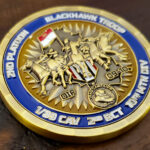
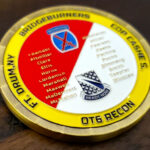
Operation Iraqi Freedom ran from 2003 to 2010, which means almost every OIF coin ordered now is made long after the deployment it marks. That changes what the coin is. It is no longer a closeout piece handed out as a unit comes home, it is a record, usually ordered by a unit association, a reunion group or individual veterans. This one carries a sculpted cavalry trooper on the front and the soldiers’ names engraved on the reverse.
A Coin Made After the Deployment
A deployment coin produced at the time and one produced fifteen years later are different objects, and the later one is in several ways easier to get right.
- The roster is final. A coin made during or at the end of a deployment is often ordered before everyone is accounted for, with people still attached, detached or in transit. A retrospective coin has a settled list.
- The facts are checkable, and they will be checked. Veterans know their own dates, designations and locations, and they will notice an error on a coin about their own deployment faster than anyone else would.
- The recipients are civilians now. The coin goes into a house, not a wall locker, and it will be shown to family and to people who were not there.
- It is funded privately. Association dues, a reunion committee or individuals, not a unit budget, which makes the quantity and the price more sensitive than a serving unit’s order.
For the version made at the time instead, see an end of deployment coin, and for more recent operations see an Operation Inherent Resolve coin and an Operation Freedom’s Sentinel coin.
Names on the Reverse
The reverse of this coin carries the soldiers’ names, which is what makes it a record rather than a souvenir, and it brings three decisions with it.
The names set the size. A name cannot be shortened or left out, so the length of the longest name and the number of them decide the type size, and the type size decides the diameter. Expect a roster coin to be larger than a standard one.
Settle the order in advance. Alphabetical, by rank, or by platoon or section. This belongs to the group, not to the manufacturer, and it is far easier to change on a proof than after a strike.
Decide how to mark anyone who did not come home. Groups handle this in different ways, and there is no single convention: some set those names apart, some add a device beside them, some keep the list uniform deliberately. It is a decision for the people ordering the coin and it should be made before artwork rather than raised at the proof stage.
Engrave the lettering rather than raising it. Cut letters keep crisper edges at the small sizes a long list forces, and they read more clearly against a struck surface.
Cavalry Imagery on a Unit That Never Rode
The front of the coin is a sculpted cavalry trooper, and modern cavalry units operate armoured and aviation platforms rather than horses. That is not a mistake, and understanding why is useful for anyone designing a unit coin.
Branch imagery honours the branch, not the equipment. Cavalry units keep the horse, the sabre, the Stetson and the spurs because those belong to the cavalry as an institution, in the same way the infantry keeps crossed muskets nobody has fired in a century. The imagery is a statement about identity and tradition, and it is correct precisely because it is anachronistic.
Two things follow for a coin. Branch imagery ages extremely well, because it was already old when you put it on, so a cavalry trooper will look right on a coin in thirty years when a drawing of current equipment will not. And it sculpts beautifully: a mounted figure is a solid three-dimensional subject with real depth, which is what high relief is for, where a modern vehicle tends to flatten into a silhouette at coin size.
What the 89th Cavalry Actually Is
The current page gets this tangled, and the real lineage is better than the garbled version.
The unit was constituted on 1 June 1940 in the Regular Army as the 10th Antitank Battalion, and became the 899th Tank Destroyer Battalion in December 1941. As the 899th it landed at Utah Beach in the Normandy invasion and fought through France, Belgium and Germany, including the Ardennes, and reached the Mulde River in April 1945. Two of its soldiers received the Medal of Honor.
It was designated the 89th Cavalry Regiment on 30 March 2004, with squadrons serving in the 10th Mountain Division, and the 1st Squadron deployed to Iraq in 2006 and again in 2009. The regiment was inactivated in June 2024.
Two things in that are worth putting on the page. The cavalry designation is younger than the war the coin commemorates, since OIF began in March 2003 and the unit became cavalry a year later. And the unit’s deepest combat heritage is not cavalry at all, it is a tank destroyer battalion at Utah Beach. A coin for this regiment has two completely separate histories available to it, and that is a choice worth making deliberately rather than by default. For how to handle that kind of split lineage, see the 48th Infantry coin.
The inactivation also matters commercially: with the regiment inactivated, any coin for it is now a veterans’ and association piece rather than a serving unit’s, which is exactly the retrospective case this page describes.
Getting the Dates and Designations Right
On a retrospective coin this is the whole job, because the audience is the people who were there.
Check four things before the proof is approved. The operation name and the dates it actually covered, since Operation Iraqi Freedom ended in 2010 and later Iraq operations carried different names. The unit’s designation at the time of the deployment rather than its current or final one. The campaign or tour dates as the group remembers them. And the spelling of every name.
A coin with one wrong detail on it becomes the thing people talk about instead of the thing it was meant to mark. Send us what you want on it and we will put it on a proof, but the facts belong to the group that lived them.
Order a Deployment or Reunion Coin
Send your unit insignia, the operation and dates, and the roster if the coin is carrying names. Tell us whether you want the unit’s branch imagery or its historical lineage on the front, because those may be two different things.
Professional artwork is free with unlimited revisions, the minimum order is 50 coins, and nothing goes into production until you approve a digital proof. Standard production runs about 45 to 50 days after final artwork approval, rush production is available on many projects, and shipping within the continental United States is included. Embleholics is veteran-owned, SDVOSB and registered in SAM.gov. See veteran coins, a cavalry squadron coin, or more Army challenge coins.
Finished Coin (Front)
Finished Coin (Back)
Frequently Asked Questions
What is an OIF challenge coin?
An OIF challenge coin marks service in Operation Iraqi Freedom, the US-led operation in Iraq that ran from 2003 to 2010. OEF, Operation Enduring Freedom, is the equivalent for Afghanistan. Because both operations have ended, coins for them are now usually ordered retrospectively by unit associations, reunion groups or individual veterans.
How is a retrospective deployment coin different from one made at the time?
The roster is final rather than provisional, the facts are settled and will be checked by the people who were there, the recipients are civilians, and it is funded privately rather than from a unit budget. A coin made at the end of a deployment is often ordered before everyone is accounted for, which a later one avoids.
Can soldiers’ names be engraved on a challenge coin?
Yes, and it is what turns a coin into a record. Because a name cannot be shortened or omitted, the number of names and the longest of them set the type size and therefore the coin’s diameter, so a roster coin is normally larger than a standard one. Engrave the lettering rather than raising it, since cut letters stay crisper at small sizes.
How should names of those who did not return be handled on a coin?
There is no single convention. Some groups set those names apart, some add a device beside them, and some keep the list uniform as a deliberate choice. It is a decision for the people ordering the coin, and it should be settled before artwork begins rather than raised when a proof arrives.
Why do cavalry units use horses and sabres when they operate vehicles?
Because branch imagery honours the branch rather than the equipment, in the same way the infantry keeps crossed muskets. It also has two practical advantages on a coin: it does not date, since it was already historical when you used it, and a mounted figure is a solid three-dimensional subject that sculpts well in high relief, where modern vehicles tend to flatten into silhouettes at coin size.
What is the lineage of the 89th Cavalry Regiment?
It was constituted on 1 June 1940 as the 10th Antitank Battalion and became the 899th Tank Destroyer Battalion in December 1941, landing at Utah Beach in the Normandy invasion and fighting through France, Belgium and Germany. It was designated the 89th Cavalry Regiment on 30 March 2004, with squadrons in the 10th Mountain Division, deployed to Iraq in 2006 and 2009, and was inactivated in June 2024.
Should a coin use a unit’s current designation or its historical one?
On a deployment coin, use the designation the unit carried at the time of that deployment, since that is what the people receiving it served under. Where a unit has an older and deeper lineage under a different name, that is a separate design option worth considering deliberately rather than defaulting to whichever name is most recent.
When did Operation Iraqi Freedom end?
Operation Iraqi Freedom ran from 2003 to 2010. Later US operations in Iraq carried different names, so a coin marking a deployment after 2010 should use the correct operation name for the period rather than OIF.
More Army Projects