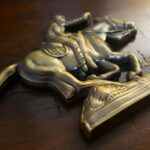
This coin is cut to the outline of a soldier on horseback, with the relief milled across its whole surface, so the piece is a small sculpture rather than a disc with a picture struck into it. The front is left as bare polished brass and the reverse carries the lettering.
A Sculpture, Not a Coin With a Picture On It
Three terms get used interchangeably and they mean different things. Getting them straight is the useful part of this page.
A shaped coin is cut to an outline. The profile is something other than a circle, but the faces inside that profile may be flat or lightly struck like any other coin.
A sculpted coin has contoured relief across its surface. The depth varies continuously rather than sitting at two or three fixed levels, so forms have actual curvature. The coin can still be round.
This piece is both at once, which is a third thing and much less common. There is no round coin underneath with a horse on it. The coin is the horse and rider. For another rider cut into a coin’s outline, see our FLELOGSUPPRON Four Zero Challenge Coin, shaped around a cowboy on horseback.
What makes the combination possible is machine milling. A computer-controlled mill cuts a three-dimensional master directly from the artwork, with depth varying continuously across the whole surface. A conventional die carries relief at a small number of levels, which is enough for a crest and not enough for a flank, a shoulder and a foreleg that all need to curve differently.
Bare metal is the right finish for a sculpture, and this is the part people get wrong. Color fills recesses, and recesses are where a sculpted surface keeps its shadows. Enamel over contoured relief flattens the thing the relief was for. Leaving the front unpainted and polished means the form is read entirely through light, which is how sculpture has always worked.
There are honest limits. A fully sculpted face has nowhere comfortable to put text. A polished bare surface marks, so it needs a protective coating. And a complex outline is fragile at its thin points. It also costs more than a struck coin, for real reasons rather than as a premium: more tooling, more operations and an extra finishing stage. See custom shaped challenge coins and 2D and 3D coins compared for where each approach fits.
One Face an Object, One Face Information
This coin splits the work cleanly. The front is sculpted bare brass. The reverse is painted across most of its surface and carries the small inscriptions and lettering.
If one face is sculptural, the other face has to carry the words. That is close to a rule. Lettering set across a contoured surface bends over the relief and stops being readable, because the baseline is physically no longer straight. Trying to fit a unit designation around a sculpted figure produces text that follows the landscape instead of the line.
So the sculpture gets a clean face and everything else goes on the back. It sounds obvious and it is routinely got wrong, usually because the customer wants the designation on the side with the picture.
Painting the flat reverse gives the back a completely different character from the front, which is the intention rather than an accident. The two faces should still share something, though, or the coin reads as two unrelated objects stuck together. Usually that is the border treatment or the typography.
What a Cavalry Scout Does
A cavalry scout performs reconnaissance. The job is to find the enemy, observe and report, rather than to close with them, and scouts operate forward of the main force where that information is gathered.
The modern scout works from vehicles, but the role and all of its imagery descend directly from horse cavalry, which is why the branch has kept its old devices. A mounted figure on a coin for a unit that has not ridden horses in a century is not nostalgia, it is lineage.
This coin was made for the 2nd Squadron, 15th Cavalry Regiment, a training squadron whose stated mission is turning civilian volunteers into disciplined, competent and committed scouts. The 15th Cavalry Regiment was formed in 1901 at the Presidio of San Francisco.
For a formation-level piece from the same branch, see a cavalry brigade coin.
Polished, Coated and Bare
The front is bare brass, polished, and then given a clear protective coating.
That coating is doing necessary work rather than being an upgrade. Bare brass tarnishes, and a polished surface shows every fingerprint, so an unplated sculptural piece needs a clear layer in a way that a plated or antiqued coin does not. Without it the coin darkens unevenly within months.
There is a trade worth knowing about. A coating keeps the metal bright and very slightly softens the shadows that make a sculpture read. The compensation is to cut the milling a touch deeper when the plan is to coat it, which is a decision made before tooling rather than after. Our page on milling, polishing and coating covers the options.
Order a Sculpted or Shaped Coin
Professional artwork is free with unlimited revisions, and nothing goes into production until you approve a digital proof. The challenge coin minimum is 50 pieces, standard production runs about 45 to 50 days after final artwork approval, rush production is available on many projects, and shipping within the continental United States is included. Embleholics is veteran-owned, SDVOSB and registered in SAM.gov.
Two things to settle at the start. If you want a figure or a vehicle sculpted rather than drawn, say so early, because it changes the tooling and the schedule rather than just the artwork. And plan for your text to live on the reverse, since a sculpted face has nowhere flat to put it. See more Army challenge coins or request a free quote.
Frequently Asked Questions
What is a cavalry scout challenge coin?
It is a coin made for soldiers in the reconnaissance role, whose job is to find and report on the enemy rather than engage. This one was produced for a cavalry training squadron and is cut to the outline of a mounted soldier, carrying the branch’s horse cavalry lineage in its shape.
What is the difference between a shaped coin and a sculpted coin?
A shaped coin is cut to an outline other than a circle, and its faces may still be flat. A sculpted coin has contoured relief across its surface, with depth varying continuously, and it can still be round. This piece is both: the outline is a mounted figure and the relief is milled across the whole of it.
How is sculpted relief made on a coin?
A computer-controlled mill cuts a three-dimensional master from the artwork, with the depth varying continuously rather than sitting at two or three fixed levels as a conventional die does. That continuous variation is what gives a figure actual curvature rather than stepped relief.
Can a coin be a full sculpture rather than a disc?
Yes. When the outline is cut to the subject and the relief is milled across the whole surface, there is no disc underneath at all. It costs more than a struck coin because of the extra tooling and operations, and the outline needs enough thickness at its thin points to survive handling.
Why is a sculpted coin left unpainted?
Because color fills recesses, and the recesses are where a sculpted surface holds its shadows. Enamel over contoured relief flattens the form the relief was created for. Leaving the metal bare and polished lets the shape be read through light, which is how the sculpting is meant to work.
Where does the text go on a sculpted coin?
On the reverse. Lettering set across a contoured surface physically bends over the relief and stops being readable, because the baseline is no longer straight. The usual arrangement is a sculpted front and a flatter back carrying the unit designation and any inscriptions.
Does bare brass tarnish?
Yes, and a polished bare surface also shows fingerprints, so an unplated piece needs a clear protective coating. The coating keeps the metal bright and slightly softens the shadows on sculpted relief, which is why the milling is cut a little deeper when a coating is planned.
Does a sculpted coin cost more?
Yes, and for real reasons rather than as a premium. There is more tooling to produce the three-dimensional master, more production operations, and an additional finishing stage for the polish and the protective coat. A struck coin with a flat design skips all three.
More Army Projects