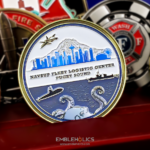
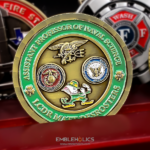
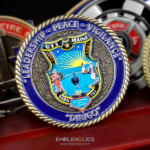
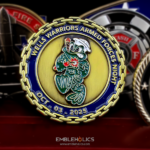
A wardroom coin belongs to a command’s commissioned officers, in the same way a chief’s mess coin belongs to its chiefs. This one was made for the wardroom of Naval Mobile Construction Battalion ONE, the Seabee battalion that traces its line back to the first construction battalion of the Second World War. The brief asked for color and detail: the battalion emblem etched and glossy painted inside a gold rim, the battalion name embossed in black across it, the motto engraved and gold painted along the base, and engraved inscriptions and symbols on a glossy white reverse.
What a wardroom coin is
The wardroom is the mess compartment for commissioned officers above midshipman rank, and like the chief’s mess it is both a room and a group. A command can easily have three separate coins in circulation at once, and they do different jobs:
- The command coin represents the whole unit and is what the commanding officer hands to visitors. Everyone in the command can be given one.
- The chief’s mess coin belongs to the chief petty officers. It is made by chiefs for chiefs and usually carries the mess’s own identity rather than the command’s.
- The wardroom coin belongs to the officers. It tends to sit closer to the command’s formal heraldry than a mess coin does, because the wardroom’s identity and the command’s are not far apart.
That last point is why wardroom coins look the way they do. A chief’s mess will put an octopus or an inside joke on a coin. A wardroom generally puts the unit emblem, the motto and the command’s colors, done well. This coin is a good example: there is nothing eccentric about it, and the quality is in the execution rather than the concept.
Quantities are small, which is the practical consequence. A battalion wardroom is a few dozen officers at most, so the die is a real share of the order. That argues strongly for a design with no dates and no names on it, so the same tooling serves successive wardrooms rather than being retired with one.
Designing for the Seabees
The Seabees have one of the strongest visual identities in the Navy, and it is worth using properly. The name comes from the initials of Construction Battalion, and the community’s insignia and traditions are instantly recognizable to anyone who has served alongside them. The battalion emblem carries that, which is why this coin builds everything around it rather than inventing imagery.
A gold rim around a colored emblem is doing real work here. An etched and painted emblem sitting directly against the coin’s edge looks unfinished. A plain raised rim frames it, gives the eye a boundary, and separates the colored centre from the hand holding it. For a design where the emblem is the whole front, the rim is what makes it read as a coin rather than a badge.
The gloss white reverse is the unusual choice. White is uncommon as a field color because it shows every mark, but against engraved detail it gives the highest possible contrast and a clean, formal look. If you want it, specify hard enamel rather than soft, because a recessed white field picks up grime quickly and a flush one wipes clean.
Two faces, two registers
Splitting a coin between a colorful face and a restrained one is a reliable structure, and this coin uses it. The front is the emblem in full color inside its rim. The reverse is engraved inscriptions and symbols on a plain field, with no competing color.
It works because the two sides have different jobs. The front identifies the command at a glance and is what people see when the coin is handed over. The reverse is where the text lives: the things somebody reads when they turn it over, which do not need color and are harmed by it. Trying to make both faces equally decorative is the most common way a coin ends up looking cluttered.
About the battalion
Naval Mobile Construction Battalion ONE descends from the first of the Navy’s construction battalions, formed in 1942 and deployed to the Pacific in the opening years of the war. Its modern mission is to provide expeditionary engineering and construction support to naval and joint forces, building and defending what it builds.
That dual character is specific to the Seabees and worth reflecting in a design. They are engineers and they are sailors who fight, which is why the community’s own symbolism tends to pair tools with arms. A coin that shows only construction imagery misses half of what the battalion is.
Ordering a wardroom or mess coin
Tell us which group the coin is for. A command coin, a wardroom coin and a chief’s mess coin are three different briefs from the same unit, and knowing which one you are ordering settles the register before any artwork starts. Give us the officer count rather than the battalion strength, and keep dates and names off the design so the wardroom can reorder. You can see more Navy challenge coins we have produced, including the Old Salts Chief’s Mess coin, or send your artwork through the free quote form.
More Navy Projects