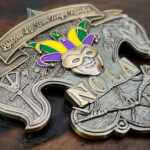
Navy medicine runs on small commands, and a branch clinic is one of the smallest: a handful of providers and corpsmen attached to a parent hospital, often several states away from it. This coin was made for Naval Branch Health Clinic Belle Chasse in Louisiana, one of ten branch clinics under Naval Hospital Pensacola. Rather than a round coin, it is cut in the shape of a fleur-de-lis, which places it in Louisiana before anyone reads a word.
A branch clinic is a command, not a department
This is the thing that most often gets misjudged when a small medical command orders coins. A branch clinic sits beneath a parent hospital on the organizational chart, and the instinct is to treat its coin as a variant of the hospital’s. In practice the clinic is a distinct place with its own staff, its own patients and usually its own regional character, and its people identify with it rather than with a parent command they may rarely visit.
So the coin should belong to the clinic. The parent hospital can appear, usually in the rim or on the reverse, but the clinic’s own identity should own the design. Naval Hospital Pensacola supports a large number of beneficiaries across several states through its branch clinics, and a coin that reads as a Pensacola coin means little to someone working in Belle Chasse.
It also keeps the quantities sane. A clinic coin is sized to clinic staff, which is a small, countable number, and that makes the per-unit economics a real consideration. For runs this small the die is a meaningful share of the cost, which is an argument for a design that will not need replacing: no dates, no named individuals, nothing tied to a current commanding officer.
Regional identity in Navy medicine
Navy medical commands lean on local symbols more than almost any other part of the service, and there is a reason for it. A squadron or a ship carries its identity with it. A clinic does not move, its staff live in the community it serves, and many of its patients are local families. The place is genuinely part of what the command is.
The fleur-de-lis is close to a perfect example. It is instantly Louisiana and New Orleans, it reads cleanly at silhouette with no color or text, and it is a symmetrical, structurally sound shape to cut with no fragile extremities. It is also simple enough to leave real working area for insignia, which many decorative outlines do not.
One thing worth knowing about this particular symbol: the fleur-de-lis is also the emblem of world Scouting, and it carries French royal and heraldic associations besides. None of that is a problem for a Louisiana command, but if you are choosing it purely as decoration rather than as a regional reference, be aware it already means several specific things to several specific audiences.
What goes on a medical coin
Navy medicine has its own vocabulary, and it is worth using accurately. The caduceus and the rod of Asclepius are the obvious starting points, though they are not interchangeable: the rod of Asclepius, a single snake on a staff, is the older medical symbol, while the caduceus with two snakes and wings is the one the US military services adopted. Both appear across military medicine, so either is defensible, but the distinction is the sort of thing a medical audience notices.
The audience splits in a way that matters for the design. A clinic’s staff are a mix of commissioned medical officers, nurses, hospital corpsmen and civilians, and corpsmen in particular have a strong culture and their own iconography. A coin that reads as an officers’ piece will land differently from one that recognizes the whole clinic. If the coin is going to everyone, keep the imagery to the command rather than to any one community within it.
Keep patient-facing material off it. It should go without saying, but a medical command’s coin is not the place for anything that could identify a patient, a case or a facility layout.
Why a shaped coin suits a small command
A distinctive outline does disproportionate work when the organization is not widely known. Nobody outside Navy medicine recognizes the abbreviation NBHC, and a round coin with an unfamiliar acronym on it is just a round coin. The fleur-de-lis gives the piece an identity that works on anyone, and it means the coin gets kept by people who have no idea what the command does.
The cost is modest for a shape this simple. A symmetrical outline with no thin projections sits at the affordable end of custom shape work, and for a small command weighing whether to leave the circle behind, shapes like this one are where the value is.
Ordering a coin for a clinic or medical command
Tell us the clinic’s staff number, whether the parent command needs to appear, and whether there is a regional symbol you want to use. Those three answers cover most of the design. If you are unsure whether your symbol works as an outline, send it and we will test it at silhouette before any die work. You can see related medical work including the Madigan Army Medical Center coin and the U.S. Public Health Service coin, more Navy challenge coins, or send your details through the free quote form.
Frequently Asked Questions
What is a Navy medical challenge coin?
It is a coin for a Navy medical command, from a naval hospital down to a branch health clinic, recognizing the medical officers, nurses, hospital corpsmen and civilian staff who work there. Because Navy medical commands are rooted in one place rather than deploying, their coins tend to lean on local and regional identity more than most military coins do.
Should a branch clinic use its parent hospital’s coin?
Usually not. A branch clinic has its own staff, patients and regional character, and its people identify with the clinic rather than with a parent hospital that may be in another state. The parent command can appear in the rim or on the reverse, but the clinic’s own identity should carry the design.
Is the caduceus the correct medical symbol?
Both are used, but they are not the same thing. The rod of Asclepius, a single snake on a staff, is the older medical symbol; the caduceus, with two snakes and wings, is the one the United States military services adopted. Either is defensible on a military medical coin, but a medical audience will notice which you chose.
Why do medical commands use regional symbols so often?
Because they do not move. A ship or a squadron carries its identity with it, while a clinic’s staff live in the community it serves and many of its patients are local families, so the place is genuinely part of what the command is. A regional symbol also identifies the coin to people who have never heard of the command.
Does a fleur-de-lis work well as a coin shape?
Very well. It reads at silhouette with no color or text, it is symmetrical and structurally sound with no thin projections to bend or catch, and it is simple enough to leave real working area for insignia. It is also one of the cheaper custom outlines for those same reasons.
How many coins does a small clinic need?
Sized to clinic staff, which is usually a small and countable number. Because the die cost is a meaningful share of a short run, it is worth designing something that will not need replacing: no dates, no named individuals, and nothing tied to the current commanding officer, so the same die serves for years.
Is there anything that should not go on a medical command’s coin?
Anything patient-related. No case references, no identifying details, nothing about facility layout. Beyond that, if the coin is going to the whole clinic rather than one community within it, keep the imagery to the command rather than to any single group such as officers or corpsmen, so everyone receiving it sees themselves in it.
More Navy Projects