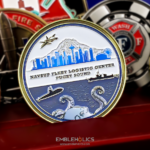
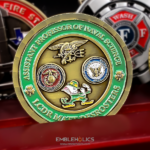
This coin has no paint and no plating. The client asked for a simple monochromatic piece, which means the engraving and the layout carry the entire design with nothing to fall back on.
A Coin With Nothing to Hide Behind
Most coins use color to do the heavy lifting. Enamel separates elements, creates hierarchy and draws the eye where the design wants it to go. Take the color away and all of that has to come from somewhere else.
That makes a monochrome coin the most revealing thing we produce. There is nowhere for a weak layout to hide. A design that works in color because the colors are doing the organizing will fall apart in bare metal, and you find out at the proof stage.
What carries a monochrome coin instead:
Depth difference. With one tone, the only contrast available is how far each element stands off or cuts into the surface. A sculpted device beside an engraved one reads as two distinct things purely because the light treats them differently.
Line weight. Thick and thin become the whole vocabulary. On a colored coin the line weight barely registers; here it does the work that color would.
Negative space. Empty metal is not a gap on a monochrome coin, it is a tone. Treating the bare field as an active part of the composition rather than as background is the difference between restrained and unfinished.
And layout precision. On a colored coin a slightly crowded arrangement is forgiven because the colors keep things apart. In one tone, spacing errors are obvious.
Sculpted Insignia, Engraved Map
This coin uses both techniques, one on each face, and that is exactly how a monochrome piece should be built.
The insignia, an anchor and a thunderbolt, is sculpted. It stands off the surface and casts a shadow, which makes it the dominant element on its face without needing a single drop of color.
The reverse carries an engraved map of the command’s region. Engraving cuts into the surface rather than rising from it, so the map sits back and reads as a flat tonal image. It is quieter than the insignia by construction.
That pairing is the point. One face advances and one recedes, so the coin has a clear front and a clear back even though both are the same metal. For more on how the two techniques differ, see 2D and 3D coins compared.
Putting a Region on a Coin
The engraved map solves a problem that reserve and regional commands have constantly: the organization is not in one place.
A command drawing people from across several states cannot put a building or a base on its coin, because no single location belongs to everyone. A map of the region does, and it is one of the few devices that includes every member without ranking them.
Two practical notes if you want the same. Keep the map as an outline rather than a detailed chart, because borders, cities and labels all disappear at coin size and leave visual noise behind. And check the boundaries are current, since a coin outlives any reorganization of regions.
Information Warfare and the Problem of Showing It
NAVIFOR, the Naval Information Force Reserve, provides information warfare capability from the Reserve Component to the Fleet, Combatant Commands and Department of Defense agencies. It organizes, mans, trains and equips those capabilities and identifies what the Fleet requires.
Information warfare is one of the hardest missions to depict, because there is no vehicle, no weapon and no scene. The anchor and thunderbolt carry it instead: the anchor for the Navy, the thunderbolt for the electromagnetic and information domain. Two devices, both conventional, both immediately legible to anyone in the community.
That is the standard answer for an abstract mission, and it is the same approach used on an electronic attack squadron coin. See more Navy challenge coins.
Order a Monochrome Coin
Professional artwork is free with unlimited revisions, and nothing goes into production until you approve a digital proof. The challenge coin minimum is 50 pieces, standard production runs about 45 to 50 days after final artwork approval, rush production is available on many projects, and shipping within the continental United States is included. Embleholics is veteran-owned, SDVOSB and registered in SAM.gov.
Two things to know if you want no color. The layout has to be stronger than it would be on a colored coin, so expect the artwork stage to take a little longer rather than less time. And pair a sculpted element with an engraved one, because that contrast is what gives a single-tone coin its structure. Ask about engraving and relief options or request a free quote.
Frequently Asked Questions
What is a monochrome challenge coin?
It is a coin with no enamel color and often no plating either, where the design is carried entirely by engraving, relief and the bare metal. This one was made for a Navy command that asked specifically for a simple monochromatic piece.
Can a challenge coin be made with no color at all?
Yes, and it is one of the most elegant options available. Without color, the design relies on depth, line weight and negative space instead. It also exposes a weak layout, because there are no colors to keep crowded elements apart.
Does leaving out color make a coin cheaper?
Somewhat, since enamel fill is a production step and removing it removes that cost. The saving is smaller than people expect, because the die cost does not change and a monochrome design often needs more sculpting work to compensate for the absent color.
What makes a monochrome coin work?
Contrast from depth rather than from color. Pair a sculpted element with an engraved one so that one advances and the other recedes, vary the line weight deliberately, and treat the bare metal as an active tone rather than as background.
What is the difference between sculpted and engraved on one coin?
Sculpted relief rises from the surface and casts a shadow, which makes it dominant. Engraving cuts into the surface and reads as a flat tonal image, which makes it quieter. Using one on each face gives a single-metal coin a clear front and back.
Can a map go on a challenge coin?
Yes, and it suits any organization spread across a region, because a map includes everyone where a building or a base does not. Keep it as an outline rather than a detailed chart, since borders, cities and labels become noise at coin size.
How do you design a coin for information warfare?
Through conventional devices rather than depiction, since the work has no vehicle or scene to show. An anchor for the service and a thunderbolt for the electromagnetic domain carry the mission to anyone in that community without needing any explanation.
Is unplated the same as unpainted?
No. Unpainted means no enamel color has been applied. Unplated means the base metal has no nickel, gold or antique finish over it either. This coin is both, which is why the engraving quality matters so much on it.
More Navy Projects