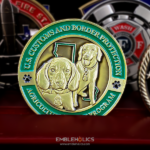
The client did not want colors or paint. Nothing. The coin relies entirely on cut and machined elements, graphic details engraved at set heights for a three dimensional effect, and every surface brushed and polished to the right tone. It carries the ECI emblem and the K9 Team insignia.
A Coin With No Color at All
Most coins described as restrained still have some paint. This one has none, and that changes what the coin depends on.
Everything rests on depth. With no color to separate elements, the only thing distinguishing one area from another is how high or low it sits. That makes the engraving depth the entire design rather than a supporting detail.
Which means depth has to be varied deliberately. The page describes graphics engraved at set heights, and that is the technique: not one cut depth throughout, but several, so elements sit at distinct levels and the eye reads a hierarchy. A coin cut at a single depth with no paint looks flat no matter how good the artwork is.
And the finish does the work paint would do. Brushed and polished surfaces reflect light differently, so a brushed area next to a polished one reads as two different materials even though both are the same metal. That contrast is what replaces color.
There is nothing to hide behind. Paint covers a multitude of small imperfections. On a bare coin every machining mark, every slightly uneven surface and every soft edge is visible. It is the least forgiving specification there is, which is also why a well executed one looks expensive. For a single-metal brushed design, see our Mark 12:30 Meadows Religious Challenge Coin.
See finish and engraving options and antique vs polished finishes.
Mixing Brushed and Polished
This is the mechanism worth understanding, because it is how an unpainted coin gets visual variety.
Polished areas are bright and reflective. They throw light back and read as the lightest tone on the coin.
Brushed areas scatter light. They read as a softer, more even mid tone, and they do not change much as the coin is turned.
Recessed areas read as the darkest tone, because they catch shadow regardless of finish.
Three tones, no paint. That is enough to build a complete design, and it is the reason a bare metal coin does not have to look empty.
The decision to make is which areas get which treatment. The usual approach is to polish the raised devices so they catch the eye, brush the background fields so they stay quiet, and let the recesses supply the shadow. Reversing it, with a brushed device on a polished field, is also valid and gives a more subdued result.
One practical note: a polished surface shows fingerprints immediately while a brushed one hides them, so a coin that will be handled constantly is better off with more brushed area than polished.
When Bare Metal Is the Right Choice
Three situations where no paint is the better specification.
When the organization’s register is technical rather than ceremonial. A company whose work is precise and unglamorous is often better represented by a precise, unglamorous object. Bright enamel reads as commemorative; bare machined metal reads as made.
When the coin will be carried for years. Paint is the first thing to wear on any coin. A piece with no paint on it cannot lose any, and the wear it does accumulate, softening at the high points, patina in the recesses, generally improves it.
And when the artwork is detailed. Color boundaries compete with fine engraving. Removing the color lets dense line work read without anything fighting it.
It is the wrong choice when the organization’s identity is tied to specific colors, when the coin needs to attract attention on a table or be sold, or when the design depends on a logo that only works in its own palette.
About the Company
Explosive Countermeasures International, Inc. was founded in 1989 and is based in Delaplane, Virginia. It describes itself as dedicated to eliminating the threat to human life caused by the use and misuse of explosives worldwide.
ECI has long-term partnerships with government clients, has provided explosive detection canine team services for more than a decade, and has delivered explosive countermeasures specialty services for close to 30 years, including over 20 years of complex canine support across a changing threat environment.
The K9 Team insignia on the coin reflects that canine work, and it is the right thing to put alongside the company emblem: the emblem says who, the K9 insignia says what they are known for. See also a shield shaped police K9 coin and more corporate challenge coins.
Order a Coin With No Paint
Professional artwork is free with unlimited revisions, and nothing goes into production until you approve a digital proof. The challenge coin minimum is 50 pieces, standard production runs about 45 to 50 days after final artwork approval, rush production is available on many projects, and shipping within the continental United States is included. Embleholics is veteran-owned, SDVOSB and registered in SAM.gov.
Two things to raise at the quote stage. Say explicitly that you want no paint, because the artwork is built differently from the start: elements have to be separated by depth and finish rather than by color, and that is a decision made at the first sketch rather than by leaving the fills empty later. And ask which areas will be brushed and which polished, since that contrast is doing the job color normally does and it is worth having an opinion on. Request a free quote to begin.
Frequently Asked Questions
What is a bare metal challenge coin?
It is a coin with no paint or enamel anywhere on it. Elements are separated by engraving depth and by the contrast between brushed and polished surfaces rather than by color.
Can a challenge coin have no color at all?
Yes, and it is a deliberate specification rather than a stripped-down version of a colored coin. The artwork has to be built differently from the first sketch, with depth and finish doing the work color normally does.
How does an unpainted coin avoid looking flat?
By varying the engraving depth. Elements cut at several distinct heights create a hierarchy the eye can read, where a coin cut at a single depth with no paint will look flat however good the artwork is.
How many tones can a bare coin produce?
Three, which is enough for a complete design. Polished areas read as the lightest, brushed areas as a softer mid tone, and recessed areas as the darkest because they hold shadow regardless of finish.
Which areas should be polished and which brushed?
Usually polish the raised devices so they catch the eye and brush the background fields so they stay quiet, letting the recesses supply the shadow. Reversing it gives a more subdued result and is equally valid.
Is a bare metal coin harder to produce well?
Yes, it is the least forgiving specification there is. Paint hides small imperfections, so on an unpainted coin every machining mark, uneven surface and soft edge is visible. That is also why a good one looks expensive.
Does an unpainted coin wear better?
Yes. Paint is the first thing to go on any coin, and a piece with none cannot lose any. The wear it does pick up, softening at the high points and patina in the recesses, generally improves it.
When is bare metal the wrong choice?
When the organization’s identity is tied to specific colors, when the coin needs to attract attention on a table or be sold, or when the logo only works in its own palette. In those cases the color is carrying meaning that depth cannot replace.
More Law Enforcement Challenge Coins Projects