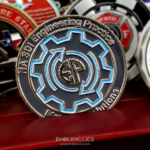
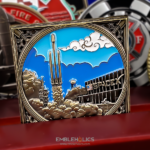
Minimalist and modern, with clean lines and very little patterning. Both faces carry embossed graphical elements with complex detail inside them, over a brushed effect finish, with high quality enamel paint on some surfaces. A digital mock-up was approved before anything went into production. This Credit Acceptance Corporation coin was made for the company’s Director of Inside Sales.
A Coin for a Sales Leader
A coin belonging to an executive rather than to a company is a specific object, and it differs from corporate merchandise in every way that matters.
It is presented, not distributed. Branded items get handed out at events. A leader’s coin is given to a particular person for a particular reason, which is the whole basis of the tradition.
Sales is a performance culture already. Teams that run on targets, rankings and recognition have an existing appetite for something that marks achievement, and a coin fills a gap between a verbal mention and a formal award.
The run is small. A director presenting selectively over a year or two needs a modest quantity, which makes a better finish affordable per piece.
And it outlasts the quarter. Bonuses are spent and plaques stay at the office. A coin is the form of recognition that someone still has years later, which is most of its value.
See more corporate challenge coins.
Credit Acceptance and the Dealer Relationship
Credit Acceptance Corporation is an American auto finance company whose primary customer is the automobile dealer rather than the car buyer. The Director of Inside Sales leads the team that signs dealerships up to the company’s financing programs.
That structure explains why a coin suits this role. Inside sales is relationship work conducted almost entirely by phone and email, building long term arrangements with dealers who have other options. It is persistent, repetitive and largely invisible, and the wins are contracts rather than anything you can put on a wall.
A team doing that kind of work has few natural recognition moments. A coin creates one, and because it comes from the director personally rather than from a program, it carries more than an automatic award would.
Embossing Complex Detail
Embossed elements carrying intricate detail is the technical demand on this coin, and there is a real tension inside that brief.
Embossing raises a shape off the field. The element sits proud of the surface and reads through its edge and the shadow it casts, which is what gives it presence on an otherwise flat coin.
Detail inside a raised element is harder than detail on a flat one. The metal has to flow into the die to form the raised shape and then hold fine internal detail at the top of that shape, which is the part most likely to come out soft.
The fix is hierarchy, not more depth. One clear raised silhouette with a limited number of internal features reads better than a raised element crowded with fine lines. Increasing relief depth does not rescue detail that is too fine.
And a corporate mark usually needs adapting. Logos are drawn for screens and print, where hairlines are free. A mark going into relief often needs its thinnest strokes thickened to survive, and that is a decision to make deliberately rather than discover on the sample.
Brushed Finish With Enamel on Some Surfaces
Brushing the whole coin and painting only part of it is the structure that makes this piece read as modern rather than as a standard award coin.
A brushed field scatters light, so the embossed elements stay readable at any angle and the surface has texture without pattern. That is what keeps a minimalist coin from looking blank: there is something to see even where there is nothing drawn.
Restricting enamel to some surfaces then gives the color a job. The painted areas become the focal points by being the only colored things present, which is a more controlled result than coloring everything and hoping a hierarchy emerges.
The pairing is also consistent in register. Brushed metal and clean enamel both read as contemporary, where a high polish with heavy color would read as an award and an antique finish would read as heritage. For a company coin in a modern industry, this is the right pair.
See antique vs polished finishes and enamel options.
Approving a Digital Mock-Up
This design went through a digital mock-up before production, which is the step worth understanding on any order.
A mock-up shows the layout, the proportions and the color placement, and it is where most problems get caught. It is also the last point at which anything is free to change, because once a die is cut the coin exists in that form permanently.
What a digital mock-up cannot show is finish behavior. Brushed texture, enamel gloss and the way embossing catches real light are physical properties that a rendering approximates. For a design whose whole character comes from finish rather than from artwork, that gap matters, and it is the argument for asking about a physical sample on a piece like this.
Revisions before approval are free and unlimited. The expensive mistake is approving something that nearly works.
Order a Corporate or Executive Coin
Professional artwork is free with unlimited revisions, and nothing goes into production until you approve a digital proof. The challenge coin minimum is 50 pieces, standard production runs about 45 to 50 days after final artwork approval, rush production is available on many projects, and shipping within the continental United States is included. Embleholics is veteran-owned, SDVOSB and registered in SAM.gov.
Two suggestions. If a corporate logo is going into relief, check whether its thinnest strokes need thickening, since marks drawn for screen and print assume a resolution metal cannot deliver. And if the coin’s character comes from its finish rather than its artwork, ask about a physical sample, because a digital mock-up approximates texture and gloss rather than showing them. Request a free quote to begin.
Coin Front

Coin Rear

Frequently Asked Questions
Why would a company executive order a personal coin?
Because it is presented rather than distributed. A leader’s coin is given to a specific person for a specific reason, which carries more weight than a branded item handed out at an event.
Do sales teams suit challenge coins?
Yes. Sales cultures already run on targets and recognition, and a coin fills the gap between a verbal mention and a formal award, particularly where the wins are contracts rather than anything visible.
How many coins does an executive need?
A modest quantity, since presentation is selective over a year or two rather than issued to everyone. That also makes a better finish affordable per piece.
Is detail inside an embossed element harder to produce?
Yes. The metal has to flow into the die to form the raised shape and then hold fine detail at the top of it, which is the part most likely to come out soft.
How do you keep an embossed element legible?
Set a hierarchy rather than adding depth. One clear raised silhouette with a few internal features reads better than a raised shape crowded with fine lines.
Does a corporate logo need changing for a coin?
Often. Logos are drawn for screen and print where hairlines cost nothing, so the thinnest strokes usually need thickening to survive a strike.
Why brush the whole coin and paint only part of it?
The brushed field gives texture without pattern so a minimal coin is not blank, and limiting enamel to some surfaces makes those areas the focal points by being the only color present.
What does a digital mock-up not show?
Finish behavior. Brushed texture, enamel gloss and the way embossing catches real light are physical properties a rendering only approximates, which matters most when the finish is the design.
More Corporate Projects