There is no shame in asking what a coin costs, and the honest answer is that three things move the price and almost nothing else does. Once you know which three, you can spend a small budget well instead of spending it on the wrong things.
The Three Things That Move the Price
Quantity, by a long way. This is the biggest single factor and it is not close. The tooling to make a coin costs the same whether you order fifty or five hundred, so that cost is spread across the run. Doubling an order does not double the price, and the difference per coin between a minimum order and a large one is bigger than every other decision on this list combined.
How much of the coin is painted. Paint is applied area by area and each color is a separate step, so a fully painted face costs more than a face where the metal shows. A design with two or three colors against a metal field is cheaper than one painted edge to edge, and it usually looks better, which is the happiest overlap in this trade.
Size and shape. A small round coin is the cheapest thing to make. Larger diameters use more metal. Custom outlines, cutouts and projecting elements all add tooling work and sometimes thickness. None of those are expensive in isolation, but choosing all of them at once is how a budget disappears.
For actual figures rather than principles, see how much custom challenge coins cost, the cost of 100 coins and our minimum order.
What to Spend On
If the budget is tight, this is where the money goes furthest.
Weight, before anything else. The first thing anybody notices about a coin is how it feels, and a piece with some heft is read as a good coin before it is even looked at. It is also among the cheapest qualities to buy. A thin coin with elaborate artwork will disappoint. A substantial coin with simple artwork will not.
One finish, chosen deliberately. Brushed, matte, antique or polished all cost about the same, and picking one on purpose rather than taking a default is free. A brushed or matte field also makes a small amount of color read as strongly as a lot of color does, which is how you buy contrast without buying paint.
Getting the artwork right. Revisions are included, so this costs nothing but attention. A design that was thought about is the difference between a coin people keep and one they put in a drawer, and no amount of plating fixes a crowded layout.
What to Cut
Extra colors. Past three or four, each additional color adds cost and subtracts emphasis. If everything is colored, nothing is highlighted.
Complexity on the reverse. Most coins are looked at from the front. A clean reverse with short lettering costs less and looks more considered than a second face crowded with a motto, a date, a second emblem and a border.
Several shape features at once. A custom outline or a cutout or a projecting element can each be the one interesting thing about a coin. All three together cost more and read as fussy.
Text nobody will read. Every word has to be large enough to be legible, so a crowded design forces either a bigger coin or illegible type. Cutting the text is free and it improves the coin.
What Costs Nothing At All
Worth stating plainly, because these are the decisions that separate a good budget coin from a poor one and none of them appear on a quote.
Putting one subject on each face rather than two or three.
Leaving the rim plain when the field is busy, or the field plain when the rim is patterned.
Choosing metal over paint wherever the color is not telling you what something is.
Setting the type large enough by using fewer words.
Deciding who approves the proof before artwork starts, which saves a round of revisions and sometimes a reorder.
A plain, well-made coin is also the hardest kind to make, because there is nothing to distract from the execution. We make that argument in full on our plain emblem coin page.
If You Will Order Again
One thing worth knowing before you choose a quantity. Reordering an existing design is cheaper than a first run, because the tooling already exists. That has two implications for a tight budget.
Start at the minimum if you are unsure, and reorder once you know the design works. And keep the design undated if you expect to reorder, because a dated coin cannot be made again after the year passes. The exception is an anniversary or an event piece, where the date is the whole point and the quantity has to be generous because there is no second run.
See whether reordering is cheaper and the cheapest way to get coins made.
The Coin on This Page
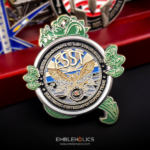
The piece shown here was made for a department, and it is a good example of spending in the right places.
One face carries the department’s crest with a badge, scales and a wreath around a detailed centre. The other carries the design for one unit within the department, with cartoon devices set around the outer ring.
Two things worth pointing out. The department face is detailed and the unit face is lighter, which is the right division: a crest needs room and a unit device does not. And the cartoon elements on the reverse sit apart from the official crest on the front rather than beside it, which keeps the formal device formal and lets the informal one be informal. We cover that split in more detail on our unit mascot page.
For another coin in the same field, see this task force coin, and for the category, police challenge coins.
Get a Quote
Free professional artwork, unlimited revisions and a digital proof before anything is produced. Free shipping within the continental US, a 50-coin minimum, and most orders complete 45 to 50 days after artwork approval, with rush production available. Embleholics is veteran-owned, an SDVOSB, and registered in SAM.gov.
Tell us your budget and your quantity when you ask, rather than asking for a price on a design you have already settled. If the budget is fixed we will tell you where to spend it, and the answer is usually not where people expect.
Frequently Asked Questions
What makes challenge coins cheaper?
Ordering more of them, painting less of the surface, and keeping the size and shape simple. Quantity is by far the biggest factor, because the tooling costs the same whatever the run and that cost is spread across it.
Does ordering more coins reduce the price per coin?
Substantially, yes. The tooling to make a coin is a fixed cost, so a larger run spreads it further. The difference per coin between a minimum order and a large one is bigger than every design decision combined.
Is paint or plating cheaper on a coin?
Plating. Paint is applied area by area and each color is a separate step, so leaving metal showing costs less than covering a face. Two or three colors against a metal field is usually both cheaper and better looking.
Do custom shapes cost more?
Yes, because a custom outline, a cutout or a projecting element each adds tooling work and sometimes thickness. Any one of them can be affordable; choosing several at once is how a budget disappears.
What is worth paying for on a cheap coin?
Weight, first. A substantial coin is read as a good coin before anyone examines it, and it is one of the cheapest qualities to buy. After that, one deliberately chosen finish, which costs the same as any other.
What should be cut from a coin to save money?
Extra colors past three or four, complexity on the reverse, several shape features at once, and any text that would end up too small to read. Cutting text is free and it improves the design.
What improves a coin for free?
One subject per face, a plain rim when the field is busy, metal instead of paint wherever color is not identifying something, fewer words set larger, and naming one person to approve the proof before artwork starts.
Is it cheaper to reorder a coin?
Yes, because the tooling already exists. If you are unsure about a design, starting at the minimum and reordering once it is proven is a reasonable approach, as long as the coin is not dated.
Is a cheap coin a worse coin?
Not necessarily. A plain, well-made, substantial coin beats an elaborate thin one, and most of the decisions that make a coin look considered do not cost anything. What a small budget rules out is complexity, not quality.
More Law Enforcement Challenge Coins Projects