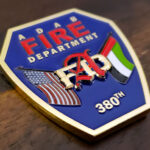
The base is brass colored, which gives the coin a warm weight, with solid glossy background colors behind simple graphics and no overwhelming patterning. One face carries the engraved and painted flags of the United States and the United Arab Emirates. The other carries aircraft silhouettes. Fire department lettering runs across both sides. It was commissioned by the fire department of the 380th Air Expeditionary Wing at Al Dhafra Air Base.
Coins at an Expeditionary Wing
An expeditionary wing is a different coin client from a home-station unit, and three things follow from it.
The population rotates constantly. People arrive on deployment orders, serve a rotation and leave. Over a few years an enormous number of airmen pass through, which means a wing-level coin has a far wider audience than a permanent unit’s and a single design can keep being issued.
Which argues for an undated design. A coin tied to one rotation is obsolete within months. One carrying the wing and the location stays correct for as long as the wing is there, and can be reordered from the same die.
And the host nation is part of the identity. A deployed wing operates from somebody else’s country, and that relationship is the thing a home-station coin has no equivalent of. Putting both flags on the coin is the direct way to say it.
A support function needs it most. A fire department at an air base is not the operational story of the wing, and that is exactly why a coin matters: it is one of the few ways a support organization’s contribution gets acknowledged in an object. For another Air Force fire unit, see our Goodfellow AFB Fire Academy Challenge Coin.
See also the same department’s bottle opener and more Air Force challenge coins.
Two Nations’ Flags on One Face
The flags are engraved and then painted, including the small details such as the stars, which is the demanding part.
Flags have exact colors. A national flag is specified, and people from that country notice an incorrect shade in a way they never would on an invented design. Send the color reference for each rather than describing it.
The stars are the problem on the American flag. Fifty five-pointed stars at coin size is beyond what striking holds, so they become a haze. The approaches are to reduce the count deliberately, to render the canton as a textured field, or to enlarge the canton relative to the stripes so the stars have room. Painting them neatly, as this coin does, requires the engraving underneath to be clean enough to hold the fill.
Flags reduce differently from one another. A flag built from bands of color reproduces beautifully. One carrying a central emblem or fine device loses that detail first, so the two flags on a coin frequently need different treatment to look equally well made.
And side by side at equal size is the neutral arrangement. Overlapping, crossing or sizing them differently says something else, which matters when one country is hosting the other.
See an embassy challenge coin for the same two-nation problem in a diplomatic setting.
Aircraft Silhouettes
The other face carries aircraft silhouettes, which is the most economical way to say what a wing flies.
A silhouette is recognized from its outline alone: wing shape, tail configuration, engine placement. That is exactly what survives at coin size, where a detailed aircraft rendering loses its panel lines, markings and undercarriage and turns to texture.
Three notes. Aviators identify airframes precisely, so the outlines have to be accurate even though nothing else about them is detailed. A plan view or a clean side profile reads better than a dramatic angle, because the recognizable shape is the one people have seen in reference material. And several silhouettes arranged on one face work better than one, since a group reads as a fleet and gives the composition some structure.
A Brass Base With Glossy Solid Colors
The combination here is worth copying for a deployed unit’s coin.
A brass colored base reads as warm and substantial rather than bright and new, which suits an organization with a serious job. Against it, solid glossy color fields read as contemporary, so the coin avoids looking either ceremonial or novelty.
Keeping the graphics simple with no overwhelming patterning is the third element. On a coin that already carries two flags, aircraft silhouettes and lettering on both faces, a machined background texture would have tipped it into clutter. The restraint is what lets the content read.
The one durability note is that glossy painted areas on a coin carried in a pocket wear before the metal does, so an epoxy coat is worth specifying on any heavily colored piece. See enamel and finish options.
About the Wing
The 380th Air Expeditionary Wing was established at Al Dhafra Air Base in the United Arab Emirates on 25 January 2002. The wing provides high-altitude, all-weather intelligence, surveillance and reconnaissance, airborne command and control, and air refueling.
A base fire department serving a deployed flying wing has an unusually broad job: aircraft rescue and firefighting alongside structural and medical response, for a population that changes continuously. That combination is part of why the department’s own identity matters enough to put on a coin.
Order a Coin for Your Wing or Deployed Unit
Professional artwork is free with unlimited revisions, and nothing goes into production until you approve a digital proof. The challenge coin minimum is 50 pieces, standard production runs about 45 to 50 days after final artwork approval, rush production is available on many projects, and shipping within the continental United States is included. Embleholics is veteran-owned, SDVOSB and registered in SAM.gov.
Two things worth planning. Leave the rotation and the year off, because a deployed unit’s population turns over continuously and an undated design can be reordered from the same die for as long as the unit exists. And if flags are involved, send the color reference for each one and expect the color count to affect the quote, since two nations’ reds and blues are rarely the same. Request a free quote to begin.
Frequently Asked Questions
What is an expeditionary wing challenge coin?
It is a coin for an Air Force wing operating from a deployed location rather than a home station. Because the population rotates constantly, a wing-level coin has a wide audience and a single design can keep being issued for years.
Should a deployed unit’s coin carry a date?
No. A coin tied to one rotation is obsolete within months, where one carrying the wing and the location stays correct for as long as the unit is there and can be reordered from the same die.
Why put the host nation’s flag on the coin?
Because a deployed unit operates from another country, and that relationship is something a home-station coin has no equivalent of. Two flags side by side is the most direct way to say it.
How should two national flags be arranged?
Side by side at equal size, which is the neutral reading. Overlapping, crossing or sizing them differently says something else, and that matters when one country is hosting the other.
How are the stars on the US flag handled?
Not at full count. Fifty five-pointed stars is beyond what striking holds at coin size, so the options are reducing the count, rendering the canton as a textured field, or enlarging the canton relative to the stripes so the stars have room.
Why do two flags sometimes need different treatment?
Because they reduce differently. A flag built from bands of color reproduces beautifully, while one carrying a central emblem or fine device loses that detail first, so matching their apparent quality takes deliberate adjustment.
How should aircraft be shown on a coin?
As silhouettes in plan view or clean side profile. A silhouette reads from its outline, which is what survives at coin size, where a detailed rendering loses its panel lines and markings and turns to texture.
Does a heavily painted coin need a protective coat?
Yes. Glossy painted areas wear before the metal does on a coin carried in a pocket, so an epoxy layer over the colored areas is worth specifying on any piece with substantial color.
More Firefighters Projects