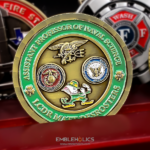
Brushed dark brass throughout, with a rope pattern etched around the rims and naval symbols sculpted into the faces, the trident among them. Blue accents appear on both sides in small quantity and nothing else carries color. This fleet logistics center coin was made for NAVSUP FLC Puget Sound at Naval Base Kitsap in Bremerton, Washington, and the design represents both NAVSUP and the state.
The Rope Rim
A rope edge is the most recognizable naval convention available on a coin, and there are good reasons it persists.
It says Navy without using an anchor. Rope is maritime shorthand that every sailor reads instantly, and it leaves the faces free for content that is specific to the command.
It frames without competing. A rope border is repetitive and regular, so it defines the edge of the design without drawing attention away from whatever is inside it.
And it uses the least productive part of the coin. The outer ring is hard to put content in. A rope pattern fills it with something purposeful.
The execution point is consistency. A repeating pattern shows any irregularity immediately, so the strands have to be even all the way around and the join has to be invisible. Etching rather than deep sculpting suits this, because a shallow consistent cut is easier to hold around a full circumference than a deep one.
See also Navy challenge coins.
NAVSUP Fleet Logistics Center Puget Sound
NAVSUP FLC Puget Sound is based at Naval Base Kitsap in Bremerton, supporting fleet and shore commands of the Navy along with other military and government agencies across the Pacific Rim. Fleet logistics centers are the regional nodes of Navy supply, handling contracting, fuel, material and household goods for everything in their area.
Two things make this a notable coin for a Port Orchard manufacturer. The first is proximity: Naval Base Kitsap is in the same county, so this is a local command rather than a distant one. The second is that the design deliberately represents the state as well as the organization, which is a choice a command makes when its people identify with where they are stationed as much as with the organization they belong to. Puget Sound commands tend to do that.
The support organization pattern applies here as it does across logistics. A fleet that has what it needs does not notice, and a fleet that does not has a problem. Recognition in a command like this has to be generated internally.
See also a Defense Logistics Agency challenge coin.
Brushed Dark Brass
Dark brass with a brushed texture is a restrained finish and it does several things at once.
Dark gives the sculpting contrast. A deeper base value means shadows in the relief read strongly, so the trident and the other naval symbols have depth without any paint.
Brushing keeps it readable. Scattered light means the etched rope and the sculpted elements stay visible from any angle, where a polished brass would throw highlights across them.
Brass is warm without being gold. It carries a traditional association without the award register that bright gold brings, which suits a working command.
And it handles well. A brushed dark finish hides fingerprints and fine scratches far better than any bright plating, so it stays looking right in a pocket.
See antique vs polished finishes.
Minimal Accents on a Monochromatic Coin
Using blue in small quantity on an otherwise single metal coin is the most controlled way to introduce color, and the principle generalizes.
A small amount of color on a metal field is the only colored thing present, so it draws the eye with no competition. The same blue on a coin that also had red, white and gold would be one element among several and would carry a fraction of the weight.
The decision that matters is what gets the color. The strongest choice is the element that would be hardest to read in bare relief, so the color is earning its place by solving a legibility problem rather than decorating. The weakest choice is coloring whatever happens to be in the middle.
There is also a consistency point. If accents appear on both faces, as they do here, they should be the same color and roughly the same weight. Accents that differ between the two sides make the coin read as two designs.
Order a Logistics or Naval Command Coin
Professional artwork is free with unlimited revisions, and nothing goes into production until you approve a digital proof. The challenge coin minimum is 50 pieces, standard production runs about 45 to 50 days after final artwork approval, rush production is available on many projects, and shipping within the continental United States is included. Embleholics is veteran-owned, SDVOSB and registered in SAM.gov.
Two suggestions. If the design uses a rope rim or any repeating border, check it on the proof for even spacing and an invisible join, since a repeating pattern shows every irregularity. And when adding an accent color to a metal coin, give it to the element that would be hardest to read in bare relief rather than to whatever sits in the center. Request a free quote to begin.
Frequently Asked Questions
What does a rope rim mean on a coin?
It is naval shorthand, read instantly by anyone in the sea services. It says Navy without using an anchor, which leaves the faces free for content specific to the command.
What should be checked on a rope edge?
Even spacing all the way around and an invisible join. A repeating pattern shows any irregularity immediately, which is why a shallow etched rope holds better than a deeply sculpted one.
What does a fleet logistics center do?
It is a regional node of Navy supply, handling contracting, fuel, material and household goods for fleet and shore commands in its area. FLC Puget Sound covers the Pacific Rim from Naval Base Kitsap.
Why use dark brass rather than gold?
Brass is warm without carrying the award association that bright gold brings, which suits a working command. A darker base also gives sculpted relief stronger shadow contrast.
Why brush the finish?
Brushing scatters light so etched and sculpted detail stays readable from any angle, and it hides fingerprints and fine scratches far better than a bright plating.
How much accent color should a metal coin carry?
A small amount. A single color on a metal field is the only colored thing present and draws the eye without competition, where several colors would each carry a fraction of the weight.
Which element should get the accent color?
The one that would be hardest to read in bare relief. That way the color solves a legibility problem rather than simply decorating whatever sits in the middle.
Should accents match across both faces?
Yes, in both color and rough quantity. Accents that differ between the two sides make a coin read as two separate designs rather than one.
More Navy Projects