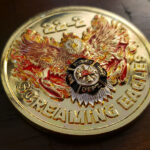
The front carries the Screaming Eagles mascot, engraved in fine organic lines. The back carries both districts’ insignias, inscribed side by side. The base is a bright gold and the edge is left smooth and plain with no patterning at all. This East Central Pierce fire rescue coin was made for East Pierce Fire and Rescue, District 22, and Central Pierce Fire and Rescue, District 6.
A Coin for Two Departments
Putting two agencies on one coin is a situation that comes up more than people expect, and it has to be handled carefully.
Neither can be the smaller one. Two insignias at different sizes, or one on the front and one on the back, creates a hierarchy somebody will notice. Equal treatment on the same face is the only neutral option.
A shared element should lead. This coin puts a shared mascot on the front and the two insignias together on the back, which says the partnership first and the parties second. That order is correct and it is the part most joint coins get backwards.
The marks have to be redrawn to one standard. Two departments’ insignias were designed independently, with different line weights and levels of detail. Reproducing both as supplied makes a face that looks like two logos pasted together.
And both sides approve the proof. A joint coin needs sign off from each organization, which takes longer than a single approval and should be allowed for in the schedule.
See also fire department challenge coins.
Fire Districts in Pierce County
East Pierce Fire and Rescue and Central Pierce Fire and Rescue are separate fire protection districts serving different parts of Pierce County, Washington. Districts like these are independent taxing authorities with their own commissioners, which makes them genuinely separate organizations rather than divisions of one department. More on how districts work in our South Kitsap Firefighters Coin.
That independence is why a joint coin means something here. Neighboring districts run mutual aid together, train together and show up on each other’s incidents, but they remain distinct employers with distinct identities. An object representing both is acknowledging a working relationship rather than an organizational chart.
It is also a Washington state coin, which is worth noting for a manufacturer based in Port Orchard. Pierce County is the next county south, and these are neighbors.
See also a Port Angeles fire department coin.
Engraving Fine Organic Lines
An eagle rendered in fine organic line work is a specific technical approach, and it suits the subject better than the alternatives.
Feathers are lines, not shapes. A bird’s plumage is hundreds of small overlapping strokes. Engraving reproduces that directly, where sculpted relief at coin scale tends to smooth it into a mass.
Line work implies motion. Flowing, varied strokes read as energy in a way an even outline does not, which matters for a mascot meant to look like it is doing something.
And it does not need color. Fine engraving on gold reads through shadow alone, which keeps the whole coin monochromatic and lets the two inscribed insignias on the reverse match the front in treatment.
The constraint is line spacing. Engraved lines set too close together merge when struck, and the result is a dark smudge rather than fine detail. There is a minimum gap below which detail stops being detail, so a dense drawing has to be opened up before it goes to a die.
See engraving and finish options.
Bright Gold With a Plain Edge
Two finishing choices here work against each other in a useful way.
Bright gold is the most assertive plating available. It is high contrast, it catches light aggressively, and it carries an unmistakable association with awards and achievement. On a coin meant to be presented rather than carried, that is exactly right.
The plain edge pulls the other way. A rope or milled rim on a bright gold coin would push it toward ornate, and the restraint keeps the piece from tipping over. The eagle is doing the decorative work, so the edge does not need to.
The one practical note on bright plating is that it shows handling. Fingerprints and fine scratches are more visible on a mirror finish than on a brushed or antique one. For a presentation coin that is a fair trade, and for a pocket coin it is worth considering a satin gold instead.
Order a Fire Department or Joint Agency Coin
Professional artwork is free with unlimited revisions, and nothing goes into production until you approve a digital proof. The challenge coin minimum is 50 pieces, standard production runs about 45 to 50 days after final artwork approval, rush production is available on many projects, and shipping within the continental United States is included. Embleholics is veteran-owned, SDVOSB and registered in SAM.gov.
Two suggestions for a joint coin. Decide the split of the order before artwork, since two agencies dividing a run need to agree on quantity as well as design, and that conversation is easier early. And allow extra time for approvals, because every revision needs sign off from both sides rather than one. Request a free quote to begin.
Frequently Asked Questions
Can two departments share one challenge coin?
Yes, and it is common between neighboring agencies that run mutual aid. The key is equal treatment, since two insignias at different sizes creates a hierarchy somebody will notice.
How should a joint coin be laid out?
Lead with something shared, such as a common mascot, and put the two insignias together on the reverse. That says the partnership first and the parties second, which is the right order.
Do both agencies’ logos need redrawing?
Usually. Marks designed independently have different line weights and levels of detail, and reproducing both as supplied produces a face that looks like two logos pasted together.
What slows down a joint coin order?
Approvals. Every revision needs sign off from both organizations rather than one, so the schedule should allow for it rather than assuming a single approver.
Why engrave a mascot in fine lines rather than sculpt it?
Because feathers and fur are line work. Engraving reproduces hundreds of small overlapping strokes directly, where sculpted relief at coin scale smooths them into a mass.
How close together can engraved lines be?
There is a minimum spacing below which lines merge when struck and the detail becomes a dark smudge. A dense drawing has to be opened up before it goes to a die.
What does a bright gold finish suit?
Presentation. It is high contrast with a strong association with awards, which fits a coin handed over at an event rather than carried every day.
Should a bright gold coin have a patterned edge?
Often not. A rope or milled rim pushes an already assertive finish toward ornate, so leaving the edge plain keeps the design balanced when the artwork is doing the decorative work.
More Firefighters Projects