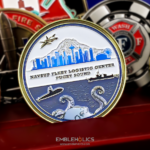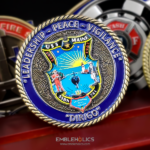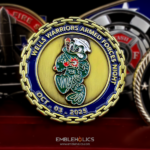
USS Duarte has never existed. She was invented in 1971 by an instructor so that students would have a ship to practice on, and she has been in service as a teaching device ever since. This coin was made for the battalion companies who learned on her, which makes it one of the more unusual pieces in the gallery.
A Coin for a Ship That Does Not Exist
The Duarte is a fictitious destroyer, given a hull number and a crew, created so that students could work real problems against something that behaved like a real ship without being one. Her crew photographs and division photographs hang in the school’s hallways. Generations of students have worked her books.
She is a shared reference, and that is exactly what a coin is for.
This is worth drawing out, because the same situation comes up more often than people realize. Training organizations are full of constructs: a fictional ship, a notional unit, an exercise scenario, a simulated company, a named problem set that every student has worked. Those constructs are frequently the strongest shared experience in the whole course, stronger than the building or the staff, because everyone who passed through has met them.
A coin marks what a group has in common. If what a cohort has in common is a ship that was made up in 1971, then that is the right subject, and putting the school’s crest on it instead would produce a weaker coin about a less shared thing.
Why a Battalion Coin Is Its Own Thing
This coin was made for a battalion’s companies rather than for the school or for an individual, and battalion-level coins have a particular shape to them.
The group is defined and finite. A battalion knows exactly how many people are in it, which makes the quantity decision easier than almost any other order. There is no guessing at who might ask later.
It has sub-units that want to be named. Companies, platoons, divisions. A battalion coin that names its companies is doing something a school coin cannot, and it is usually what the members actually want on it. The constraint is space: naming two or three companies works, naming eight does not.
The population turns over completely. In a training battalion it turns over every few months. That means the coin is reordered often, which is an argument for a design that does not reference one class, one date or one staff roster.
And it is presented rather than issued. A battalion coin tends to be given at a completion or a milestone, which makes it a marker of having finished something rather than of belonging somewhere.
Gold and Blue, and Why It Reads as Navy
The brief asked for a classic Navy-looking coin in gold and blue, and that pairing is doing more work than a color choice usually does.
Blue and gold are read as Navy before anything else on the coin is read. Service color associations are among the strongest shortcuts available in this trade: gold and blue says Navy, scarlet and gold says Marine Corps, black and gold says Army at a glance. A coin that uses the right pair identifies its service from across a room with no insignia involved.
Two practical notes on the combination. Gold raised elements against a blue field is the strongest arrangement of the two, because gold is the brighter and belongs on the artwork rather than the background. And blue is one of the colors that benefits most from being enclosed: a blue field with a gold rim around it reads cleanly, where blue running to the edge tends to look unfinished.
An Antique Finish on a Relief of a Ship
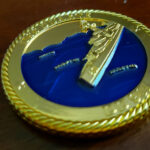
The coin carries the Duarte in relief, with an antique finish over it.
That is the right finish for a hull. A ship in relief is a long low shape built of planes: the hull side, the superstructure, the deck. Those planes only read as separate if the shadows between them are dark, and an antique finish darkens exactly those recesses while leaving the raised surfaces light.
A polished finish on the same relief would give you a bright coin and a flat ship, because the reflection competes with the modelling. That is the trade in one sentence, and it holds for any sculpted subject.
The piece was also given layers of coating for durability, which matters on a coin that will be carried rather than displayed.
See antique and polished finishes and plating options.
Drawing a Ship That Has No Photographs
One genuine oddity here. A real ship can be drawn from photographs, and the crew will check it against the ship. A fictitious ship cannot be, and there is nothing to check it against except what the school has always used.
That makes the school’s existing material the source of truth rather than a reference. If there are hallway photographs, drawings or diagrams of the Duarte that students have looked at for decades, those are what the relief should match, because the recognition the coin depends on is recognition of that version rather than of a destroyer in general.
The broader rule for any invented or heraldic subject: find the version the group already knows and reproduce it. Inventing a better one produces something nobody recognizes.
About the School
The Navy Supply Corps School trains Supply Corps officers, and the Duarte was created in 1971 by an instructor at the school’s former Georgia location for use in case study work. The school is now at Newport, Rhode Island, and the ship went with it.
For the Supply Corps itself, its device and its history, see Navy Supply Corps coins and this school coin.
See more Navy challenge coins.
Order a Battalion Coin
Free professional artwork, unlimited revisions and a digital proof before anything is produced. Free shipping within the continental US, a 50-coin minimum, and most orders complete 45 to 50 days after artwork approval, with rush production available. Embleholics is veteran-owned, an SDVOSB, and registered in SAM.gov.
If your coin is built on something your organization already uses, a crest, a mascot, a construct, send the version your people know rather than a description of it. On a subject like that, matching what everyone recognizes matters more than drawing it well.
Frequently Asked Questions
What is a battalion challenge coin?
A battalion challenge coin is made for a battalion and usually names its companies or divisions. The group is defined and finite, which makes the quantity easy to settle, and in a training battalion the population turns over often enough that the design is reordered regularly.
What was USS Duarte?
USS Duarte is a fictitious destroyer created in 1971 by an instructor at the Navy Supply Corps School for use in case study work. She has a hull number and a crew, her photographs hang in the school’s hallways, and students have worked her books ever since.
Can a challenge coin be made for something fictional?
Yes, and sometimes it is the better subject. A coin marks what a group has in common, and in a training organization a shared construct such as a notional ship or a named problem set is often a stronger common experience than the building or the staff.
Should a battalion coin name its companies?
Naming two or three works well and is usually what members want. Naming eight does not fit, and the fix is to name the battalion and leave the companies off rather than to set the lettering smaller.
Why are gold and blue read as Navy?
Service color pairings are among the strongest shortcuts in coin design, and gold and blue identifies the Navy before any insignia is read. Gold belongs on the raised artwork and blue on the field, because gold is the brighter of the two.
Does a blue field need a rim around it?
It benefits from one. Blue running to the edge of a coin tends to look unfinished, while a blue field enclosed by a gold or metal rim reads cleanly and keeps the color contained.
Why use an antique finish on a ship?
Because a hull in relief is built from planes that only read as separate when the shadows between them are dark. An antique finish darkens those recesses, where a polished finish gives you a bright coin and a flat ship.
How do you draw a ship that has no photographs?
Use the version the group already knows. For an invented subject there is nothing to check accuracy against except the organization’s own long-standing material, so matching that is what makes the coin recognizable.
What is the minimum order for a battalion coin?
The minimum is 50 coins, which suits a company or a small battalion. Training battalions that present at each completion tend to reorder the same design rather than order a single large run.
More Navy Projects