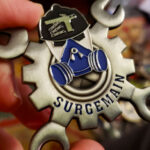
This coin is cut to the outline of a gear crossed with two wrenches rather than struck as a disc, made for the Navy Reserve force that surges into naval shipyards when maintenance workload exceeds what the permanent workforce can absorb. The shape states the trade before anybody reads a word on it.
Tools as a Unit’s Identity
Putting a tool on a coin is an obvious idea that works better than obvious ideas usually do, and it is worth understanding why.
Tools read instantly at any size. A wrench is a wrench at an inch and a half, in any country, to anyone who has ever held one. A crest has to be read and an acronym has to be known. A tool is simply recognized.
They say what the unit does rather than where it sits. A hull number or a command designation tells you the organizational chart. A wrench tells you the job. For a unit whose identity is its trade rather than its address, the second is more useful.
Their shapes suit metal. Tools are bold outlines with strong silhouettes and very little fine detail, which is exactly what survives a strike and a die cut. They were designed for function, and function produced shapes that happen to reproduce well.
And crossed implements are an old heraldic device. Crossed tools have signified a trade for centuries, in guild marks, military branch insignia and civic heraldry alike. That history is why the arrangement reads as a badge rather than as clip art, and it is the detail that separates a considered tool coin from a stock one.
The honest caution is that everybody reaches for a wrench. Every maintenance unit has the same first idea, so a tool coin needs something more to be distinctive. Three ways to get it: use the specific tool of your trade rather than a generic wrench, make the tool the coin’s outline rather than a picture printed on it, or pair the tool with the thing it works on. This coin takes the second route, which is the strongest of the three.
Cutting the Coin to the Tools
A gear crossed with wrenches is a harder outline than it looks, and this one needed particular care in manufacture.
Gear teeth are a row of small projections. Each one is a point that can bend or catch, and there are a lot of them around the circumference. They have to be deep enough to read as teeth and shallow enough to survive handling.
The wrench handles extend past the gear. That gives you long thin arms with leverage working against them, which is the classic failure mode on a shaped coin. The further a projection extends, the easier it is to bend.
The junctions are the stress points. Where each wrench meets the gear body, the die carries concentrated force during the strike. Those corners want radiusing rather than being left sharp. An anchor outline faces the same problem; see our Navy Anchor Command Challenge Coin.
And the open jaw of a wrench is an internal cutout. That is a separate operation from cutting the outer profile, and it needs enough metal around it to hold its shape.
The practical consequences are consistent across shapes like this. The piece usually wants to be thicker than a round coin of the same width. Packaging has to be specified rather than assumed, because nothing standard will fit it. And the tooling costs more, because the profile is doing work that a simple disc does not. Our page on custom shaped challenge coins sets out where that trade is worth making.
What SurgeMain Is
The name explains nothing on its own, so it is worth setting out.
SurgeMain is a Navy Reserve surge maintenance force, established in 2005. When maintenance workload at a naval shipyard exceeds what the permanent civilian workforce can absorb, SurgeMain sailors mobilize to augment it. They maintain machinery, return equipment to service and fill shipyard supervisory roles. The force numbers in the low thousands across dozens of units.
What makes it genuinely unusual is where the skill comes from. These Reserve sailors are drawn for their civilian trades. Welders, machinists, electricians, planners and supervisors who do the same work in uniform that they do at home. That is rare in the military, where training normally runs the other way, and it is precisely why a tool is the right device on their coin rather than an anchor or a ship.
There is a second SurgeMain piece in the gallery, made for a mobilization at Puget Sound Naval Shipyard, with a very different design approach. See that shipyard coin alongside this one, and a Navy Reserve center coin for the wider component.
Coins for Trades and Maintainers
Maintenance organizations across every service, and plenty of civilian industries, share one recognition problem: the work is invisible when it is done right. There is no finished product to photograph, because the product is something else working.
The answer is to show the tool rather than the outcome. A wrench, a gear, a welding torch, a multimeter, a set of calipers. The trade’s own instrument is the most specific thing a maintenance unit owns, and the one thing that cannot be mistaken for another unit’s.
It is the same logic that puts a gear on an electrical power production coin and crossed wrenches on this one. If your people are identified by what they can fix, the coin should carry what they fix it with.
Order a Coin for Your Unit
Professional artwork is free with unlimited revisions, and nothing goes into production until you approve a digital proof. The challenge coin minimum is 50 pieces, standard production runs about 45 to 50 days after final artwork approval, rush production is available on many projects, and shipping within the continental United States is included. Embleholics is veteran-owned, SDVOSB and registered in SAM.gov.
Two things help with a shaped tool coin. Tell us the tool that defines your trade and we will build the outline around it rather than putting a picture of it on a disc. And if the shape has projections or internal cutouts, we will tell you at the artwork stage what needs thickening, rather than finding out at the strike. See more Navy challenge coins or ask about die cutting and finishes.
Frequently Asked Questions
What is a SurgeMain challenge coin?
It is a coin made for Navy Reserve Surge Maintenance, the force that mobilizes into naval shipyards when maintenance workload spikes. This one is cut to the outline of a gear crossed with two wrenches, so the coin’s shape identifies the trade before any lettering is read.
What is Navy SurgeMain?
SurgeMain is a Navy Reserve surge maintenance force established in 2005. Its sailors augment the civilian shipyard workforce during periods of heavy maintenance demand, maintaining machinery, returning equipment to service and filling supervisory roles, and they are selected largely for the civilian trades they already practice.
Can a coin be cut into the shape of tools?
Yes, and tools are among the better subjects for a custom outline because their silhouettes are bold and instantly recognizable. Gear teeth, wrench handles and similar projections need enough thickness to resist bending, and the junctions between elements should be radiused rather than left as sharp corners.
Do gear teeth or thin handles break on a shaped coin?
They can bend if the piece is specified too thin, and they are the parts most likely to catch on a pocket. Gear teeth are shallow enough to be reasonably robust; long wrench handles extending past the body carry more leverage and need more attention at the artwork stage.
Does an irregular shape need a thicker coin?
Usually yes. A profile with projections and internal cutouts carries stress that a circle does not, so it is normally specified thicker than a round coin of the same width. That raises the cost slightly and gives the piece more weight in the hand.
What should a maintenance unit put on its coin?
Show the tool rather than the outcome. Maintenance work is invisible when it succeeds, because the result is something else functioning, so the trade’s own instrument is the most specific thing the unit owns. Choose the tool particular to your trade rather than a generic wrench, since every maintenance unit reaches for the same first idea.
Can a wrench or gear design be made distinctive?
Yes, in three ways. Use the specific tool of your trade instead of a generic one, make the tool the coin’s outline rather than a picture on a round face, or pair the tool with the equipment it works on. Combining two of those is usually enough to separate a coin from every other maintenance piece.
Does a cut-out shape cost more than a round coin?
Yes. The tooling is more involved because the profile has to be cut rather than simply struck, internal cutouts are a separate operation, and the piece often needs to be thicker. Packaging also has to be specified separately, since standard capsules and sleeves are made for round coins.
More Navy Projects