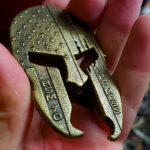
This helicopter squadron challenge coin is cut to the shape of a Spartan helmet and finished to look like one that has been in the ground for two thousand years. No paint, no color, no gloss. Making metal look old on purpose takes two separate jobs, and most people assume it only takes one.
Two Jobs, Not One
When somebody asks for a coin that looks ancient, worn or corroded, there are two completely different things that have to happen, and leaving either out produces a coin that misses.
The texture has to be cut into the die. Pitting, erosion, nicks along an edge, the uneven surface of metal that has been buried: all of that is geometry. It is sculpted into the tooling as actual relief, the same way a portrait or an insignia is. If it is not in the die, it is not on the coin, and no amount of finishing will put it there.
The finish has to make that texture read. An antique finish darkens the recesses and leaves the raised surfaces lighter. On a plain coin that just adds depth to the artwork. On a coin whose surface is already pitted, it fills every one of those pits with shadow, and the result reads as corrosion rather than as decoration.
That is the whole trick, and it explains the most common disappointment in this area. A smooth coin with an antique finish looks like a smooth coin that has been darkened. A textured coin with a bright finish looks like a textured coin. You need both, and they are decided at different stages: one at artwork, one at finishing.
See antique and polished finishes for what the finishing step does on its own.
Why a Weathered Coin Cannot Be Shiny
The client asked for no paint, no colors and no shiny finish, and all three follow from the same logic.
Gloss reads as new. A polished or glossy surface is what a freshly made object looks like, which is the opposite of what a weathered piece is claiming. One bright highlight anywhere on the coin undoes the whole effect.
Paint reads as applied. An ancient helmet has no color on it except the color of the metal. Paint on a weathered design announces that someone decorated it, which breaks the illusion the texture is working to build.
And a matte surface scatters light. That matters practically rather than only conceptually. A pitted surface under a scattering finish shows its texture from every angle, where the same surface polished would show a reflection instead of the pitting.
So the restraint here is not minimalism for its own sake. It is what the subject requires. A coin pretending to be old has to give up the three things that make a coin look well made, and get its quality across through the texture and the sculpting instead.
A Helmet Is a Good Shape and an Easy One to Get Wrong
A Spartan helmet is a strong choice for a shaped coin. It is close to symmetrical, it has a hard recognizable outline, and it reads instantly at any size, which is the test any custom shape has to pass.
Two things need deciding:
The crest. A helmet crest runs along the top and is the one part that projects. On a shaped coin, projecting elements are the outermost metal and the first to be knocked, so the crest is either kept low and broad or brought into the main mass of the shape. A tall thin crest is the weak point.
The eye and nose openings. A helmet reads from its negative space as much as its outline, because the openings are what make it a helmet rather than a bowl. Those can be cut through as openings or recessed deeply, and the choice changes the piece: cut through, the openings show whatever is behind the coin, which on a weathered design can be very effective.
For shape work generally, see custom shaped challenge coins, and for a coin that is cut to a unit figure rather than an object, see this squadron figure coin.
Engraving Into a Textured Surface
The coin carries the Navy insignia and lettering, and putting clean artwork onto a deliberately rough surface is its own problem.
Recessed artwork survives, raised artwork fights the texture. A raised letter standing on a pitted field has to compete with the pitting around it, and at small sizes the two read as one rough area. Cut the same letter into the surface and it is a clean edge against a rough field, which is a contrast rather than a collision.
The second rule is to give the artwork a calm zone. A band or panel where the surface is left smoother gives the insignia and the lettering somewhere to sit. The texture does not have to be uniform across the whole coin, and varying it is what makes a weathered piece look weathered rather than simply rough.
About HSM-70
Helicopter Maritime Strike Squadron 70, the Spartans, is a US Navy squadron established on 12 February 2009 and based at Naval Air Station Jacksonville, Florida. It flies the MH-60R Seahawk.
The squadron’s nickname is the whole reason this coin exists in the form it does, and it is worth noting how well that worked out. A nickname that points at a specific object gives a coin a shape, a texture and a finish all at once. A nickname that points at an abstraction gives you none of those, and the design has to be built from the unit emblem instead.
See more Navy challenge coins.
Order a Weathered or Shaped Coin
Free professional artwork, unlimited revisions and a digital proof before anything is produced. Free shipping within the continental US, a 50-coin minimum, and most orders complete 45 to 50 days after artwork approval, with rush production available. Embleholics is veteran-owned, an SDVOSB, and registered in SAM.gov.
If you want a coin that looks aged, say so at the quote stage rather than at the proof. The texture has to be built into the tooling, so it is an artwork decision rather than a finishing one, and it cannot be added to a die that was cut smooth.
Frequently Asked Questions
What is a helicopter squadron challenge coin?
A helicopter squadron challenge coin is made for a Navy or Marine helicopter squadron and usually built around the squadron’s nickname, emblem or airframe. HSM and HSC squadrons order them for their own members rather than at air wing level.
How do you make a challenge coin look old or corroded?
Two things have to happen. The texture, meaning the pitting and erosion, is sculpted into the die as real relief, and then an antique finish darkens those recesses so they read as corrosion. Leaving either step out produces a coin that looks either smoothly darkened or roughly bright.
Can an antique finish alone make a coin look weathered?
Not on its own. An antique finish darkens whatever recesses already exist, so on a smooth coin it just adds depth to the artwork. Without texture in the die there is nothing for it to fill.
Why should a weathered coin have no gloss?
Because gloss is what a new object looks like. A single bright highlight undoes the effect the texture is building, and a matte surface also scatters light so the pitting shows from every angle rather than being hidden behind a reflection.
Should a weathered coin be painted?
Usually not. An aged object carries the color of its own metal and nothing else, so paint announces that the piece was decorated and breaks the illusion. The quality has to come through in the sculpting and the texture instead.
Can a coin be shaped like a helmet?
Yes, and a helmet is one of the better custom shapes because it is near symmetrical with a hard recognizable outline. The crest is the element to watch, since it projects and is the first part to take wear, so it is kept low and broad or brought into the main shape.
Should lettering be raised or recessed on a textured coin?
Recessed. A raised letter standing on a pitted field competes with the pitting around it and the two read as one rough area, while a cut letter is a clean edge against a rough surface, which is a contrast instead.
What aircraft does HSM-70 fly?
HSM-70 flies the MH-60R Seahawk. The squadron, nicknamed the Spartans, was established on 12 February 2009 and is based at Naval Air Station Jacksonville, Florida.
When does a texture decision have to be made?
At the artwork stage, before the die is cut. Texture is geometry rather than finishing, so it cannot be added to tooling that was made smooth, which is why a weathered look needs to be specified in the original brief.
More Navy Projects