A coin series applies one design rule over and over, producing a set rather than a sequence of unrelated pieces. The rule stays fixed, one element changes, and every new coin is recognizable as part of the same program the moment somebody sees it next to an earlier one.
What Is a Coin Series?
A series is a set produced to a rule. The rule is decided once, at the start, and then applied each time without being renegotiated.
The common rules are simple: one coin per state or region, one per year, one per project, one per event, one per division or office. The rule itself matters less than the fact that there is one.
It is worth separating a series from a reorder, because people use the words interchangeably and they are different things. A reorder is the same coin again. Same die, same design, more pieces. A series is a new coin that obviously belongs with the last one. New die, new design within the rule, and a set that grows.
Why a Rule Beats Starting Over
Three reasons, and the third is the one organizations underestimate.
The conversation gets shorter every round. The first coin in a series settles the diameter, the thickness, the finish, the rim, the position of the organization’s mark and the typeface. Every coin after it is one decision rather than a dozen. A program that took six weeks to agree on coin one can take an afternoon on coin four, which matters when the person running it has another job.
The set becomes recognizable. Four coins made to one rule read as a program. Four unrelated coins read as four coins. Somebody who already holds one recognizes the next one across a table, and that recognition is doing work no individual coin could do on its own.
People collect sets. This is the part that gets underestimated. A coin that is visibly one of a series creates a reason to want the others, and that turns recipients into an audience who ask what is coming next. A single coin, however good, does not generate that. It is the closest thing a coin program has to compound interest.
What makes a rule a good one:
- Mechanical enough to apply without an argument. “The outline of the state” is a good rule because nobody has to interpret it. “Something that feels like us” is not a rule.
- Specific enough to produce a real difference between coins, so each one is worth having rather than being a near-duplicate.
- Durable enough to still work at number twelve. Rules built on a finite list run out. Rules built on states, years or projects do not.
What Stays Fixed and What Changes
Fix the diameter, the thickness, the plating and finish, the rim treatment, the typeface and the position of the organization’s mark. Vary the one element the series is built on.
The reason to be strict about this is that if two things vary, the set stops reading as a set. A program where the shape changes and the colour changes and the layout changes is not a program; it is a habit of ordering coins. The constraint is what makes the series visible.
It also makes each new piece easier to approve, because the only question on the table is the variable element. Everything else was decided once and is no longer up for discussion.
What a Series Costs
Here is the honest part, because it is easy to assume a series is cheaper per coin than it is.
Each new design in a series needs its own tooling. A die is cut per design, and a new state outline is a new shape, which means new tooling. So a program is not one setup cost spread across several years; it is a setup cost each time.
What does get cheaper is everything around the tooling. The design time, the number of revisions, the approval cycle and the decisions all shrink once the rule is established, and that is a real saving in money and in somebody’s attention.
The practical consequence: if budget is the constraint, order more coins per design rather than more designs. A program of three coins at larger quantities costs less than a program of six at the minimum, and it still reads as a series. More on why the minimum exists is on our page about why coins have a minimum order.
Numbering individual pieces within a series is a related option, covered on our page about numbered and serialized coins.
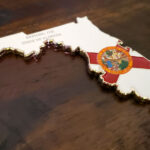
About This Motorola Florida Coin
Motorola Solutions supplies communications and technology to public safety organizations. This coin was produced in connection with the company’s work with the State of Florida.
It is cut to the outline of Florida, with the company’s logo on the reverse.
The reason this page is about programs rather than about shapes is the client’s standing rule: every coin they order is cut to the outline of the state the work was done in. That one sentence turns a coin order into a coin program. There is no design brief to write each time, no debate about the concept, and no risk of coin four looking unrelated to coin one. The state changes and nothing else does.
It is close to an ideal rule. It is mechanical, so it applies itself. It produces a genuinely different object every time, because no two state outlines are alike. It will not run out. And it carries meaning rather than being an arbitrary visual device, because the shape says where the work happened, which is the whole point of the coin.
For another coin in the same series and for how place outlines behave at coin size, see our Mississippi state shaped coin. For a coin marking work between a company and a government body, see our Motorola Arkansas coin.
Can We Use a State Outline and Our Logo on a Coin?
A state outline is a geographic shape rather than a protected emblem, so cutting a coin to one is not a permissions question in itself.
State flags and seals are different. State seals are frequently restricted by state law, and those rules draw a distinction between the state’s own use, use by an authorized body, and commercial use by a private company. If a coin in your program carries a seal or an official emblem, confirm your position before the artwork is finalized.
Your own logo is yours, subject to whoever controls the brand inside your organization. On a program that will run for years, it is worth getting that sign-off once at the start rather than each time.
We produce from artwork the customer is authorized to supply, and the authorization is the customer’s to obtain. We do not grant permission on anyone’s behalf.
Start a Coin Program
Tell us at the first coin that a series is intended. The decisions that make a program work — the fixed diameter, the finish, the mark position, the typeface — are all made on coin one, and changing any of them at coin three means the first two no longer match the rest.
Professional artwork is free with unlimited revisions, and nothing goes into production until you approve a digital proof. The minimum order is 50 coins per design. Standard production runs about 45 to 50 days after final artwork approval, rush production is available on many projects, and shipping within the continental United States is included. Embleholics is veteran-owned, SDVOSB and registered in SAM.gov. See more custom corporate challenge coins or request a free quote.
Frequently Asked Questions
What is a challenge coin series?
A challenge coin series is a set of coins produced to one design rule, such as one per state, one per year or one per project. The rule and the format stay fixed while a single element changes, so each new coin is recognizable as part of the same program.
Can we order one coin a year as a set?
Yes, and an annual coin is one of the most common program rules. Settle the format on the first coin, including size, finish and the position of your mark, and each subsequent year becomes a single decision rather than a new design project.
What should stay the same across a coin series?
Fix the diameter, thickness, plating, finish, rim treatment, typeface and the position of your organization’s mark. Vary only the element the series is built on. If two things vary, the coins stop reading as a set.
Is a coin series cheaper than ordering separately?
The design and approval side gets considerably cheaper and faster once the rule is set, but the tooling does not, because each new design needs its own die. Expect a setup cost per design rather than one cost spread across the program.
Do we need new tooling for each coin in a series?
Yes, where the design or the shape changes. A die is cut for each design, so a new state outline or a new year’s artwork means new tooling. Reordering an identical coin uses the existing die and is a different situation.
How many coins should each one in a series be?
Order against who will receive that particular coin, with a reserve. If budget is limited, it is better to order larger quantities of fewer designs than minimum quantities of many, because the per-coin cost falls with quantity while the tooling cost repeats per design.
Can a series be built around states or regions?
Yes, and it is one of the strongest rules available, because it is mechanical, it produces a visibly different coin every time, it will not run out, and the shape carries real meaning about where the work happened.
What is the minimum order for each coin in a series?
The minimum order for custom challenge coins is 50 coins per design. Each design in a program is treated as its own order, so the minimum applies to each rather than to the series as a whole.
More Corporate Projects