A coin can be cut to the outline of a state or region instead of being round. The outline identifies the place with no text at all, which frees both faces for everything else, provided the shape is distinctive enough to recognize and its thin projections are handled properly.
Why Cut a Coin to the Shape of a Place?
Because an outline does the work of a sentence, and it does it faster.
Anyone from a state recognizes their own border without being told. They have seen it on license plates, highway signs, school classroom maps and weather forecasts their entire life. Put that shape in somebody’s hand and the question of where has already been answered before they have read a single word on either face.
That is the real argument for a place shape, and it is a practical one rather than a sentimental one. A round coin that needs to say where it is from has to spend text on it, and text is the scarcest thing on a coin face. A shaped coin spends nothing.
The occasions that suit it:
- A company marking work in a particular state, especially where the relationship is with a state-level customer
- A unit or agency that identifies with a region as much as with its organization
- A state-level association or body, where the state is the membership
- An anniversary tied to a place rather than to an organization
- Events and conferences that move between states each year
Which State Outlines Work on a Coin?
Not all of them, and this is worth knowing before anyone falls in love with the idea.
Compact states with distinctive borders work best. An irregular, roughly balanced shape fills a coin’s area efficiently and is recognizable from the outline alone. Most states with a river border, a coastline or an unusual notch fall into this group, and they make excellent coins.
Near-rectangular states are the problem case. A rectangle identifies nothing. Cut a coin to the shape of a state whose borders are four straight lines and you have made a rectangular coin, which reads as a plaque rather than as a place. If the state is one of these, the better answer is usually a round or rectangular coin carrying the state’s seal, flag or name, and spending the custom shaping budget elsewhere.
Long thin states waste the coin. The piece has to be sized to the long dimension, which leaves the design sitting in a narrow band with empty space either side. The outline is recognizable, but you have paid for a large coin and received a small usable area.
Then the part nobody writes about. Panhandles, peninsulas, capes and river borders are thin projections, and thin projections are where a coin chips. They are the highest, narrowest, least supported parts of the piece, they take every knock first, and the plating goes there before anywhere else.
So a state outline always involves a decision about which features are essential to recognition and which can be thickened or gently smoothed. A panhandle that makes the state identifiable has to stay, but it can be drawn slightly more generously than the map. A tiny cape that nobody would notice missing can be simplified. That judgment is made deliberately at artwork stage, or it is discovered at the proof, and the first is considerably cheaper.
What Goes Inside the Shape?
The outline has already said where, so both faces are free to say who and what.
The usual elements are a logo or wordmark, a flag, a seal where authorized, a date, a motto, and sometimes a star or a marker on a particular city.
There is one trap worth naming, because people walk into it regularly. Do not put a map inside a map. A coin already cut to the shape of a state does not need an internal outline of the same state, a county map, or a rendering of its borders on either face. It is redundant, and it crowds a frame that is already irregular and harder to compose in than a circle.
The same applies to the state’s name. A coin shaped like the state can carry the name, but it does not need to, and the space is usually better spent.
Flags and Seals on a Place Coin
A state flag is a natural partner to a state outline, because it adds the one thing the shape cannot: color.
But there is a practical caution that matters more than it used to. State flags change. Mississippi adopted a new state flag in 2020, and several other states have redesigned or are considering redesigning theirs. A coin carrying a state flag is therefore a record of the flag that was in use when the coin was made, which is fine for a dated commemorative and awkward for an organization that expects the piece to represent it for the next decade.
If the coin needs to last, a seal or an emblem is a more stable choice than a flag, because seals change far less often. If the flag is the right element anyway, it is worth knowing you are committing to a particular version of it.
Either way, confirm which flag design you want reproduced rather than leaving it to be assumed. Permissions for seals and official state imagery are covered below and on our page about state seals and civic identity.
About This Motorola Solutions Coin
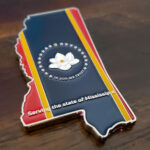
Motorola Solutions supplies communications and technology to public safety organizations. This coin was produced in connection with the company’s work in Mississippi.
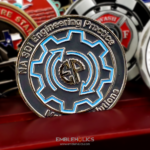
The coin is cut to the outline of the state. One face carries the Mississippi state flag imprinted; the other carries the Motorola Solutions logo with an etched inscription beneath it.
The division of labor across the piece is clean and worth copying. The shape says where. The flag says whose place. The logo says who. Three pieces of information, one per element, with none of them repeating another, which is why a coin with only a logo and a flag on it does not feel sparse.
It is also a good example of a custom shape earning its cost. Shaping is worth paying for when the outline carries meaning a round coin could not, and here the outline carries the entire premise of the project. On a design where the shape is decorative rather than meaningful, the same money is usually better spent on a larger coin or a better finish.
This is one of several coins the same client has ordered to the same rule, one per state. For more on running a coin as a repeating program rather than a one-off, see our Motorola Florida coin. For a coin shaped around a city rather than a state, see our city shaped challenge coin, and for state-level membership bodies, our state association coins.
Can We Use a State Flag or Our Company Logo on a Coin?
Your own logo is yours, subject to whoever inside your organization controls the brand. That is usually marketing or legal rather than the team ordering the coins, and it is worth checking before artwork is finalized rather than after.
State flags and seals are a different matter. State seals in particular are frequently restricted by state law, and the rules distinguish between use by the state itself, use by an authorized body, and commercial use by a private company. A company putting state imagery on a product it distributes is the case those rules exist for.
Our position is the same for any controlled mark. We produce from artwork the customer is authorized to supply, and the authorization is the customer’s to obtain. We are a manufacturer rather than an authority on state emblem use, and we do not grant permission on anyone’s behalf. If you are unsure, the state’s secretary of state office is usually where the rules are published.
Design a Shaped Coin for Your Company
Decide the shape early. A custom outline is part of the tooling rather than something added at the end, so it has to be settled before the artwork is drawn, not after.
Professional artwork is free with unlimited revisions, and nothing goes into production until you approve a digital proof. Send a logo file and tell us which state or region the piece is for, and we will tell you how the outline will behave at coin size before anything is committed. The minimum order is 50 coins, standard production runs about 45 to 50 days after final artwork approval, rush production is available on many projects, and shipping within the continental United States is included. Embleholics is veteran-owned, SDVOSB and registered in SAM.gov. See more custom corporate challenge coins or request a free quote.
Frequently Asked Questions
Can a challenge coin be cut to the shape of a state?
Yes. A state outline is a common custom shape and an efficient one, because it identifies the place with no text, leaving both faces free for a logo, a flag, a date or a motto. The outline is cut as part of the tooling.
Which state shapes work best on a coin?
Compact states with distinctive, irregular borders work best, because they fill the coin’s area and are recognizable from the outline alone. Near-rectangular states identify nothing once shaped, and long thin states leave most of the coin unusable.
What happens to panhandles and peninsulas at coin size?
Thin projections are the least supported parts of a coin, so they take knocks first and lose plating before anywhere else. Features essential to recognizing the state are kept but drawn slightly more generously than the map, and inessential small details are simplified.
What should go inside a state shaped coin?
A logo or wordmark, a flag, a seal where authorized, a date or a motto. Avoid putting a map inside a map: a coin already cut to the state’s outline does not need an internal rendering of the same borders, and the state’s name is usually unnecessary too.
Can a state flag be used on a company’s coin?
State flags and seals are often restricted by state law, and commercial use by a private company is the case those rules are written for. Confirm your position before the artwork is finalized and supply artwork your organization is authorized to use.
Does a custom shape cost more than a round coin?
A custom outline is cut into the tooling, so it is part of the overall project quote rather than a separate line item. Quantity, size, plating and the complexity of the two faces all affect a quote as well, and the shape has to be settled before artwork begins.
Can a coin be shaped like a county, a country or a region?
Yes, and the same rules apply. The outline has to be distinctive enough to recognize, reasonably compact so it uses the coin’s area, and free of very thin projections, or those projections need thickening to survive handling.
What is the minimum order for shaped coins?
The minimum order for custom challenge coins is 50 coins, including shaped ones. Larger quantities reduce the cost per coin, and because a shape needs its own tooling it is worth settling the quantity and the outline in the same conversation.
More Corporate Projects