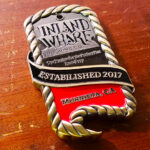
The base shape is a rectangle, but one side is shaped organically rather than cut straight, which keeps the piece from reading as a plain slab. The metal is brushed and brass colored, heavy and imposing in the hand. One face carries an engraved logotype. The other carries an American flag, embossed and painted. A ribbon runs across the sides as a finishing touch. It was made for Inland Wharf Brewing Co., a veteran-owned brewery.
Why Breweries Order Coins
Craft breweries have become steady coin customers, and the reasons are commercial rather than ceremonial.
A taproom has a membership culture already. Mug clubs, founding member programs and loyalty tiers all exist to give regulars something that marks them as regulars. A coin does that better than a card, and it does it in a form people keep.
It sells. A coin at the merchandise end of the bar is a higher-margin item than a pint glass and it costs almost nothing to display. For a brewery already selling branded goods, it fits the shelf it already has.
Veteran-owned breweries have a built-in audience. This is the specific case here. A brewery run by veterans draws veteran customers, and that is a population that already understands what a coin is and already carries them. The object needs no explaining. More in Veteran-Owned Business Challenge Coins for Clients.
And collaboration releases are an occasion. Breweries release seasonally and collaborate constantly, and either is a reason for a limited piece in a way most businesses do not have.
See more corporate challenge coins and a car club challenge coin, which is the same kind of enthusiast audience.
A Rectangle With One Organic Side
This is the detail that makes the piece, and it is a technique worth knowing.
A plain rectangle is efficient but inert. It reads as a bar of metal, and nothing about the outline says anything. Making one edge irregular while keeping the other three straight changes the object entirely for very little cost.
It reads as deliberate rather than default. A viewer registers that somebody chose the shape, which a plain rectangle does not communicate.
It keeps the layout advantages. Three straight edges still give you flat baselines for text, which is the whole reason to use a rectangle rather than a disc.
And it costs the same as any custom outline. The die has to be cut to a shape either way, so an irregular edge is not an upcharge over a straight one.
The one thing to watch is that an organic edge should relate to something. A wave, a torn edge, a hop silhouette or a stave profile all mean something on a brewery piece. An arbitrary squiggle does not, and it reads as indecision rather than design. See custom shaped challenge coins.
An Engraved Logotype
The front carries the logotype engraved rather than embossed, which is the right choice for a wordmark.
A recessed letterform keeps its exact shape. The cut defines the boundary. Raised lettering softens slightly at the edges under the strike, and on a brand wordmark with specified letterforms that is a visible loss.
Engraving suits brushed metal. On a brushed surface, a recessed line catches shadow while the surrounding texture scatters light, so the contrast comes from the surface difference rather than needing a paint fill.
And it wears better. Recessed lettering sits in a protected channel, where raised lettering is the first thing to rub on a piece people handle.
The practical note on any wordmark is weight. Striking softens every edge slightly, so type that is correct on screen frequently reads thin in metal and the weight usually has to be increased during artwork. Breweries often have a logotype with fine strokes or a script, and those are exactly the faces that need the most adjustment.
Brushed Brass and a Flag
The metal choice is doing a lot of work here.
Brushed brass is warm and matte, so it reads as substantial rather than bright, and the page describes it as heavy and imposing. For a product associated with craft and with tradition, that is a better register than a polished silver would be.
It also handles the one painted element well. The flag is embossed and colored, and a warm matte ground makes the color sit forward without the metal competing. On a polished base, bright enamel and reflective metal fight each other.
A flag on a veteran-owned business’s coin is a straightforward statement and reproduces well, with one caveat already familiar from other pieces: the stripes are easy and the stars are not, so the canton usually needs either a reduced star count, a textured treatment or extra size relative to the stripes.
See finish and enamel options.
A Ribbon Across the Sides
A ribbon running across the edges is an unusual finishing detail and worth noting as an option.
Most coins treat the edge as a finish: plain, reeded or patterned. Carrying a design element around the sides turns the edge into a third surface that connects the two faces, so the object reads as one piece rather than two designs back to back.
The constraints are the usual edge ones. It has to be shallow, because the edge is the thinnest part, and it works better on a matte or brushed metal than on a polish, since it reads by shadow.
Order a Coin for Your Brewery
Professional artwork is free with unlimited revisions, and nothing goes into production until you approve a digital proof. The challenge coin minimum is 50 pieces, standard production runs about 45 to 50 days after final artwork approval, rush production is available on many projects, and shipping within the continental United States is included. Embleholics is veteran-owned, SDVOSB and registered in SAM.gov.
Two suggestions. If you intend to sell the coins in the taproom rather than give them out, say so at the quote stage, since larger quantities lower the cost per piece and that margin is the point. And send your logotype as artwork rather than a photograph of a sign or a can, because a wordmark has specified letterforms and an engraved version has to match them exactly. Request a free quote to begin.
Frequently Asked Questions
What is a brewery challenge coin?
It is a coin made for a brewery, usually carrying the logotype and often sold in the taproom or given to mug club and founding members. Craft breweries already have a membership culture that a coin fits naturally.
Why do breweries order coins?
Because a taproom already has loyalty tiers and merchandise shelves. A coin is a higher-margin item than glassware, it suits mug club and founding member programs, and seasonal and collaboration releases give a reason for limited pieces.
Can a coin be rectangular with one shaped side?
Yes, and it is an effective and inexpensive choice. Three straight edges keep the flat baselines that make a rectangle useful for text, while the irregular fourth edge stops the piece reading as a plain bar of metal.
Does an irregular edge cost more?
No. The die has to be cut to a shape either way, so an organic edge is not an upcharge over a straight one. It should relate to something, though, since an arbitrary curve reads as indecision rather than design.
Should a logotype be engraved or raised?
Engraved. A recessed letterform keeps its exact shape because the cut defines the boundary, where raised lettering softens at the edges under the strike. Recessed type also wears better on a handled piece.
Does our wordmark need changing for a coin?
The weight usually does. Striking softens every edge slightly, so type that is correct on screen reads thin in metal. Fine strokes and script faces, which are common on brewery logos, need the most adjustment.
Why use brushed brass?
Because it is warm and matte, so it reads as substantial rather than bright, which suits a craft product. It also lets a single painted element sit forward without the metal competing, where a polished base would fight bright enamel.
Can a design run around the edge of a coin?
Yes, and it connects the two faces so the object reads as one piece rather than two designs back to back. It has to be shallow, since the edge is the thinnest part, and it works better on matte or brushed metal than on a polish.
More Corporate Projects